

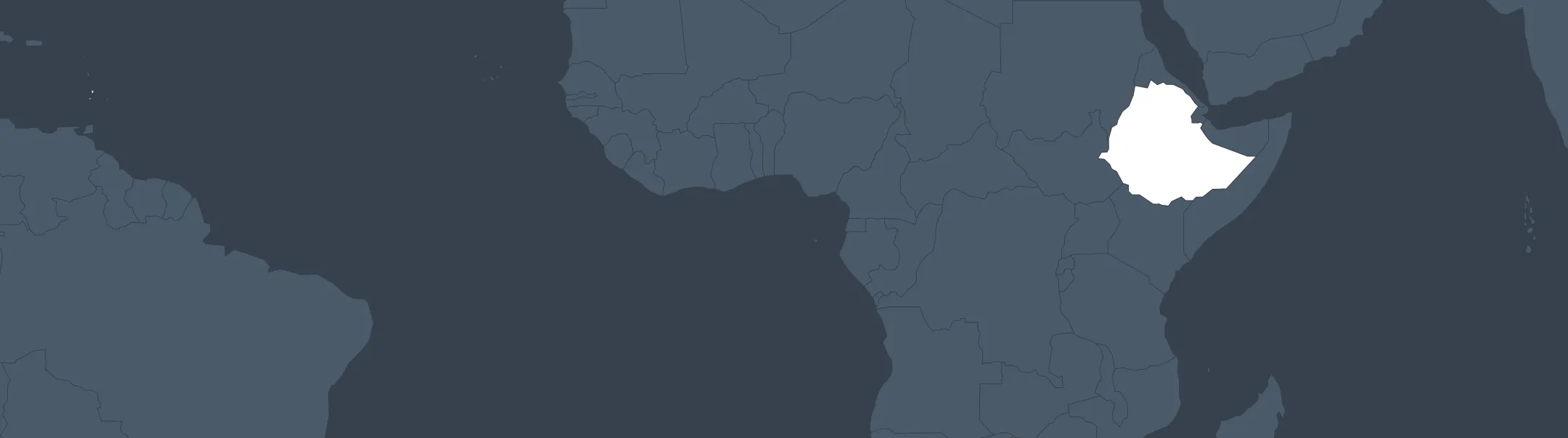

Ethiopia
Freedom at a Glance
Global Freedom
18 / 100
Not Free
Internet Freedom
30 / 100
Not Free


Ethiopia remains beset by civil war and intercommunal violence, abuses by security forces and violations of due process are still common, and many restrictive laws remain in force. Since late 2020 and until November 2022, fighting between the Federal Government and the Tigray Defense Force (TDF) has led to the displacement of millions and credible allegations of atrocity crimes, and violence has spilled over into neighboring regions.
Research & Recommendations
Ethiopia
Not Free
18
100
| PR Political Rights | 8 40 |
| CL Civil Liberties | 10 60 |
Last Year's Score & Status
18
100
Not Free
A country or territory’s Freedom in the World status depends on its aggregate Political Rights score, on a scale of 0–40, and its aggregate Civil Liberties score, on a scale of 0–60.
See the methodology.
Overview
The 2018 election of Prime Minister Abiy Ahmed initially set off a transitional period. Abiy pledged to reform Ethiopia’s authoritarian state, undertook legislative reforms, held elections, and implemented some liberalization policies. However, Ethiopia remains beset by internal conflicts and intercommunal violence; abuses by security forces and violations of due process are common, many reformed laws have yet to be implemented meaningfully; and many restrictive laws remain in force. Armed conflicts in the Amhara, Oromia, and Tigray Regions in recent years have caused widespread displacement, and credible allegations of atrocity crimes have emerged.
Freedom in the World 2026 Policy Recommendations
Strengthen democratic coordination and collective action in a contested global order
Democratic resilience will increasingly depend on stronger coordination among countries that share a commitment to freedom, the rule of law, and accountable governance.
Reimagine international democracy assistance to help reverse the global decline in freedom
International support for democratic institutions, civil society, and independent media has been associated with modest but meaningful improvements in democratic governance, and it is far less costly than the military outlays necessitated by rising authoritarian aggression.
Prioritize engagement with younger generations in the digital spaces where civic identity is now formed
Young people are increasingly dissatisfied with democracy—not because they reject its principles, but because they see institutions failing to deliver on them. Programmatic work should create clear pathways for meaningful political participation, from voting and policy engagement to community organizing and public leadership, so that young people can translate their expectations into agency.
Ethiopia
Not Free
30
100
| A Obstacles to Access | 7 25 |
| B Limits on Content | 13 35 |
| C Violations of User Rights | 10 40 |
Last Year's Score & Status
30
100
Not Free
Scores are based on a scale of 0 (least free) to 100 (most free).
See the methodology en report acknowledgements.
Overview
Internet freedom remained gravely constrained in Ethiopia during the coverage period. Localized connectivity restrictions continued to limit internet access in areas affected by armed conflict, particularly in Amhara Region. Journalists continued to face imprisonment, kidnapping, and physical violence in retaliation for their reporting, while authorities punished independent digital media outlets and journalists for their work by revoking their licenses. Internet users in several cities reported slow speeds and difficulty accessing YouTube during a live-streamed event that criticized the government in June 2025.
Freedom on the Net 2026 Policy Recommendations
Undermine Authoritarian Internet Restrictions
Access to the internet is under threat as authoritarian powers continue to create barriers for people to freely express themselves online. Internet shutdowns, throttling, and platform blocking remain among the most common tools of digital repression. At the same time, digital technologies serve as a lifeline for people seeking to expose human rights violations to the outside world and hold dictators accountable.
Safeguard Privacy Online
Protecting privacy online is essential to safeguarding free expression in repressive contexts. Without strong privacy protections, journalists and human rights defenders may self-censor out of a fear of reprisal. Rapid advances in AI—and the growing threat of automated vulnerability exploitation—heighten these risks, leaving civil society organizations increasingly vulnerable to sophisticated cyberattacks.
News and Updates
Featured

Freedom House Perspectives


News Releases & Media Coverage

Country Facts
Basic Facts
Freedom in the World Score
18
/ 100
Not Free
Freedom on the Net Score
30
/ 100
Not Free
Population: 123,400,000
Election Facts
Status
Past Election
Date of Election
June 5, 2021
Type of Election
Parliamentary
Internet Penetration
17.87%
Election Year
2021
Vulnerability Index
30
/ 100
Transnational Repression
Status
Not Tracked
