


Political Prisoners Watch August 20, 2026
Political Prisoners Watch: Why Human Rights and Democracy Are the Only Way Forward for Cameroon
Journalist Tsi Conrad once covered the devastation inflicted amid Cameroon’s decade-long Anglophone crisis. Wrongfully imprisoned for doing his job, Tsi writes from prison that embracing democracy is the only way to end the violence.
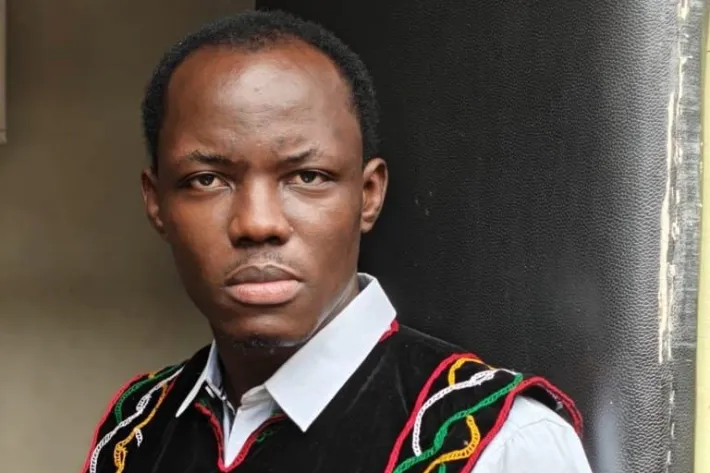
Tsi Conrad is a journalist in Cameroon who has been imprisoned for over 9.5 years. In this piece written from prison, Tsi shares his thoughts on Cameroon’s now decade-long Anglophone crisis: the violent conflict between the Francophone-dominated government and the English-speaking regions that has left thousands dead and millions displaced. Cameroon’s president Paul Biya—who has been in power since 1982, enabled by the elimination of constitutional term limits in 2011—has been unwilling or unable to secure a cease-fire. Freedom House’s Fred Hiatt Program to Free Political Prisoners has adopted Tsi’s case and has been advocating for his release.
By Tsi Conrad, Cameroonian journalist, political prisoner
From my cell in Yaoundé’s Kondengui Central Prison, where I have spent nearly a decade, the world outside can seem devastatingly distant. In December 2016, I was a freelance photojournalist and filmmaker doing my job, documenting peaceful marches by lawyers and teachers who were demanding respect for our language, culture, and legal systems in the Anglophone regions of Cameroon. Instead of dialogue, the government responded with bullets, and I was arrested at gunpoint, tortured, and handed a 15-year sentence by a military tribunal for simply capturing and telling the truth.
I am a journalist, a husband, a father, and a prisoner of conscience. My confinement is a small reflection of a much broader, heartbreaking tragedy. Over the past ten years, the Anglophone crisis has evolved into a devastating conflict—hundreds of burned villages, thousands of empty schools, thousands of lives lost, over one million Cameroonian refugees in Nigeria and Ghana alone, and nearly two million people internally displaced. In the face of such brutality, it would be easy to fall into cynicism. Yet, even from behind these bars, my conviction remains unshaken—human rights, democracy, and a commitment to a peaceful, negotiated resolution are not merely idealistic dreams; they are the only forces that will ultimately win in Cameroon.
They will win because guns have utterly failed. Over the past decade, the ruling regime has relied on the machinery of state suppression, arbitrary detentions, military courts, and the silencing of dissent to crush legitimate calls for institutional equity. Simultaneously, armed separatist groups have met violence with violence, creating a continuous cycle of suffering for ordinary civilians who simply want to live their lives. This military stalemate proves that a lasting peace cannot be built on coercion or terror. True stability can only grow from legitimacy, and legitimacy is forged only through democratic expression.
Furthermore, the desire of the Cameroonian people for equality and justice runs deep. The demands of the Anglophone people in 2016 were rooted in the basic human right to cultural identity, fair treatment under the law, and freedom of expression. You can lock up journalists, suppress peaceful protests, and impose long prison sentences, but you cannot kill the universal human desire for dignity. The language of human rights provides a common ground that transcends ethnic and political divides. It reminds both the government and the separatists that the protection of human life must come before political ambition.
For democracy to win, international complacency must end. The Anglophone crisis remains a catastrophe hidden in plain sight. The international community, including the United Nations, the African Union, and our democratic allies, must shift from expressing concern to active diplomatic pressure. They must demand an immediate cease-fire, an inclusive national dialogue mediated by neutral international parties, and the release of all political prisoners.
A peaceful resolution requires courageous leadership that embraces democratic principles. It requires a system where grievances are debated at a negotiation table rather than fought out in villages, where local communities have a genuine say in how they are governed, and where the press can report the truth without fear of military torture and imprisonment.
The future of Cameroon does not belong to the forces of authoritarianism or violent division. It belongs to the citizens who yearn for peace, justice, and democratic accountability. Human rights will win in the Anglophone regions because they are the only foundation strong enough to support a united, peaceful, and truly democratic Cameroon. From Kondengui Prison, I still believe that day will come.