



Policy Brief September 17, 2026
Xi Jinping in Washington, DC: Countering Beijing’s Efforts to Undermine Free Speech Beyond Its Borders
The Chinese Communist Party is taking unprecedented steps to target its critics abroad. Xi Jinping’s forthcoming visit to Washington offers an opportunity for the United States to stand up for Chinese dissidents and rights defenders, at home and around the world.
Written By
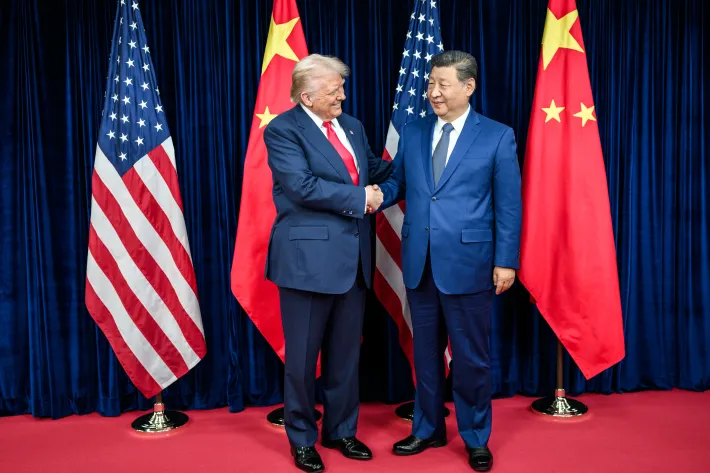
US President Donald Trump greets Chinese Communist Party General Secretary Xi Jinping before a bilateral meeting in 2025 in South Korea. (Photo Credit: The White House/Daniel Torok)
On September 24, President Trump plans to hold a White House State Dinner in Washington, DC, for Chinese Communist Party (CCP) General Secretary Xi Jinping. Much of the media coverage is likely to highlight trade, security, technology, and strategic competition; however, the US government has both a moral and national security obligation to forcefully condemn the CCP’s human rights abuses at home and its efforts to extend repression and restrictions on free speech abroad.
Just as importantly, given the CCP’s extensive record of transnational repression and authoritarian coercion abroad, federal and local authorities should protect the rights of the demonstrators expected to peacefully protest Xi’s visit on US soil and ensure that Beijing is not permitted to export the restrictions on dissent commonly seen in China.
Transnational repression against Chinese and minority communities
The Chinese government’s campaign of transnational repression, when governments reach outside their borders to silence dissent among exiles and diasporas, poses a persistent threat to communities inside the United States. For example, the last time Xi set foot on US soil, in November 2023 for the Asia-Pacific Economic Cooperation (APEC) Summit in San Francisco, hundreds of Chinese democracy activists, Hong Kongers, Tibetans, and Uyghurs turned out to protest. Media outlets reported shocking accounts of violence against them, many of whom were US citizens and lawful permanent residents, and in a report releases some months later, the Hong Kong Democracy Council and Students for a Free Tibet documented dozens of cases of harassment, intimidation, and assault by organizations and individuals affiliated with the Chinese government.
What happened at APEC was not an isolated incident. It reflects a concerted effort by the CCP to intimidate, silence, and control critics far beyond China’s borders and manufacture an image of itself as a responsible international partner. In the United States, attacks have included the harassment and targeting of students and scholars, including the disruption of a 2020 Brandeis University event on Uyghur repression and the 2024 stalking of a prodemocracy activist; the operation of illegal overseas police stations; an organized intimidation campaign targeting people sought by Beijing; and efforts to surveil and terrorize activists, including members of groups commemorating the Tiananmen Square massacre and the family of a US Olympic athlete.
As Freedom House has long documented, China is the world’s leading perpetrator of transnational repression, conducting the most sophisticated, global, and comprehensive campaign of its kind. The regime’s efforts to pressure and control the overseas population of Chinese and members of minority communities span the full spectrum of tactics: from direct attacks like renditions, to using its geopolitical weight to co-opt other countries into detaining and rendering exiles, to mobility controls, to threats from a distance like digital threats, spyware, and coercion by proxy. All told, China is responsible for 23 percent of the physical transnational repression incidents catalogued by Freedom House between 2014 and 2025, and ethnic and religious minorities are among the government’s most frequent targets. In February 2025, for example, Beijing secured custody of 40 Uyghur men from Thailand, returning them to China where they and other ethnic and religious minorities face severe repression, including mass detention, forced labor, pervasive surveillance, restrictions on religious practice, and coercive assimilation policies aimed at eliminating distinct cultural, linguistic, and religious identities.
Undermining free speech in other countries
Beijing’s sweeping campaign of transnational repression is only one component of the CCP’s broader campaign of malign influence abroad. Of growing concern is Beijing’s effort not only to further legalize and institutionalize its repression of diaspora and exile communities, but to extend its authority over the speech and activities of people and organizations with no national connection to China.
The cancellation of RightsCon 2026 in Zambia is a recent example. Chinese diplomats reportedly pressured the Zambian government over the participation of Taiwanese civil society and planned discussions of China’s digital authoritarian practices, resulting in the cancellation of one of the world’s largest gatherings on human rights and technology. A few months later, a conference on Tibetan studies was canceled abruptly in Nepal at the request of Nepalese government officials and ultimately forced online. While no reason was given for the decision, many suspect the CCP played a role in discouraging Kathmandu University from hosting the gathering. These episodes demonstrate Beijing’s willingness to use its influence over other governments to constrain lawful speech, association, and advocacy beyond China’s borders.
The recently enacted Law on Promoting Ethnic Unity and Progress adds a new legal dimension to Beijing’s efforts to suppress criticism and political activity abroad. The law codifies the CCP’s efforts to discourage members of China’s many ethnic minority groups from speaking their own languages and participating in their own unique traditions and practices, and reasserts the power of the state to enforce a shared Chinese national identity. The law also asserts state authority to police speech and advocacy beyond China’s borders: Article 63 authorizes Chinese authorities to pursue “legal responsibility” against organizations and individuals outside China, including US citizens, whose actions Beijing determines “undermine ethnic unity” or “create ethnic division.” The provision is especially concerning because such terms can encompass peaceful advocacy for Tibetan, Uyghur, and other minority rights, as well as challenges to the CCP’s official historical narratives and propaganda. In effect, the law provides a statutory basis for Beijing to claim jurisdiction over speech and political activity that takes place entirely outside China and is lawful in democratic countries.
This approach is not without precedent. Article 38 of Hong Kong’s notorious National Security Law similarly claims jurisdiction over offenses committed outside Hong Kong, including by nonresidents, and Hong Kong authorities have used the law to issue arrest warrants and bounties against exiled activists for alleged national security offenses tied to their activities abroad. While other countries obviously have no obligation to enforce CCP’s restrictive laws, the regime’s vast transnational repression campaign shows that no one who has been targeted is safe.
The Ethnic Unity Law prompted bipartisan condemnation in the US Congress, and deservedly so. Its apparently limitless authority to prosecute those outside Chinese borders is a direct threat to individual rights and a direct challenge to the sovereignty of the United States and other democracies. Not only does the law try to further legitimize the CCP’s longstanding campaign of transnational repression, it threatens countless others who disagree with the regime’s policies. The implication is significant: peaceful speech in support of human rights in China or solidarity with China’s ethnic minorities could be treated by Beijing as conduct subject to criminal liability under Chinese law.
In practice, the CCP is effectively claiming the power to prosecute anyone who joins the protests against Xi Jinping when he arrives in Washington, DC on September 24.
Recommendations
To counter the CCP’s efforts to repress free expression in the United States, Freedom House urges the US administration, the US Congress, and other US authorities to take the following actions.
Condemn the Ethnic Unity Law and the CCP’s transnational repression campaign. President Trump should formally condemn the Ethnic Unity Law, its extraterritorial application, and the CCP’s ongoing campaign of transnational repression. Building upon concerns raised by the State Department, President Trump must make clear that Beijing’s domestic law has no jurisdiction over those exercising their fundamental freedoms on US soil. The administration’s decision to impose sanctions on Thai officials involved in the deportation of Uyghurs to China was an important step toward accountability. The United States should make greater use of targeted punitive measures against governments and individuals that facilitate Beijing’s repression abroad.
Codify a formal definition of transnational repression. The US Congress should codify a definition of transnational repression into law. Such a government-wide definition will not only inform a consistent federal response to transnational repression, but will help shape state-level responses and ensure consistency in policy between changes in administrations.
Defend the right to peaceful assembly. US authorities, particularly law enforcement and security agencies, should defend the right of all people on US soil to peacefully and lawfully protest Xi Jinping’s visit. The right to free speech is not only universal, but also deeply American, and US authorities can set a powerful example by providing police protection for those who protest from any pro-CCP agitators. Authorities should engage with diaspora communities ahead of Xi’s visit to hear concerns and provide information on how to recognize and report transnational repression. Civil society organizations can be helpful interlocutors.
Be wary of CCP manipulation. US authorities should take precautions to ensure that they do not facilitate transnational repression on behalf of the CCP during the upcoming state visit and more broadly. Federal and local law enforcement should guard against efforts by pro-CCP counterprotesters or other actors to provoke confrontations, misrepresent events, or manipulate authorities into detaining peaceful demonstrators. Wrongful arrests can carry particularly serious consequences for noncitizens, including heightened risk of removal to countries including China where they may face persecution. More broadly, US agencies should remain alert to efforts by Beijing to exploit US law enforcement or immigration systems to target activists, dissidents, or other perceived critics.
Make room for Chinese and Hong Kong rights defenders. The CCP’s attempts to dampen free speech on US soil should encourage us to seek out what Xi Jinping wants to hide. In addition to condemning the CCP’s ongoing and documented human rights violations, Xi’s state visit offers an important opportunity for senior administration and congressional leaders to meet with exiled human rights defenders and political dissidents from China and Hong Kong. By standing publicly with these brave advocates, US leaders can make clear that there is no moral equivalence between a democratic system that protects dissent and an authoritarian regime that imprisons people for it.