




Perspectives June 30, 2026
Don’t Leave the Iranian People Behind
The US-Iran MOU as currently formulated is likely to deepen repression for the Iranian people. The US can still shape an agreement that strengthens the people of Iran rather than the institutions that have oppressed them.
Written By
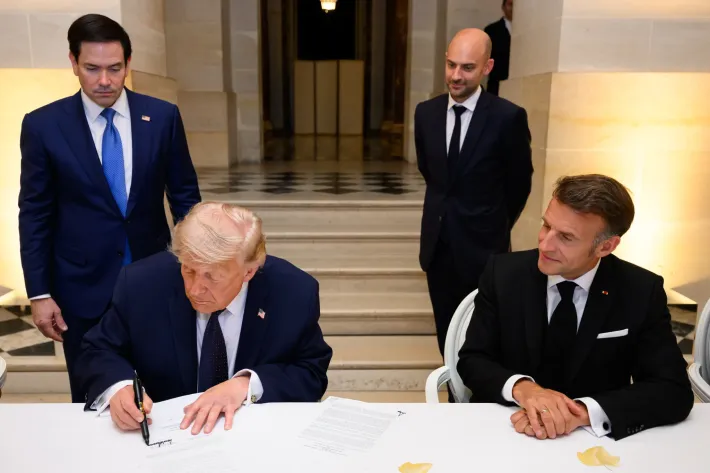
President Donald Trump signs the Islamabad Memorandum of Understanding between the Islamic Republic of Iran and the United States at the Palace of Versailles, France. (Photo Credit: The White House)
In early 2026, when Iranian surgeon Alireza Golchini saw protesters with gunshot and stab wounds from the regime, he did what doctors are trained to do: he treated them. For that, Iranian authorities arrested him, charged him with “waging war against God,” and threatened him with a sentence that can carry the death penalty. His alleged crime was not violence or espionage; it was providing medical care to wounded Iranians.
His story is a reminder of a simple reality: the Islamic Republic is one of the world’s most repressive regimes. Just recently, a woman was sentenced to 74 lashes for singing in a YouTube video without a hijab, and a 17-year-old swimmer and boxer was sentenced to death for participating in a protest. The regime just executed another dissident, bringing the total number of political executions in 2026 to at least 45.
Days ago, the United States and Iran announced a memorandum of understanding (MOU) intended to end months of fighting between the two, reopen the Strait of Hormuz to commercial shipping, and create space for further negotiations over Iran’s nuclear program. Renewed hostilities have underscored just how fragile that agreement remains.
For the Iranian people, however, the US-Iran deal as currently formulated is likely to deepen repression. It will strengthen the authorities that only months ago were imprisoning, executing, and killing Iranians in the streets for demanding basic freedoms and improved living conditions.
Late in 2025 and early 2026, millions of Iranians took to the streets in the most significant challenge the Islamic Republic has faced in decades. Authorities answered with a crackdown that left thousands dead and tens of thousands arrested. The regime also imposed a near-total internet shutdown that lasted for months, cutting Iranians off from one another and from a world that might otherwise have witnessed the scale of the violence. Yet reports indicate that a final agreement could bring this same regime sweeping sanctions relief, access to frozen assets, and billions of dollars in new investment. For Iranians who risked their lives demanding change, the likely outcome is not a more moderate government, but a more entrenched and repressive one.
Until a final agreement is reached, the Trump administration still has cards to play in the next 60-day negotiation period. The fragile MOU’s sanctions relief and access to frozen assets will be conditioned on Iran’s implementation of the agreement, and the opportunity remains to secure additional concessions from the regime.
At a minimum, the United States should make any relief conditional on five things: the release of Iran’s political prisoners, an end to the executions handed down in protest cases, a binding guarantee against another nationwide internet shutdown, and the return of the Americans now imprisoned in Iran or barred from leaving—six by the assessment of the James W. Foley Legacy Foundation. Tehran should also be required to come clean about the fate of kidnapped former FBI Agent Bob Levinson and help his family recover his remains. These are among the clearest and most immediate signs of whether Iranian authorities are prepared to act in good faith.
But the broader objective should be even more ambitious: US policy should focus on supporting the Iranian people and increasing the costs of repression. This includes expanding access to independent information through anticensorship and secure communications technologies that can reach Iranians during regime-imposed blackouts, as well as US international broadcasting to counter state propaganda. Washington should continue identifying and sanctioning human rights abusers while working with allied governments to harmonize sanctions regimes and crack down on sanctions-evasion networks. It should also sustain emergency assistance and direct support for Iranian journalists, human rights defenders, and civil society organizations, including efforts to document human rights abuses, preserve evidence for future accountability, strengthen digital security, and help activists and independent media operate despite government censorship and surveillance. The administration should also get creative and explore programs that incentivize lower-level regime defections that weaken the regime’s stranglehold on the Iranian people.
If the Trump administration does not pursue these terms in its negotiations, as well as its broader policy towards Iran, this deal will enable and finance one of the most repressive and destabilizing regimes in modern history.
For decades, US administrations of both parties have treated the aspirations of the Iranian people as secondary concerns while focusing on nuclear issues, regional security, sanctions, and diplomacy. Yet this has always been a false distinction. Those in the Iranian regime that deny Iranians basic freedoms are the same leaders that have fueled regional instability, supported armed proxies, taken hostages, and challenged US interests abroad. The result has been a recurring pattern in which governments negotiate over Iran’s future while ordinary Iranians are left waiting for the freedoms they not only deserve but have repeatedly and courageously risked their lives to demand.
The coming 60 days offer an opportunity to break with that history. If the United States brings its remaining leverage to bear, it can shape an agreement that strengthens the people of Iran rather than the institutions that have oppressed them. President Trump has the chance to avoid the mistakes of his predecessors. He should take it.