



Perspectives June 10, 2026
No Reset Without Releases: Georgia’s Political Prisoners and the Price of Better Relations with Washington
There should be no normalization of US-Georgia relations until Georgian authorities release those detained or imprisoned for exercising their fundamental freedoms.
Written By
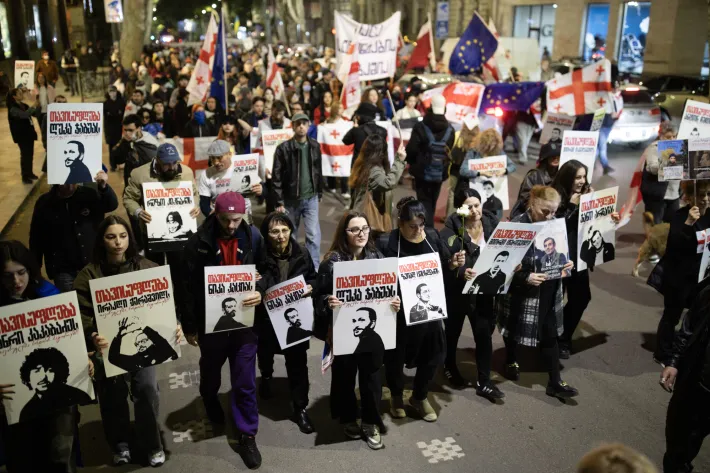
Demonstrators march in April 2025 with posters supporting Georgian prisoners of conscience. (Photo Credit: Sebastien Canaud, Wikimedia Commons, CC BY-SA 4.0)
In recent months, Georgian officials have signaled a desire to improve ties with the Trump administration. Members of the Georgian Dream government have pointed to renewed diplomatic contacts and commercially driven initiatives—including plans for a 70-story Trump Tower Tbilisi—as signs that relations with Washington may be improving after several years of tension.
But as Georgian Dream works to repair relations with the United States, they have expanded ties with counterparts in China, including through a 2023 strategic partnership; they have pursued closer engagement with the Iranian regime, including via high-level Georgian attendance at Iranian state ceremonies, and have been implicated in Iranian sanctions evasion schemes; and they have also faced growing scrutiny over the government’s role in sanctions evasion linked to Russian authorities. At home, Georgian Dream has launched a sweeping crackdown on dissent prompted by the approval of repressive laws and a 2024 decision suspending European Union (EU) negotiations that spurned citizens’ overwhelming support for European integration and closer ties with democratic partners. Georgian Dream has also sought to reframe Euro-Atlantic integration as a source of instability and conflict rather than a guarantor of Georgia’s long-term security and prosperity. Journalists, political opponents, students, artists, and ordinary citizens have been imprisoned, and authorities have passed laws aimed at curbing free expression. The US State Department noted that parliamentary elections that had preceded the EU decision were marred by vote buying and voter intimidation. Georgia is rated Partly Free in Freedom House’s Freedom in the World; its score fell to 51 in the 2026 edition, having lost 7 points in the past two years alone.
It is in the United States’ strategic interest to prevent Georgia from drifting further toward US adversaries. Washington should want to keep Georgia anchored in the democratic, Euro-Atlantic community because Georgia’s trajectory will shape the balance of influence between democratic and authoritarian powers in a strategically important region. But that does not mean the United States should normalize relations on Georgian Dream’s terms. The Trump administration should instead treat the release of Georgia’s political prisoners as a clear first test of whether Georgian Dream is truly prepared to make deals that can improve relations with the United States.
Imprisoned for speaking out
The Trump administration has already demonstrated that sustained pressure and high-level diplomacy can secure the release of political prisoners. Notably, under Special Envoy John Coale’s efforts, hundreds of detainees have been released from Belarus’s prisons in recent months. Georgia’s political prisoners deserve similar attention.
Some of the most emblematic cases of political imprisonment illustrate the breadth of Georgian Dream’s crackdown. Journalist Mzia Amaglobeli, founder of the independent outlets Batumelebi and Netgazeti, is one of the country’s most internationally recognized detainees. The two outlets were known among other things for exposing ruling-party violations in 2024 elections, and her detention since January 2025 on disproportionate charges signals to Georgia’s journalists that reporting the facts carries serious risk.
Zviad Tsetskhladze, a young activist associated with pro-European demonstrations that erupted after EU negotiations were suspended, was arrested while protesting in December 2024; he remains in prison in Tbilisi and has emerged as a symbol of the government’s repression of student and youth activism. The crackdown has also extended beyond traditional political actors. Andro Chichinadze, a well-known Georgian actor, and Paata Burchuladze, an internationally recognized opera singer who often sang at demonstrations, have both been imprisoned for protest activities amid the widening crackdown. Opposition figures including Giorgi Vashadze, Zurab Japaridze, Nika Melia, and Elene Khoshtaria—an opposition politician and mother of four—have also faced detention or prosecution.
These cases reflect a broader pattern in which state institutions, including the judiciary and prosecutorial system, are increasingly being used to raise the cost of dissent and weaken Georgia’s democratic opposition. Independent monitoring organizations have documented systemic judicial bias, excessive use of pretrial detention, and politically motivated prosecutions tied to peaceful protest activity. Within a few years, politically motivated detention has skyrocketed. Compared to just a few isolated cases before 2024 there are now 113 individuals deprived of liberty in cases widely regarded as politically motivated, according to Georgian human rights defenders; 58 are currently serving their sentences, and an additional 55 are in pretrial detention.
A path toward freedom
The Trump administration’s National Security Strategy provides a clear basis for making political prisoner releases central to any reset. It affirms that Americans’ “rights of free speech, freedom of religion and of conscience, and the right to choose and steer our common government are core rights that must never be infringed,” and adds that the United States will press countries that “share, or say they share,” those principles to uphold them “in letter and spirit.” The Georgian government claims to share those principles, but its treatment of political prisoners is the clearest test of whether that claim has meaning.
The United States should not normalize repression in Georgia simply because Georgian Dream has decided to seek warmer relations with Washington through diplomatic outreach and business deals. If the ruling party wants closer ties with the United States, Washington should demand concrete steps to reverse democratic backsliding—including restoring political pluralism, protecting civil society and independent media, and ensuring free and fair elections—in return for deeper engagement. These reforms are essential to keeping Georgia anchored in the Euro-Atlantic community and preventing further drift toward authoritarian powers whose interests run counter to free societies. The release of political prisoners should be treated as the minimum benchmark—not the final one.
So long as Georgian Dream continues to crack down on its own citizens, weaken democratic institutions, and deepen ties with US adversaries, the United States and its democratic partners should continue imposing costs on those responsible. That includes sustained sanctions, visa bans, and targeted measures against Georgian Dream officials, judges, prosecutors, and enablers implicated in democratic backsliding and politically motivated repression.
The Georgian public remains overwhelmingly supportive of democracy and Euro-Atlantic integration. US policy should reflect solidarity with those aspirations—not acceptance of the government’s accelerating authoritarian trajectory.