

Sri Lanka
Partly Free
63
100
| PR Political Rights | 29 40 |
| CL Civil Liberties | 34 60 |
Last Year's Score & Status
58
100
Partly Free
A country or territory’s Freedom in the World status depends on its aggregate Political Rights score, on a scale of 0–40, and its aggregate Civil Liberties score, on a scale of 0–60.
See the methodology.
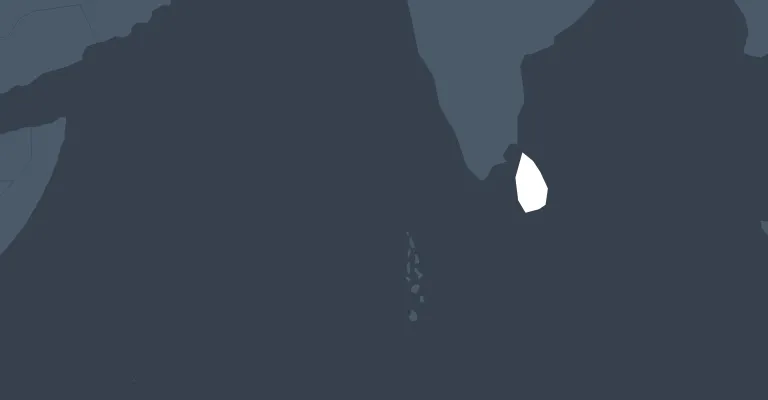


The slight improvements in political rights and civil liberties that Sri Lanka experienced after the 2015 election of President Maithripala Sirisena were stalled after Gotabaya Rajapaksa became president in 2019 and his family’s ethnic Sinhala Buddhist nationalist party Sri Lanka Podujana Peramuna (SLPP) won parliamentary polls in 2020. A pattern of governmental mismanagement, corruption, and acute economic crisis under SLPP rule prompted the 2022 Aragalaya (Struggle) protest movement, which resulted in the ouster of President Rajapaksa and his brother, Prime Minister Mahinda Rajapaksa. A new government overseen by veteran politician Ranil Wickremesinghe, who was chosen by Parliament to serve out the remainder of Rajapaksa’s presidential term, brought relative stability, but the austerity measures it introduced under pressure from international creditors further damaged public confidence in the political establishment and contributed to a sweeping victory by the leftist opposition National People’s Power (NPP) alliance in the 2024 presidential and parliamentary elections.
This report has been abridged for Freedom in the World 2026. Freedom in the World is entirely funded by nongovernmental sources such as private foundations, corporations, and individuals like you. Please consider making a donation to support future editions of this vital resource.
For additional background information, see the reports from the 2024 and 2025 editions of Freedom in the World.
A1
1.00-4.00 pts0-4 pts
| Was the current head of government or other chief national authority elected through free and fair elections? | 4.004 4.004 |
A2
1.00-4.00 pts0-4 pts
| Were the current national legislative representatives elected through free and fair elections? | 4.004 4.004 |
A3
1.00-4.00 pts0-4 pts
| Are the electoral laws and framework fair, and are they implemented impartially by the relevant election management bodies? | 3.003 4.004 |
B1
1.00-4.00 pts0-4 pts
| Do the people have the right to organize in different political parties or other competitive political groupings of their choice, and is the system free of undue obstacles to the rise and fall of these competing parties or groupings? | 4.004 4.004 |
Score Change: The score improved from 3 to 4 because political parties faced few obstacles to compete in local polls held during the year.
B2
1.00-4.00 pts0-4 pts
| Is there a realistic opportunity for the opposition to increase its support or gain power through elections? | 3.003 4.004 |
B3
1.00-4.00 pts0-4 pts
| Are the people’s political choices free from domination by forces that are external to the political sphere, or by political forces that employ extrapolitical means? | 3.003 4.004 |
Score Change: The score improved from 2 to 3 because, while the military continues to play a powerful role in society, it has not actively promoted the political interests of the ruling party and the ruling party is not exerting extrapolitical influence over people’s political choices.
B4
1.00-4.00 pts0-4 pts
| Do various segments of the population (including ethnic, racial, religious, gender, LGBT+, and other relevant groups) have full political rights and electoral opportunities? | 2.002 4.004 |
C1
1.00-4.00 pts0-4 pts
| Do the freely elected head of government and national legislative representatives determine the policies of the government? | 3.003 4.004 |
C2
1.00-4.00 pts0-4 pts
| Are safeguards against official corruption strong and effective? | 2.002 4.004 |
Score Change: The score improved from 1 to 2 because the authorities have taken steps to combat corruption in recent years, resulting in arrests, convictions, and dismissals of high-profile figures.
C3
1.00-4.00 pts0-4 pts
| Does the government operate with openness and transparency? | 2.002 4.004 |
.
Add Q
| Is the government or occupying power deliberately changing the ethnic composition of a country or territory so as to destroy a culture or tip the political balance in favor of another group? | -1.00-1 |
D1
1.00-4.00 pts0-4 pts
| Are there free and independent media? | 3.003 4.004 |
D2
1.00-4.00 pts0-4 pts
| Are individuals free to practice and express their religious faith or nonbelief in public and private? | 3.003 4.004 |
Score Change: The score improved from 2 to 3 because interreligious conflict associated with past government ties to Buddhist nationalist groups has decreased in recent years, and the current government has taken steps to promote religious tolerance.
D3
1.00-4.00 pts0-4 pts
| Is there academic freedom, and is the educational system free from extensive political indoctrination? | 2.002 4.004 |
D4
1.00-4.00 pts0-4 pts
| Are individuals free to express their personal views on political or other sensitive topics without fear of surveillance or retribution? | 2.002 4.004 |
E1
1.00-4.00 pts0-4 pts
| Is there freedom of assembly? | 3.003 4.004 |
Score Change: The score improved from 2 to 3 because protests in recent years have faced fewer restrictions than in the past, though some criminal cases stemming from earlier protests remain unresolved.
E2
1.00-4.00 pts0-4 pts
| Is there freedom for nongovernmental organizations, particularly those that are engaged in human rights– and governance-related work? | 3.003 4.004 |
E3
1.00-4.00 pts0-4 pts
| Is there freedom for trade unions and similar professional or labor organizations? | 3.003 4.004 |
F1
1.00-4.00 pts0-4 pts
| Is there an independent judiciary? | 3.003 4.004 |
F2
1.00-4.00 pts0-4 pts
| Does due process prevail in civil and criminal matters? | 1.001 4.004 |
F3
1.00-4.00 pts0-4 pts
| Is there protection from the illegitimate use of physical force and freedom from war and insurgencies? | 2.002 4.004 |
F4
1.00-4.00 pts0-4 pts
| Do laws, policies, and practices guarantee equal treatment of various segments of the population? | 1.001 4.004 |
G1
1.00-4.00 pts0-4 pts
| Do individuals enjoy freedom of movement, including the ability to change their place of residence, employment, or education? | 2.002 4.004 |
G2
1.00-4.00 pts0-4 pts
| Are individuals able to exercise the right to own property and establish private businesses without undue interference from state or nonstate actors? | 2.002 4.004 |
G3
1.00-4.00 pts0-4 pts
| Do individuals enjoy personal social freedoms, including choice of marriage partner and size of family, protection from domestic violence, and control over appearance? | 2.002 4.004 |
G4
1.00-4.00 pts0-4 pts
| Do individuals enjoy equality of opportunity and freedom from economic exploitation? | 2.002 4.004 |


Country Facts
-
Population
22,180,000 -
Global Freedom Score
63 100 partly free -
Internet Freedom Score
53 100 partly free
