


Perspectives April 28, 2026
After the Election: Revitalizing Hungarian Democracy, and Lessons from the Opposition Victory
Five experts reflect on the opposition Tisza party’s resounding victory in the Hungarian election, how the new government should move forward, and what democracy’s defenders can learn.
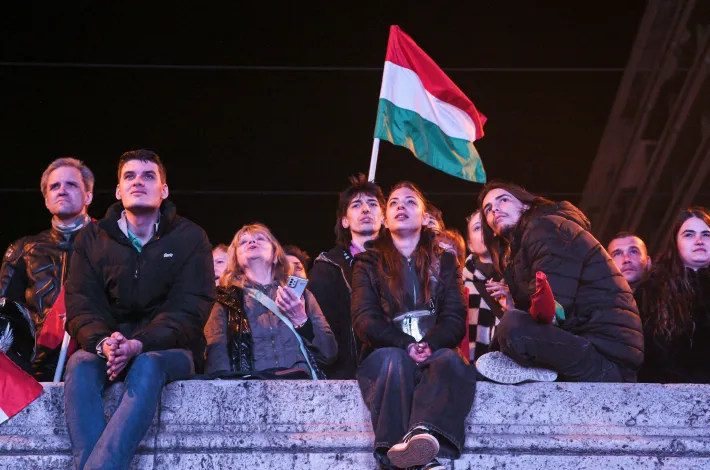
Supporters of the Tisza party await the arrival of Péter Magyar to give his victory speech in Budapest on April 12, 2026. (Photo Credit: SOPA Images Limited / Alamy)
In 2014, Hungarian Prime Minister Viktor Orbán famously pronounced Hungary “an illiberal state, a non-liberal state,” contrasting it with liberal democracies and deeming repressive governments including those of China, Russia, and Turkey as models of international success.
Throughout his Fidesz party’s 16-year administration, Orbán worked to concentrate power in a state under his leadership. He pushed through constitutional and legal changes that allowed the party to consolidate control over democratic institutions and passed measures that hampered the operations of opposition groups, journalists, universities, and nongovernmental organizations. As a result, Hungary’s status declined from Free to Partly Free in 2019 and its score has continued to decline, losing a total of 25 points in Freedom in the World between 2010 and 2025.
In April 2026, opposition leader Péter Magyar and his Tisza party won a decisive victory in Hungary’s elections, defeating Fidesz and ushering in new possibilities for Hungarians to revitalize their democracy. The country’s enthusiasm for reform was reflected in the largest voter turnout in Hungary’s democratic history. We asked five experts about what Magyar’s new administration should prioritize, and what democracy’s defenders can learn from the Hungarian opposition’s victory.
Freedom House: What should the new government prioritize to revitalize Hungary’s democracy?
Ágnes Kovács, Eötvös Loránd University: The opposition’s landslide victory gives the new government a strong democratic mandate to enact constitutional and legal reforms. Yet Orbán used a similar mandate to entrench autocracy, so the new government must offer a fundamentally different model of governance.
Restoring checks and balances is essential, but the foundations of democratic politics also need to be rebuilt. Parliament should function as a space for substantive political debate, where decisions are made through transparent and inclusive procedures grounded in professional expertise and meaningful public consultation. This requires restoring a democratic public sphere, including media freedom, freedom of information, and a stronger civil society. Sustained civic mobilization can provide an important check on the government. The autonomy of schools, universities, and research institutions as spaces for learning, critical inquiry, and knowledge production must be restored.
Personnel changes in top positions are essential. They help dismantle patronage networks, restore the independence of formerly autonomous institutions, and rebuild a professional bureaucracy, while signaling a renewed commitment to democratic norms and accountability.
Andras Toth-Czifra, fellow at the Foreign Policy Research Institute (FPRI) and Delphi Global Research Center: The key to Tisza’s ability to defeat Orbán’s government and the system that he built was the development of truly independent, consumer-financed media that has been able to foster engaging discussion about public affairs, and the genuine grassroots activism that accompanied the party at a local level. This provided a framework for people to feel like they were able to take action and participate in politics, beyond passive and reactive forms of public action, and without having to take part in national-level politics.
The survival of both will be key to fostering a return to a healthy democracy. Beyond this, the two crises that gave rise to Tisza were a deep accountability crisis, and a state capacity crisis. To combat these, Tisza will first have to restore the independence of judicial and investigative institutions for them to be able to swiftly prosecute corrupt officials and oligarchs; and do what it can to unblock European Union (EU) funding and use the improved fiscal capacity to immediately invest in public infrastructure and public services.
Freedom House: Are there bigger lessons from this election for other countries that have experienced democratic backsliding?
Jamie Fly, CEO, Freedom House: Despite twenty years of global democratic decline, Freedom House research has shown that established democracies are remarkably resilient. Hungary has experienced threats to judicial independence, media consolidation, a political takeover of public media, and corruption by senior Orbán-government officials. When leaders attempt to circumvent democratic checks and balances, they ultimately undermine faith in democratic institutions. More citizens begin to view their leaders as unable to deliver results that improve their lives. In an age when an increasing number of young people view democracy as distant from their priorities, this can be toxic.
Yet, Hungary shows that despite sustained efforts over 16 years to undermine the country’s democratic institutions, democracies are resilient so long as citizens are still given the ability to freely and fairly choose their leaders and make their views known. Even as the Magyar government seeks to deliver results for the Hungarian people, it will need to begin to unravel the changes to the institutions of Hungarian democracy that allowed Viktor Orbán’s domination of Hungarian politics to endure for so long.
Zselyke Csaky, senior research fellow, Centre for European Reform: We should be cautious about drawing sweeping conclusions from Hungary’s election results. While the outcome reflects global trends, the causes of Orbán’s defeat are first and foremost, domestic. But there are a few lessons that democracy’s defenders can take home.
One is that not even entrenched autocrats can ignore the economy. Hungary’s growth practically flatlined in the last few years. A struggling economy leaves populists vulnerable—and a challenger who is in the right place at the right time can exploit that.
Second, politics is still personal, and a politically savvy, charismatic opponent can alleviate apathy and bring the people with them. Magyar spent more than a hundred days on the road, visiting several Hungarian towns every day.
And finally, it’s never too late. Orbán was in power for 16 years, and a whole new generation came of age under his rule. But not even a captured system could contain discontent or destroy people’s hope for something better.
Yana Gorokhovskaia, research director, strategy and design, Freedom House: The defeat of Victor Orbán and his Fidesz party is a classic example of a “breakthrough election”—a pivotal ballot box victory by a political opposition that unseats an illiberal leader or disrupts the entrenched political regime. Other countries, including Guatemala, Nepal, Poland, Senegal and Sri Lanka have experienced similar defining elections in recent years. But as we argued in Freedom in the World 2025, winning elections is the beginning rather than the end of the process of reversing democratic backsliding.
Just like its counterparts across the globe, the new government led by Péter Magyar will have to undo years of attacks on democratic institutions, including the courts, public media, civil society, and academia, without resorting to the illiberal methods of his predecessor, while also maintaining the support of the broad collation that brought him to power.
Comparative research suggests that most improvements come quickly following the change in government, and tend to slow the further away the country moves from breakthrough elections. As such, Magyar’s government will need to feed public enthusiasm for reforms in order to maintain this hard-fought democratic momentum.