


Perspectives November 3, 2026
After the Election: Revitalizing Serbian Democracy, and Lessons from the Opposition Victory
Five experts reflect on the victory of the Student List opposition coalition in Serbia’s parliamentary elections, how the new government should move forward, and what democracy’s defenders can learn.
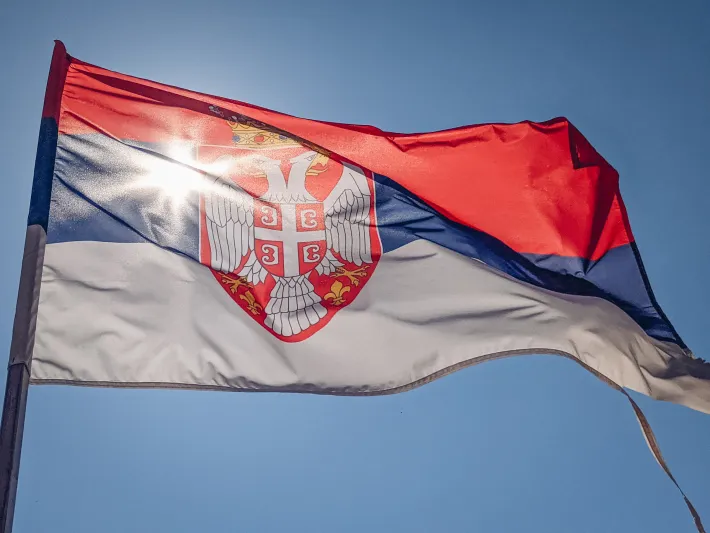
Sun shining through a Serbian flag. (Photo Credit: Ivan Radic on Flickr CC BY 2.0)
Last month Serbia’s Student List, a youth-backed opposition movement, won parliamentary elections, ending 14 years of rule by longtime Serbian leader Aleksandar Vučić and his Serbian Progressive Party (SNS). The broad coalition grew from an ongoing protest movement sparked by the collapse of a renovated canopy at Novi Sad’s train station in 2024, which killed more than a dozen people and was widely blamed on government corruption.
Political rights and civil liberties had eroded significantly under Vučić’s rule as the government placed legal and extralegal pressure on the political opposition, independent media, and civil society organizations. As a result, Serbia’s Freedom in the World status declined from Free to Partly Free in 2019. Its score has since continued to decline, now registering 53 points on Freedom in the World’s 100-point scale—the lowest score in the western Balkan region and the second-lowest score in all of Europe. Turnout in the election was reported at a massive 70 percent, reflecting Serbian citizens’ desire for reforms in their country.
After the polls, Freedom House reached out to five experts to ask what the new Serbian administration should prioritize, and what democracy’s defenders can learn from the Student List victory.
Freedom House: What should the new government prioritize to revitalize Serbia’s democracy? Are there lessons from Serbia’s election for other countries that have experienced democratic backsliding?
Nikola Burazer, Programme Director at the Centre for Contemporary Politics: The new Serbian government primarily needs to end state and media capture, restore institutional independence and integrity by removing undue political influence, enable the judiciary to tackle corruption, and ensure conditions for free and fair elections in the future.
The main lesson from Serbia is that electoral victories against entrenched populist or illiberal regimes are indeed possible, even if electoral conditions are unfair. It is, however, important to create a strong political alternative which could mobilize citizens. And even if such regimes win elections against traditional political opponents, societies could find alternative ways to mobilize.
Mila Bajić, Research Lead at SHARE Foundation: What was achieved in Serbia should serve as motivation for other countries where corruption is rampant and institutions are captured. A free press, political accountability, and stronger safeguards around key issues such as environmental protections are paramount for laying a solid foundation for future reforms.
The biggest takeaway from these elections is that solidarity is the greatest tool with which to defend your country and unity is most important in the darkest of times. Self-organizing and direct democracy were crucial for building authenticity and strengthening the movement and getting people to regain trust in institutional political participation. A day out from the elections we’re seeing people organize on the local level, help each other and support small ways of improving everyday life. That is what change looks like and how it should be cultivated.
Marko Kmezić, Professor, University of Graz: The student movement has revitalized the democratic imagination, challenging the belief that an entrenched authoritarian regime can make electoral change impossible and demonstrating that democratic mobilization can reopen the possibility of meaningful political competition.
The students have awakened the majority of Serbian society, breaking through years of political apathy, systematic demonization, and the stigmatization of political engagement and civic activism. In doing so, the students have helped reclaim democratic participation as a legitimate and necessary form of collective action—a message that may resonate far beyond Serbia, particularly in countries experiencing democratic backsliding. The message is simple yet powerful: a leaderless movement, grounded in solidarity, committed to democratic values and the rule of law, can challenge an entrenched authoritarian regime.
Filip Ejdus, Professor at the Faculty of Political Science, University of Belgrade: The main lesson is that hybrid regimes and spin dictators can be defeated in elections despite their control of traditional media and the absence of a level playing field. In our case, the antidote was a combination of student-led mobilization, connective action, and the transformation of a leaderless, horizontal, grassroots movement based on direct democracy (student plenums and local assemblies) into a catch-all electoral list of new faces.
Ahead of the elections, the list secured the support of the vast majority of opposition and diaspora groups. Turnout was very high, around 70 percent, and the Student List had a record number of highly trained polling station representatives, equipped with a well-thought-out strategy for preventing various forms of electoral fraud and determined to defend every single vote.
Marija Šajkaš, media expert focused on freedom of expression and the Balkans: Student List didn’t just defeat the ruling party. It swept away the entire political opposition, too. Last week, being a professional politician became an obsolete occupation in Serbia. This is not a change of the regime. We are witnessing a paradigm shift.
Historically, Serbia has never had long periods of democracy, and with Vučić’s mafia state and the Russian and right-wing propaganda, it appeared that the majority of Serbs had stopped believing that democracy was anything but an empty word.
By crisscrossing the country in long marches on foot while raising issues such as accountability and rule of the law, organizing massive, always-peaceful protests, mobilizing over 100,000 volunteers, et cetera, students effectively embodied and lived democratic principles. Or, to answer the question directly: in Serbia, democracy has finally been revitalized, with priorities already decided in a democratic manner—in plenums—and set by students.