


Policy Brief November 12, 2026
Defeating Authoritarian Digital Blackouts: Countering Internet Shutdowns Through Satellite Technology
Tehran wants to obstruct satellite internet operations in Iran. Democracies should take a stand in defense of internet freedom.
(Photo Credit: Diego Martinez / Alamy Live News.)
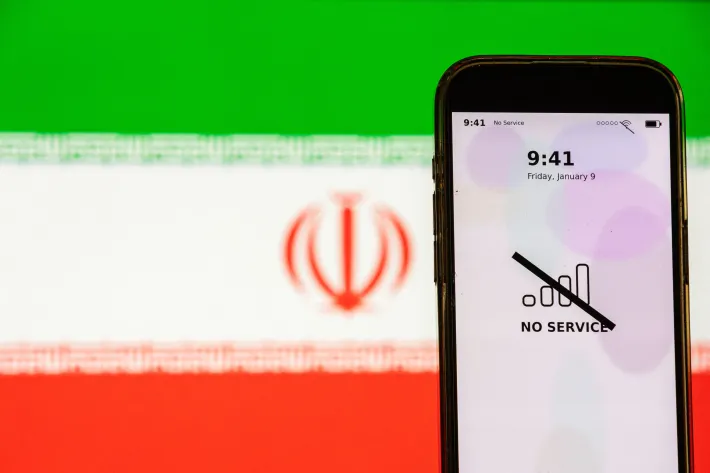
As mass antigovernment and economic protests erupted last winter across multiple Iranian cities, ordinary Iranians took to the streets to demand better living conditions. In response, the Iranian regime not only brutally murdered thousands in the streets but also shut off the internet to hide its crimes from the world and prevent its people from communicating with each other.
Fortunately, there is a way to counter this insidious digital oppression. Satellite internet provides a means for the Iranian people to circumvent the government’s internet shutdown, but Tehran is attempting to block satellite internet over its territory, branding it a “tool of war,” and is pressuring other governments and international bodies to restrict satellite services in the name of “digital sovereignty.”
Democratic governments, donors, and the satellite industry should take a stand to counter the Iranian regime’s attempt to ground the satellites providing the Iranian people a voice and a lifeline.
Why satellite internet threatens Tehran’s control
Iranians depend on internet access to connect with their loved ones across borders, communicate with fellow Iranians inside the country, run local businesses, and facilitate basic day-to-day needs. Internet access is also a critical tool to record the regime’s human rights violations, mobilize, and demand accountability from leaders. Connectivity underpins the universal rights to free expression, association, and assembly. Yet, during the regime’s nearly three-month shutdown, the longest nationwide blackout on record, abuses took place largely out of the world’s view. The shutdown was a major factor in the sharp drop from 13 to just 9 out of a total of 100 points in Iran’s score in this year’s edition of Freedom on the Net, Freedom House’s annual assessment of internet freedom around the world. This means that Iran now ranks as one of the world’s worst offenders of internet freedom, tied with China and Myanmar.
Like their counterparts in Beijing and Moscow, Iranian authorities have long depended on control of the country’s network infrastructure to slow connections, restrict platforms, and cut off access entirely when protests erupt. Satellite internet undermines that approach. Because a satellite terminal bypasses state-run networks altogether, authorities have no kill switch. Mohammad Hafez Hakami, Iran’s deputy minister for technology, innovation, and international affairs, warned on September 30 that “the spread of Starlink drives the final nail into the coffin of cyberspace governance.”
Iran’s diplomatic campaign against satellite internet
On October 4, Iran’s foreign ministry summoned Norway’s ambassador to deliver a formal protest. Because Norway had registered Starlink with the International Telecommunications Union (ITU), Tehran argued that Oslo is obligated to stop Starlink signals from reaching Iran without permission. Democracies should not be fooled, though: This argument is merely part of Tehran’s broader efforts to cut the Iranian people off from the world, curtailing their ability to exercise their fundamental freedoms.
Within the ITU itself, Iran’s push to curb the “unauthorized” use of satellite internet services within national borders is supported by its authoritarian co-conspirators in the Russian government. Should the next ITU World Radiocommunication Conference (WRC)—to take place in China in October 2027—formally adopt strict mechanisms that treat unauthorized satellite service as a breach of sovereignty, other authoritarian governments could cite that precedent to press providers to shut off service during protests and elections.
Recommendations
To counter the Iranian regime’s efforts to undermine satellite internet access, Freedom House urges the US government, like-minded democracies, donors, and the satellite industry to take the following steps. In the United States, the 120th Congress should mitigate Tehran’s efforts to block internet access by overseeing US government engagement at the WRC-27 and providing financing for satellite internet capabilities.
Engage diplomatically. Democratic governments need to ensure that Tehran and its authoritarian counterparts in China and Russia cannot write the rules for this fledgling technology. To do so, states should speak out publicly, in ITU forums and in the Freedom Online Coalition, affirming that access to the internet should be protected in times of conflict.
At the upcoming WRC-27, democratic governments should oppose Iranian authorities’ efforts to apply a maximalist approach to regulating the unauthorized use of satellite internet services. This would help prevent Tehran and its allies from altering technical language to further legitimize governments’ ability to block unauthorized satellite internet services, even in times of humanitarian crisis.
Relatedly, democracies should champion a humanitarian exception that safeguards emergency satellite connectivity for those facing shutdowns, conflict, and other crises. There is in fact already a precedent for the ITU engaging on humanitarian protections. Namely, Article 40 of the ITU Constitution regarding the “Priority of Telecommunications Concerning Safety of Life” could provide a useful starting point from which to enhance and expand humanitarian safeguards.
Finally, the US State Department should work to quickly appoint a US head of delegation for the WRC-27 to ensure adequate time to prepare a joint strategy with like-minded partners ahead of the convening.
Support direct-to-cell satellite technology. The US State Department should conduct a feasibility study of the effectiveness and potential vulnerabilities of nascent direct-to-cell (also known as direct-to-device) satellite internet technologies, currently being examined by the US Federal Communications Commission.
Direct-to-cell makes it possible for people to connect with satellites (and therefore access the internet) straight from their mobile devices, removing the need to smuggle in and conceal bulky equipment. While the technology is almost ready for market, it has yet to be extensively tested, so it warrants further study to ensure it can be effectively and safely deployed. The US government and like-minded democracies and donors should support trial deployments of this emerging capability.
Provide financial support. Satellite internet equipment is prohibitively expensive for most people under repressive rule, including human rights defenders; a Starlink terminal alone can run several hundred dollars. Donors should dedicate resources to bringing these costs down. In particular, the US Congress should consider appropriating additional funds for the Iran Internet Freedom Grant Program, a vehicle to help the Iranian people connect to the World Wide Web, to help achieve this goal.
Prioritize safety. Donors should continuously evaluate how to distribute satellite internet equipment safely, especially given recent reporting that reveals how Starlink users may be targeted with invasive surveillance via commercial spyware technologies embedded in digital ads. Iranians caught using Starlink face grave consequences. Between March and July alone, Iran’s Economic Security Police seized 997 Starlink terminals and arrested 163 people, according to the force’s head, Brigadier General Hossein Rahimi. In one case last April, Iranian authorities reportedly killed a man after arresting him for using satellite internet.
Ensure satellite connectivity is resilient to government pressure. Satellite internet companies should develop robust policies to resist government demands to terminate access. This is important to ensure that the private sector does not fall victim to authoritarians’ concerted efforts to violate their people’s human rights. To develop this type of policy infrastructure that seeks alignment with the UN Guiding Principles on Business and Human Rights and the OECD Guidelines for Multinational Enterprises, satellite internet companies should turn to the multistakeholder Global Network Initiative for support.
Freedom House is grateful to Mahsa Alimardani, Farzaneh Badiei, Giulio Coppa, Trevor Snapp, Holly Dagres, Peter Micek, and other members of the Direct-to-Cell Coalition, in addition to Project Ainita researchers, for consulting on the recommendations outlined in this policy brief.