


Political Prisoners Watch October 1, 2026
Political Prisoners Watch: Five Democracy Advocates Targeted for Seeking Help Abroad
Dictatorial regimes are retaliating against democratic activists who talk to foreign governments and international bodies.
Written By
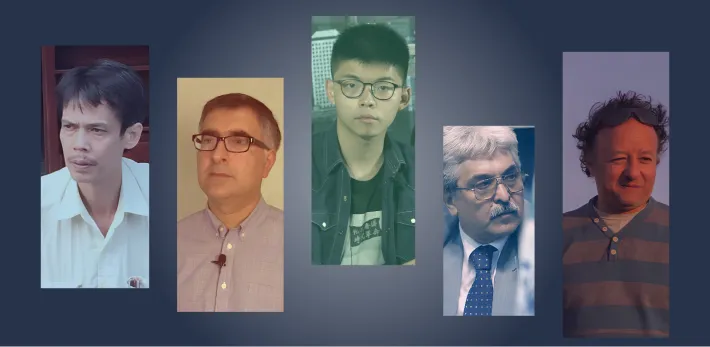
From left to right: Pham Chi Dung, Anar Mammadli, Joshua Wong, Mohammad Seifzadeh, Gasser Abdel Razek (Photo Credits: Pham Chi Dung Facebook, Wikimedia Commons, Center for Human Rights in Iran, Egyptian Initiative for Personal Rights)
On September 2, prominent Hong Kong democracy activist Joshua Wong pleaded guilty to charges under the territory’s notorious National Security Act—the second time he has faced prison time under the Beijing-imposed law. Having already been imprisoned since November 2020, he now faces the possibility of another lengthy sentence simply for demanding that Hong Kongers have a voice in their own government. Joshua’s detention has been widely recognized as emblematic of the Chinese Communist Party’s increasing restrictions on freedom in and the autonomy of Hong Kong.
However, his case is also an example of an important but less visible phenomenon: to hide truth about their abuses, dictatorial regimes are criminalizing the act of talking to the outside world. The allegations against Joshua included meetings in the United States with Congresswoman Nancy Pelosi and then Senator Marco Rubio. Unfortunately, activists around the globe are facing similar charges. The following cases highlight the efforts of repressive regimes to shut down engagement with foreign democracies and international bodies that have made protecting democracy part of their mission.
Vietnamese journalist Pham Chi Dung was detained after petitioning members of the European Parliament (EP) to pressure Vietnam over its human rights record. In 2019, he wrote to EP members asking them to postpone ratification of the EU-Vietnam Free Trade Agreement until Vietnamese authorities made human rights improvements, and made a similar appeal in a video featured at an event hosted by a British EP member. Two days later, he was arrested. UN experts noted that the arrest “appears to be an act of reprisal for his human rights advocacy.” Dung was later sentenced to 15 years in prison for “conducting antistate propaganda,” and he remains imprisoned today.
Mohammad Seifzadeh, a human rights lawyer in Iran, wrote a letter with other human rights activists to UN Secretary General António Guterres in December 2022, asking him to respond to the Iranian regime’s execution of peaceful protesters. Just a few months later, as a result of the letter, he was convicted of “propaganda against the system” and “spreading false information” and sentenced to a year in prison (though his sentence was eventually suspended for medical reasons).
Azerbaijani activist Anar Mammadli, chair of the Election Monitoring and Democracy Studies Centre (EMDS), was arrested in 2024 a few weeks after calling on Azerbaijani authorities to release political prisoners and respect fundamental rights at events hosted by the UN Human Rights Council and the Organization for Security and Co-operation in Europe (OSCE). A group of UN officials expressed “serious concerns that Mammadli’s detention and prosecution may be in retaliation for his human rights work and his engagement with UN mechanisms.” In 2026, Anar was sentenced to 13 years in prison on a variety of baseless charges.
In November 2020, three staff of the Egyptian Initiative for Personal Rights, including Executive Director Gasser Abdel Razek, were arrested a few days after discussing human rights issues with 13 foreign ambassadors and diplomats. While they were released a few weeks later, they were placed under a travel ban that remains in place to this day.