



Perspectives June 25, 2026
As the United States Turns 250, Americans Must Stand Up for Democracy and Freedom
The success of the American experiment is contingent upon renewal and the willingness of elected officials and ordinary people to stand up for democracy.
Written By
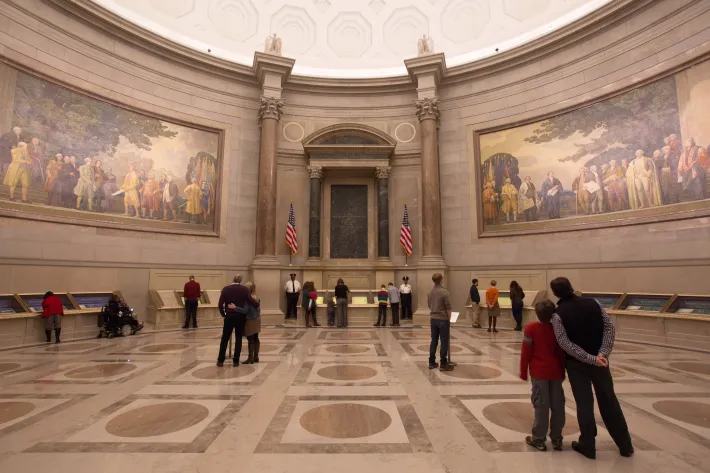
Visitors in the Rotunda of the National Archives building in Washington, DC view the Charters of Freedom. (Photo Credit: U.S. National Archives)
On July 4, 1776, the United States’ founders declared before the world a new nation grounded in the belief that all men are endowed with unalienable rights that no unaccountable power may extinguish. Trusting in the judgement of free people, they launched one of history’s greatest experiments: a democratic system based on the will and consent of citizens. Novel at the time, it is a concept that transformed the world.
Shortly before his inauguration in 1861, Abraham Lincoln said that the Declaration “gave liberty, not alone to the people of this country, but, I hope, to the world, for all future time. It was that which gave promise that in due time the weight would be lifted from the shoulders of all men."
As the United States marks its 250th anniversary, Lincoln’s prophesy has been proven true. The principles our Republic was founded upon remain as consequential—but as contested—as ever.
Freedom House’s Freedom in the World report, which rates freedom in 208 countries and territories and categorizes each as Free, Partly Free, or Not Free, rates the United States as Free due to its strong rule-of-law tradition, robust protections for freedoms of expression and belief, and vibrant political system. However, it has also documented erosion of these freedoms: in the most recent edition, the United States lost 3 points on the project’s 100-point scale, bringing the country’s net decline since 2005 to 12 points.
At the same time, Freedom in the World has documented 20 consecutive years of decline in global freedom. Coups, armed conflicts, attacks on democratic institutions by elected leaders, and repression by authoritarian regimes drove this deterioration. Since 2005, 19 Partly Free countries have dropped to Not Free, swelling the ranks of the world’s autocracies, which have become more repressive at home and more aggressive abroad. Authoritarian leaders are increasingly cooperating with each other to crush dissent and dismantle democratic institutions that expose abuses and hold them accountable: they aim to shape a darker world where unleashing repression and violence bears little cost on the international stage.
And yet, from the American Revolution to the collapse of communism in Central Europe more than two hundred years later, history is rich with freedom struggles showing that tyrants can be thrown off and systems of repression abolished. As in democratic societies everywhere, the freedoms Americans enjoy endure due to those who struggled to expand and defend them at home as well as overseas. Freedom only survives where people fight for it.
The success of the American experiment is contingent upon renewal and the willingness of elected officials and ordinary people to stand up for democracy. While Freedom House has offered recommendations to governments, businesses, and civil society on renewing and advancing democracy, there are also steps every American can take.
They include voting—including in primary elections, where a small number of voters typically determine general election ballots—or running for office. More Americans need to participate in their communities by joining civic organizations, town halls, or volunteer groups, and engaging with elected officials on topics they deem important. Being informed citizens vigilant of false and inflammatory online content packaged to provoke outrage and exacerbate polarization. Perhaps most importantly, rejecting ideas counter to democracy—not just extremism and political violence, but also efforts to weaken the rules of fair play that govern political and everyday life.
The United States’ founders made a revolutionary wager that a free people could govern themselves and strive together toward a nation that guarantees fundamental rights. Two and a half centuries later their experiment endures, not as a perfect nation but a free one, continuously correcting and renewing its course through the institutions of democracy.
Moreover, fulfilling Lincoln’s vision, the United States remains the world’s most influential democracy: no country has a greater capacity to drive positive change in an increasingly unfree world by upholding the democratic values on which it was founded. The world’s dictators and tyrants have no such moral leverage.
That’s why the American experiment itself stands for the right of free people everywhere to chart their own destiny. The American project won’t be complete until that transformational ideal is fulfilled.
Jamie Fly is CEO of Freedom House. He served as counselor for foreign and national security affairs to then-Sen. Marco Rubio (R-FL) from 2013 to 2017.