

Haiti
Not Free
22
100
| PR Political Rights | 5 40 |
| CL Civil Liberties | 17 60 |
Last Year's Score & Status
24
100
Not Free
A country or territory’s Freedom in the World status depends on its aggregate Political Rights score, on a scale of 0–40, and its aggregate Civil Liberties score, on a scale of 0–60.
See the methodology.
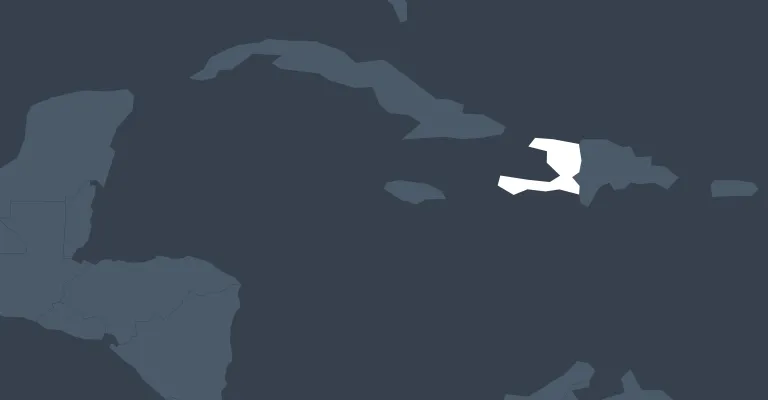


Worsening breakdowns of the Haitian electoral system over the past decade have led to a series of expired mandates and constitutional impasses, leaving citizens without proper political representation. The government’s ability to function was further damaged by the 2021 assassination of President Jovenel Moïse and the 2024 resignation of Prime Minister Ariel Henry following a wave of violence by armed criminal groups. A transitional presidential council was installed later in 2024 with international support, and it named a prime minister, but the judiciary and law enforcement agencies continue to lack the resources, independence, and integrity to uphold the rule of law.
- In December, the country’s Provisional Electoral Council released a schedule for long-overdue national elections, with a first round to be held in August 2026, but tangible steps to prepare for such elections remained limited. It was also unclear how governance would be maintained after the end of the nine-seat transitional presidential council’s original mandate in February 2026.
- In September, the UN Security Council voted to replace the Kenyan-led Multinational Security Support police mission—active in Haiti since mid-2024—with a larger Gang Suppression Force, which would have more expansive authority to combat and arrest members of armed criminal groups. Separately, the Haitian government reportedly hired private military contractors to assist with security efforts.
- Amid broader allegations of official corruption, Prime Minister Alix Didier Fils-Aimé and at least one member of the transitional presidential council were accused during the year of colluding with criminal groups or interfering with law enforcement operations against them.
- Security forces reportedly used gunfire and tear gas to disperse protesters, and engaged in extrajudicial killings. According to UN sources, police killed more than 3,200 people over the course of the year, and at least 18 percent of them were not affiliated with armed groups. More than 8,000 people were killed in the year’s violence overall, and more than 1.4 million Haitians were internally displaced as of December.
- Journalists and media outlets continued to face suspensions and threats from authorities, as well as physical violence, abductions, arson, and other interference by criminal groups throughout the year. The heavily armed groups increasingly targeted churches and other civilian gathering places for looting and kidnappings for ransom, and subjected women and children to sexual violence and forced recruitment. A series of mass killings and forced displacements prompted international condemnation; in one incident in September, a coalition of gangs killed more than 40 people in a fishing village.
This report has been abridged for Freedom in the World 2026 due to ongoing budget constraints. Freedom in the World is entirely funded by nongovernmental sources such as private foundations, corporations, and individuals like you. Please consider making a donation to support future editions of this vital resource.
For additional background information, see the reports from the 2024 and 2025 editions of Freedom in the World.
A1
1.00-4.00 pts0-4 pts
| Was the current head of government or other chief national authority elected through free and fair elections? | 0.000 4.004 |
A2
1.00-4.00 pts0-4 pts
| Were the current national legislative representatives elected through free and fair elections? | 0.000 4.004 |
A3
1.00-4.00 pts0-4 pts
| Are the electoral laws and framework fair, and are they implemented impartially by the relevant election management bodies? | 1.001 4.004 |
B1
1.00-4.00 pts0-4 pts
| Do the people have the right to organize in different political parties or other competitive political groupings of their choice, and is the system free of undue obstacles to the rise and fall of these competing parties or groupings? | 1.001 4.004 |
B2
1.00-4.00 pts0-4 pts
| Is there a realistic opportunity for the opposition to increase its support or gain power through elections? | 0.000 4.004 |
Score Change: The score declined from 1 to 0 because extreme violence and unrest have repeatedly delayed elections, preventing opposition groups from competing and gaining power.
B3
1.00-4.00 pts0-4 pts
| Are the people’s political choices free from domination by forces that are external to the political sphere, or by political forces that employ extrapolitical means? | 0.000 4.004 |
B4
1.00-4.00 pts0-4 pts
| Do various segments of the population (including ethnic, racial, religious, gender, LGBT+, and other relevant groups) have full political rights and electoral opportunities? | 1.001 4.004 |
C1
1.00-4.00 pts0-4 pts
| Do the freely elected head of government and national legislative representatives determine the policies of the government? | 0.000 4.004 |
C2
1.00-4.00 pts0-4 pts
| Are safeguards against official corruption strong and effective? | 1.001 4.004 |
C3
1.00-4.00 pts0-4 pts
| Does the government operate with openness and transparency? | 1.001 4.004 |
D1
1.00-4.00 pts0-4 pts
| Are there free and independent media? | 1.001 4.004 |
D2
1.00-4.00 pts0-4 pts
| Are individuals free to practice and express their religious faith or nonbelief in public and private? | 2.002 4.004 |
D3
1.00-4.00 pts0-4 pts
| Is there academic freedom, and is the educational system free from extensive political indoctrination? | 2.002 4.004 |
D4
1.00-4.00 pts0-4 pts
| Are individuals free to express their personal views on political or other sensitive topics without fear of surveillance or retribution? | 2.002 4.004 |
E1
1.00-4.00 pts0-4 pts
| Is there freedom of assembly? | 2.002 4.004 |
E2
1.00-4.00 pts0-4 pts
| Is there freedom for nongovernmental organizations, particularly those that are engaged in human rights– and governance-related work? | 1.001 4.004 |
E3
1.00-4.00 pts0-4 pts
| Is there freedom for trade unions and similar professional or labor organizations? | 1.001 4.004 |
F1
1.00-4.00 pts0-4 pts
| Is there an independent judiciary? | 1.001 4.004 |
F2
1.00-4.00 pts0-4 pts
| Does due process prevail in civil and criminal matters? | 1.001 4.004 |
F3
1.00-4.00 pts0-4 pts
| Is there protection from the illegitimate use of physical force and freedom from war and insurgencies? | 0.000 4.004 |
F4
1.00-4.00 pts0-4 pts
| Do laws, policies, and practices guarantee equal treatment of various segments of the population? | 1.001 4.004 |
G1
1.00-4.00 pts0-4 pts
| Do individuals enjoy freedom of movement, including the ability to change their place of residence, employment, or education? | 0.000 4.004 |
Score Change: The score declined from 1 to 0 because extreme violence has significantly increased the scale of displacement, and armed groups have restricted internal travel by setting up roadblocks and demanding payment.
G2
1.00-4.00 pts0-4 pts
| Are individuals able to exercise the right to own property and establish private businesses without undue interference from state or nonstate actors? | 1.001 4.004 |
G3
1.00-4.00 pts0-4 pts
| Do individuals enjoy personal social freedoms, including choice of marriage partner and size of family, protection from domestic violence, and control over appearance? | 2.002 4.004 |
G4
1.00-4.00 pts0-4 pts
| Do individuals enjoy equality of opportunity and freedom from economic exploitation? | 0.000 4.004 |


Country Facts
-
Population
11,580,000 -
Global Freedom Score
22 100 not free
