

Saudi Arabia
Not Free
9
100
| PR Political Rights | 1 40 |
| CL Civil Liberties | 8 60 |
Last Year's Score & Status
9
100
Not Free
A country or territory’s Freedom in the World status depends on its aggregate Political Rights score, on a scale of 0–40, and its aggregate Civil Liberties score, on a scale of 0–60.
See the methodology.
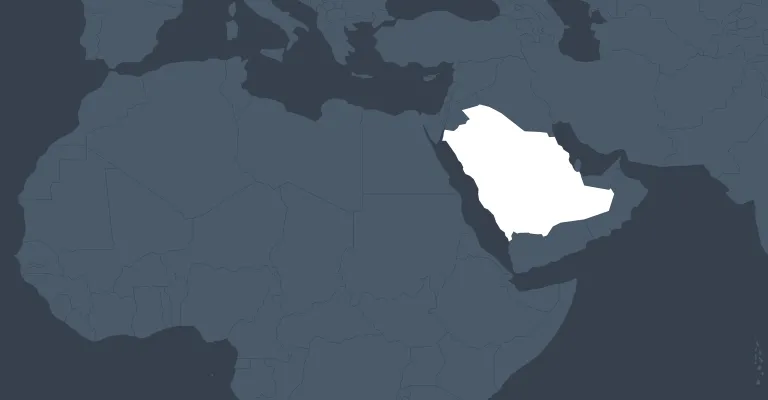


Saudi Arabia’s absolute monarchy restricts almost all political rights and civil liberties. No officials at the national level are elected. The regime relies on pervasive surveillance, the criminalization of dissent, appeals to sectarianism and ethnicity, and public spending supported by oil revenues to maintain power. Although the authorities have undertaken limited social reforms in recent years, women and members of religious minority groups still face extensive discrimination in law and in practice, and working conditions for the large expatriate labor force are often exploitative.
- In February, the government published the implementing regulations of a 2022 personal status law. The regulations granted women further discretion regarding the transfer of male guardianship in the event of negligence or injustice, for example if a father obstructs his daughter’s marital choices, and expanded women’s legal rights—and the courts’ power to support them—in divorce and child custody cases. Nevertheless, the law and the new regulations preserved the male guardianship system in general, and their practical application would still depend on a significant degree of judicial interpretation.
- The General Authority of Media Regulation issued new social media guidelines in September, banning material that could be considered bullying, mockery of others, or exposure of private family issues. The rules also restricted obscenity, indecency, displays of personal wealth, and divisive language about tribal or regional identity, among other topics. While dozens of imprisoned social media users and rights activists had been freed between December 2024 and February 2025, some faced travel bans and other restrictions after their release, and arrests or arbitrary detentions of other individuals in connection with their peaceful speech or activism continued during the year.
- The authorities executed a record number of people for the second consecutive year in 2025, putting at least 356 people to death, compared with 345 in 2024 and 170 in 2023. The cases generally lacked due process protections, and many of those executed were foreign nationals convicted of nonlethal drug-related offenses. In addition, at least two men were executed for offenses related to their participation in protests and demonstrations when they were still minors.
- Over the course of the year, the government continued efforts to reform and digitize labor governance as a means of increasing transparency and supporting workers’ rights. Among other changes, it replaced employer sponsorship (kafala) of migrant worker visas with a system of contract-based employment; required electronic rather than cash payments, including for domestic workers, via approved platforms; and mandated the digital recording of private-sector employment contracts on government portals to ensure compliance with contractual obligations. Despite such reforms, reports of migrant workers being denied their wages persisted, including on major state-backed construction projects.
This report has been abridged for Freedom in the World 2026 due to ongoing budget constraints. Freedom in the World is entirely funded by nongovernmental sources such as private foundations, corporations, and individuals like you. Please consider making a donation to support future editions of this vital resource.
For additional background information, see the reports from the 2024 and 2025 editions of Freedom in the World.
A1
1.00-4.00 pts0-4 pts
| Was the current head of government or other chief national authority elected through free and fair elections? | 0.000 4.004 |
A2
1.00-4.00 pts0-4 pts
| Were the current national legislative representatives elected through free and fair elections? | 0.000 4.004 |
A3
1.00-4.00 pts0-4 pts
| Are the electoral laws and framework fair, and are they implemented impartially by the relevant election management bodies? | 0.000 4.004 |
B1
1.00-4.00 pts0-4 pts
| Do the people have the right to organize in different political parties or other competitive political groupings of their choice, and is the system free of undue obstacles to the rise and fall of these competing parties or groupings? | 0.000 4.004 |
B2
1.00-4.00 pts0-4 pts
| Is there a realistic opportunity for the opposition to increase its support or gain power through elections? | 0.000 4.004 |
B3
1.00-4.00 pts0-4 pts
| Are the people’s political choices free from domination by forces that are external to the political sphere, or by political forces that employ extrapolitical means? | 0.000 4.004 |
B4
1.00-4.00 pts0-4 pts
| Do various segments of the population (including ethnic, racial, religious, gender, LGBT+, and other relevant groups) have full political rights and electoral opportunities? | 0.000 4.004 |
C1
1.00-4.00 pts0-4 pts
| Do the freely elected head of government and national legislative representatives determine the policies of the government? | 0.000 4.004 |
C2
1.00-4.00 pts0-4 pts
| Are safeguards against official corruption strong and effective? | 1.001 4.004 |
C3
1.00-4.00 pts0-4 pts
| Does the government operate with openness and transparency? | 0.000 4.004 |
D1
1.00-4.00 pts0-4 pts
| Are there free and independent media? | 0.000 4.004 |
D2
1.00-4.00 pts0-4 pts
| Are individuals free to practice and express their religious faith or nonbelief in public and private? | 0.000 4.004 |
D3
1.00-4.00 pts0-4 pts
| Is there academic freedom, and is the educational system free from extensive political indoctrination? | 1.001 4.004 |
D4
1.00-4.00 pts0-4 pts
| Are individuals free to express their personal views on political or other sensitive topics without fear of surveillance or retribution? | 1.001 4.004 |
E1
1.00-4.00 pts0-4 pts
| Is there freedom of assembly? | 0.000 4.004 |
E2
1.00-4.00 pts0-4 pts
| Is there freedom for nongovernmental organizations, particularly those that are engaged in human rights– and governance-related work? | 0.000 4.004 |
E3
1.00-4.00 pts0-4 pts
| Is there freedom for trade unions and similar professional or labor organizations? | 0.000 4.004 |
F1
1.00-4.00 pts0-4 pts
| Is there an independent judiciary? | 1.001 4.004 |
F2
1.00-4.00 pts0-4 pts
| Does due process prevail in civil and criminal matters? | 1.001 4.004 |
F3
1.00-4.00 pts0-4 pts
| Is there protection from the illegitimate use of physical force and freedom from war and insurgencies? | 0.000 4.004 |
F4
1.00-4.00 pts0-4 pts
| Do laws, policies, and practices guarantee equal treatment of various segments of the population? | 1.001 4.004 |
G1
1.00-4.00 pts0-4 pts
| Do individuals enjoy freedom of movement, including the ability to change their place of residence, employment, or education? | 1.001 4.004 |
G2
1.00-4.00 pts0-4 pts
| Are individuals able to exercise the right to own property and establish private businesses without undue interference from state or nonstate actors? | 1.001 4.004 |
G3
1.00-4.00 pts0-4 pts
| Do individuals enjoy personal social freedoms, including choice of marriage partner and size of family, protection from domestic violence, and control over appearance? | 0.000 4.004 |
G4
1.00-4.00 pts0-4 pts
| Do individuals enjoy equality of opportunity and freedom from economic exploitation? | 1.001 4.004 |


Country Facts
-
Population
36,410,000 -
Global Freedom Score
9 100 not free -
Internet Freedom Score
25 100 not free
