

Tunisia
Partly Free
42
100
| PR Political Rights | 11 40 |
| CL Civil Liberties | 31 60 |
Last Year's Score & Status
44
100
Partly Free
A country or territory’s Freedom in the World status depends on its aggregate Political Rights score, on a scale of 0–40, and its aggregate Civil Liberties score, on a scale of 0–60.
See the methodology.
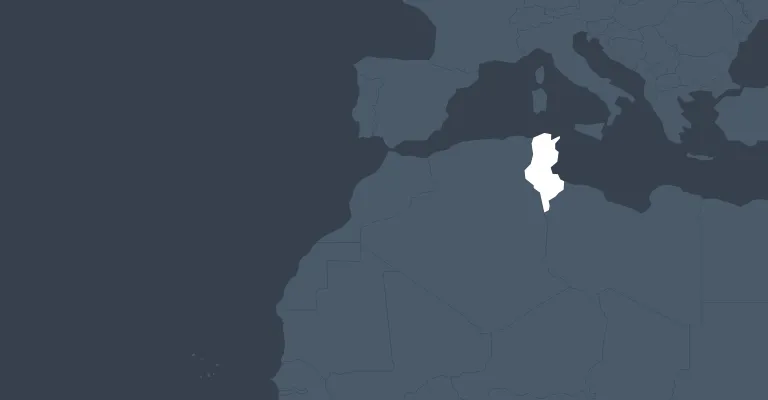


After the ouster of a longtime autocrat in 2011, Tunisia held a series of free multiparty elections, and citizens enjoyed considerable political rights and civil liberties under a constitution promulgated in 2014. However, corruption, economic challenges, security threats, and unresolved problems related to gender equality and transitional justice remained obstacles to full democratic consolidation. Following his election in 2019, President Kaïs Saïed worked to transform the political system and expand his own executive authority. In 2021, Saïed invoked emergency powers and unilaterally dismissed the legislature and the prime minister. Since then, his administration has undermined Tunisia’s other institutions, including the judiciary and the electoral commission, and engaged in campaigns of legal persecution against his opponents.
- The authorities’ attempts to eliminate dissent continued during the year, with dozens of opposition politicians and civil society figures subjected to mass trials on vague security-related charges under the penal code and a 2015 counterterrorism law. A court sentenced one group of 37 people to heavy prison terms in April, and these were largely upheld on appeal in November, with the harshest sentence set at 45 years in prison. In a second mass trial, a group of 21 people were sentenced in July to between 12 and 35 years in prison; appeals in that case were pending at year’s end. Both proceedings featured numerous violations of due process; a number of defendants had fled abroad and were tried in absentia, while others were held in pretrial detention beyond the 14-month maximum allowed by law. Some defense lawyers involved in the cases had been detained and sentenced to prison themselves.
- The government took additional steps to reduce transparency, control media coverage, and suppress critical speech. The National Authority for Access to information (INAI), which had been established in 2017 as part of the country’s democratic reforms, was disbanded and closed in August. Journalists continued to encounter harassment and the threat of jail time in response to their work, and two broadcast journalists who had been arrested for their critical commentary in May 2024 remained in prison at year’s end. In October, a social media user was sentenced to death for nonviolent posts that called for protests and the release of political prisoners; he had been held in pretrial detention since early 2024, and received a presidential pardon after his sentencing.
- Despite the growing risks associated with public demonstrations, Tunisians participated in multiple antigovernment protests during the year, and the Tunisian General Labor Union (UGTT) organized a major rally in August amid escalating state pressure on the historically influential group. In December, the UGTT announced plans for a general strike in January 2026, but internal divisions over its leadership left the plans in doubt at year’s end.
- As in previous years, Tunisian authorities arbitrarily expelled thousands of migrants from sub-Saharan African countries, and used harassment and service restrictions to compel others to seek repatriation. Civic groups, including those that provided support to migrants and refugees, faced regulatory harassment and the threat of suspension or criminal charges.
This report has been abridged for Freedom in the World 2026 due to ongoing budget constraints. Freedom in the World is entirely funded by nongovernmental sources such as private foundations, corporations, and individuals like you. Please consider making a donation to support future editions of this vital resource.
For additional background information, see the reports from the 2024 and 2025 editions of Freedom in the World.
A1
1.00-4.00 pts0-4 pts
| Was the current head of government or other chief national authority elected through free and fair elections? | 0.000 4.004 |
A2
1.00-4.00 pts0-4 pts
| Were the current national legislative representatives elected through free and fair elections? | 1.001 4.004 |
A3
1.00-4.00 pts0-4 pts
| Are the electoral laws and framework fair, and are they implemented impartially by the relevant election management bodies? | 1.001 4.004 |
B1
1.00-4.00 pts0-4 pts
| Do the people have the right to organize in different political parties or other competitive political groupings of their choice, and is the system free of undue obstacles to the rise and fall of these competing parties or groupings? | 1.001 4.004 |
B2
1.00-4.00 pts0-4 pts
| Is there a realistic opportunity for the opposition to increase its support or gain power through elections? | 0.000 4.004 |
B3
1.00-4.00 pts0-4 pts
| Are the people’s political choices free from domination by forces that are external to the political sphere, or by political forces that employ extrapolitical means? | 3.003 4.004 |
B4
1.00-4.00 pts0-4 pts
| Do various segments of the population (including ethnic, racial, religious, gender, LGBT+, and other relevant groups) have full political rights and electoral opportunities? | 2.002 4.004 |
C1
1.00-4.00 pts0-4 pts
| Do the freely elected head of government and national legislative representatives determine the policies of the government? | 1.001 4.004 |
C2
1.00-4.00 pts0-4 pts
| Are safeguards against official corruption strong and effective? | 1.001 4.004 |
C3
1.00-4.00 pts0-4 pts
| Does the government operate with openness and transparency? | 1.001 4.004 |
D1
1.00-4.00 pts0-4 pts
| Are there free and independent media? | 1.001 4.004 |
D2
1.00-4.00 pts0-4 pts
| Are individuals free to practice and express their religious faith or nonbelief in public and private? | 3.003 4.004 |
D3
1.00-4.00 pts0-4 pts
| Is there academic freedom, and is the educational system free from extensive political indoctrination? | 3.003 4.004 |
D4
1.00-4.00 pts0-4 pts
| Are individuals free to express their personal views on political or other sensitive topics without fear of surveillance or retribution? | 2.002 4.004 |
E1
1.00-4.00 pts0-4 pts
| Is there freedom of assembly? | 2.002 4.004 |
E2
1.00-4.00 pts0-4 pts
| Is there freedom for nongovernmental organizations, particularly those that are engaged in human rights– and governance-related work? | 2.002 4.004 |
E3
1.00-4.00 pts0-4 pts
| Is there freedom for trade unions and similar professional or labor organizations? | 3.003 4.004 |
F1
1.00-4.00 pts0-4 pts
| Is there an independent judiciary? | 1.001 4.004 |
F2
1.00-4.00 pts0-4 pts
| Does due process prevail in civil and criminal matters? | 1.001 4.004 |
Score Change: The score declined from 2 to 1 because due process protections have been limited under a long-running state of emergency, defense attorneys have faced charges for their work on politicized trials, and military courts have increasingly been used in recent years to try civilians who criticize the government or the army.
F3
1.00-4.00 pts0-4 pts
| Is there protection from the illegitimate use of physical force and freedom from war and insurgencies? | 2.002 4.004 |
Score Change: The score declined from 3 to 2 due to increased reports of mistreatment and torture in prisons and detention centers, including numerous cases of suspicious deaths in custody in recent years.
F4
1.00-4.00 pts0-4 pts
| Do laws, policies, and practices guarantee equal treatment of various segments of the population? | 1.001 4.004 |
G1
1.00-4.00 pts0-4 pts
| Do individuals enjoy freedom of movement, including the ability to change their place of residence, employment, or education? | 3.003 4.004 |
G2
1.00-4.00 pts0-4 pts
| Are individuals able to exercise the right to own property and establish private businesses without undue interference from state or nonstate actors? | 2.002 4.004 |
G3
1.00-4.00 pts0-4 pts
| Do individuals enjoy personal social freedoms, including choice of marriage partner and size of family, protection from domestic violence, and control over appearance? | 3.003 4.004 |
G4
1.00-4.00 pts0-4 pts
| Do individuals enjoy equality of opportunity and freedom from economic exploitation? | 2.002 4.004 |


Country Facts
-
Population
12,360,000 -
Global Freedom Score
42 100 partly free -
Internet Freedom Score
59 100 partly free
