


Perspectives July 30, 2026
Freedom In Focus: Elections Abolished in Nicaragua
Freedom House has been in the media explaining what Daniel Ortega’s announcement means.
Written By
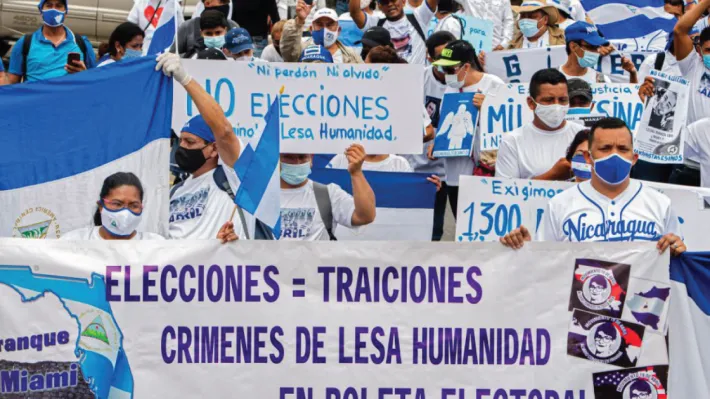
Nicaraguans living in Costa Rica protest against the government of Nicaraguan President Daniel Ortega in 2021. (Photo: Ezequiel Becerra/AFP via Getty Images)
On July 19, during a ceremony commemorating the 47th anniversary of the Sandinista Revolution, Daniel Ortega boldly declared the elimination of elections in Nicaragua, saying, “Forget it; there won't be elections here again.” Referring to the opposition and other regime critics, the 80-year-old dictator asserted that they would never again have the opportunity to take control of the government and “seize power.”
Freedom House has closely tracked Nicaragua’s transition from a fragile democracy to an outright autocracy under Ortega’s authoritarian rule. Freedom in the World data shows that the country had the second-largest deterioration in political rights and civil liberties since 2005, declining by a staggering 49 points on the survey’s 100-point scale. In light of Ortega’s announcement, Freedom House’s experts and analysis were called on to help explain what’s at stake.
In El País, Freedom House President Gerardo Berthin said that with the announcement, the regime led by Ortega and his wife and now “co-president” Rosario Murillo not only institutionalized dictatorship but moved Nicaragua closer to a North Korea model, formalizing a kleptocratic state where the family uses political power to extract public resources for their own personal and dynastic benefit.
For Reuters, Nicaraguan democracy advocate, opposition leader, and Freedom House Board member Félix Maradiaga described Ortega’s motivations as not a display of power, but “a confession of fear.” In the Washington Post Maradiaga asked why—if Ortega truly felt secure in his power—he would resort to canceling elections. For Canada’s CBC, he observed that “Ortega is afraid, not only of the opposition, but he’s afraid of the will of the people.”
The Economist turned to Freedom House’s analysis to explain how Ortega dismantled “every institution that could challenge him.”
And, Newsweek cited Freedom House’s research on how Ortega captured the judicial system to persecute opposition figures and even to shutter entire opposition parties that spoke out against him.
For much of the prodemocracy opposition and human rights movement, Ortega’s declaration represents the culmination of a deliberate, years-long campaign to eliminate freedom, political and civil rights, and independent institutions. It defies the principles of representative democracy to which the Nicaraguan people aspire for and serves only to further entrench authoritarian rule. If there was ever a moment for the international community to rally behind Nicaragua’s prodemocracy movement and exert sustained diplomatic pressure, that moment is now.
The international community must demand the restoration of the political and civil rights of the Nicaraguan people, including their right to freely and fairly elect their government. The Ortega-Murillo regime should not be recognized as a legitimate democratic authority. Any regional and global diplomatic engagement, financial dealings with banks, or commercial relationship should be conditioned on concrete steps toward restoring free and fair elections and guaranteeing the fundamental rights of all Nicaraguans.