

Nicaragua
Not Free
14
100
| PR Political Rights | 2 40 |
| CL Civil Liberties | 12 60 |
Last Year's Score & Status
14
100
Not Free
A country or territory’s Freedom in the World status depends on its aggregate Political Rights score, on a scale of 0–40, and its aggregate Civil Liberties score, on a scale of 0–60.
See the methodology.
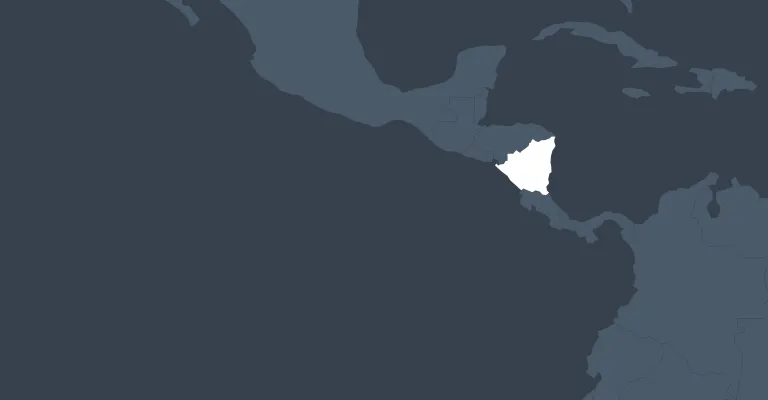


The 2006 election of Sandinista leader Daniel Ortega began a period of democratic deterioration marked by the consolidation of all branches of government under his party’s control, the limitation of fundamental freedoms, and unchecked corruption in government. In 2018, state forces, with the aid of informally allied armed groups, responded to a mass antigovernment movement with violence and repression. The rule of law collapsed as the government moved to put down the movement, with rights monitors reporting killings, extrajudicial detentions, disappearances, and torture. Since then, Ortega’s regime has consolidated its power by engaging in surveillance, curtailing press freedoms, arresting political opponents, sending opposing voices into exile, and stripping away their citizenship.
- In January, the National Assembly unanimously approved constitutional reforms that granted expansive powers to the executive branch. The reforms stipulated that the presidency “coordinates” legislative, judicial, electoral, and oversight bodies, as well as the national police. The package made President Daniel Ortega and his wife, Vice President Rosario Murillo, “copresidents,” and extended their terms to six years from five previously, allowing them to remain in office until January 2028. The changes prompted criticism from the United Nations, the Organization of American States (OAS), the United States, the European Parliament, and Nicaraguan dissidents.
- The Ortega-Murillo regime continued to assert control over media, civil society, and academia. In March, the independent outlet El Confidencial reported that the regime had shut down or confiscated at least 61 national media outlets since 2007, had stripped 25 journalists of their citizenship, forced 283 into exile, and had imprisoned 15, 4 of whom remained in detention. The regime had additionally rescinded the legal status of more than 5,670 nongovernmental organizations (NGOs) since 2018, according to government documents released during the year. In May, the regime closed the Consejo Nacional de Evaluación y Acreditación, which was responsible for accrediting universities, and passed its functions to a new office led by a government loyalist.
- Authorities continued to crack down on religious freedom including through surveillance of clergy, the confiscation of church properties, and prohibition of religious processions, including Easter processions, which were effectively banned during the year. In September, the NGO Nicaragua Never Again reported that the regime had expelled at least 261 religious figures and closed 1,294 religious organizations since 2018.
- The NGO Monitoreo Azul y Blanco reported in February that 349 Nicaraguans had experienced “migratory repression” between January 2024 and February 2025—meaning they had been expelled, denied passport renewal, or prohibited from leaving the country. In May, the National Assembly voted to ban dual citizenship.
- In August, the National Assembly passed the Border Territory Law, which designated all territory, buildings, and bodies of water located within 15 kilometers (9 miles) of the country’s borders as state property. Analysts said the law revoked legal protections for Indigenous lands and other protected areas.
This report has been abridged for Freedom in the World 2026 due to ongoing budget constraints. Freedom in the World is entirely funded by nongovernmental sources such as private foundations, corporations, and individuals like you. Please consider making a donation to support future editions of this vital resource.
For additional background information, see last year’s full report.
A1
1.00-4.00 pts0-4 pts
| Was the current head of government or other chief national authority elected through free and fair elections? | 0.000 4.004 |
A2
1.00-4.00 pts0-4 pts
| Were the current national legislative representatives elected through free and fair elections? | 0.000 4.004 |
A3
1.00-4.00 pts0-4 pts
| Are the electoral laws and framework fair, and are they implemented impartially by the relevant election management bodies? | 0.000 4.004 |
B1
1.00-4.00 pts0-4 pts
| Do the people have the right to organize in different political parties or other competitive political groupings of their choice, and is the system free of undue obstacles to the rise and fall of these competing parties or groupings? | 0.000 4.004 |
B2
1.00-4.00 pts0-4 pts
| Is there a realistic opportunity for the opposition to increase its support or gain power through elections? | 0.000 4.004 |
B3
1.00-4.00 pts0-4 pts
| Are the people’s political choices free from domination by forces that are external to the political sphere, or by political forces that employ extrapolitical means? | 0.000 4.004 |
B4
1.00-4.00 pts0-4 pts
| Do various segments of the population (including ethnic, racial, religious, gender, LGBT+, and other relevant groups) have full political rights and electoral opportunities? | 1.001 4.004 |
C1
1.00-4.00 pts0-4 pts
| Do the freely elected head of government and national legislative representatives determine the policies of the government? | 0.000 4.004 |
C2
1.00-4.00 pts0-4 pts
| Are safeguards against official corruption strong and effective? | 0.000 4.004 |
C3
1.00-4.00 pts0-4 pts
| Does the government operate with openness and transparency? | 1.001 4.004 |
D1
1.00-4.00 pts0-4 pts
| Are there free and independent media? | 0.000 4.004 |
D2
1.00-4.00 pts0-4 pts
| Are individuals free to practice and express their religious faith or nonbelief in public and private? | 1.001 4.004 |
D3
1.00-4.00 pts0-4 pts
| Is there academic freedom, and is the educational system free from extensive political indoctrination? | 1.001 4.004 |
D4
1.00-4.00 pts0-4 pts
| Are individuals free to express their personal views on political or other sensitive topics without fear of surveillance or retribution? | 0.000 4.004 |
E1
1.00-4.00 pts0-4 pts
| Is there freedom of assembly? | 0.000 4.004 |
E2
1.00-4.00 pts0-4 pts
| Is there freedom for nongovernmental organizations, particularly those that are engaged in human rights– and governance-related work? | 0.000 4.004 |
E3
1.00-4.00 pts0-4 pts
| Is there freedom for trade unions and similar professional or labor organizations? | 2.002 4.004 |
F1
1.00-4.00 pts0-4 pts
| Is there an independent judiciary? | 0.000 4.004 |
F2
1.00-4.00 pts0-4 pts
| Does due process prevail in civil and criminal matters? | 0.000 4.004 |
F3
1.00-4.00 pts0-4 pts
| Is there protection from the illegitimate use of physical force and freedom from war and insurgencies? | 1.001 4.004 |
F4
1.00-4.00 pts0-4 pts
| Do laws, policies, and practices guarantee equal treatment of various segments of the population? | 1.001 4.004 |
G1
1.00-4.00 pts0-4 pts
| Do individuals enjoy freedom of movement, including the ability to change their place of residence, employment, or education? | 1.001 4.004 |
G2
1.00-4.00 pts0-4 pts
| Are individuals able to exercise the right to own property and establish private businesses without undue interference from state or nonstate actors? | 1.001 4.004 |
G3
1.00-4.00 pts0-4 pts
| Do individuals enjoy personal social freedoms, including choice of marriage partner and size of family, protection from domestic violence, and control over appearance? | 2.002 4.004 |
G4
1.00-4.00 pts0-4 pts
| Do individuals enjoy equality of opportunity and freedom from economic exploitation? | 2.002 4.004 |


Country Facts
-
Population
6,948,000 -
Global Freedom Score
14 100 not free -
Internet Freedom Score
38 100 not free
