



Perspectives September 17, 2026
The CCP is Trying—and Failing—to Extinguish Defiance among Chinese Citizens
People across China persistently express discontent through “lying flat” and public protest.
Written By
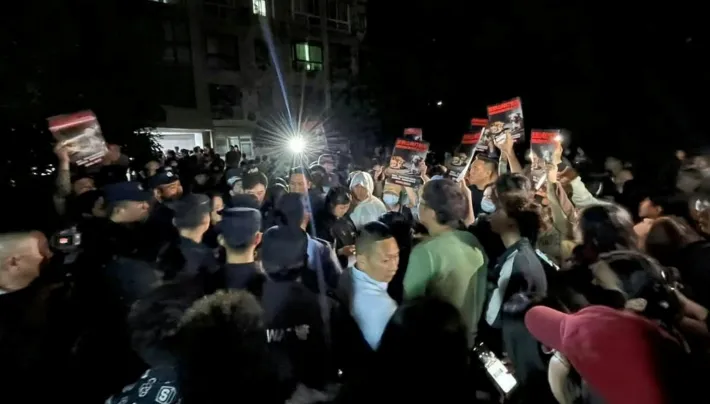
Demonstrators in Chongqing protest animal abuse with large numbers of police on the scene (Photo Credit: HK01).
Recent propaganda and censorship efforts by the Chinese Communist Party (CCP) have revealed an urgent desire among party leadership to blunt a spirit of defiance within Chinese society. Despite the party’s attempts to curb dissent, however, China’s citizens continue to defy authority, as evidenced by recent findings of Freedom House’s China Dissent Monitor (CDM).
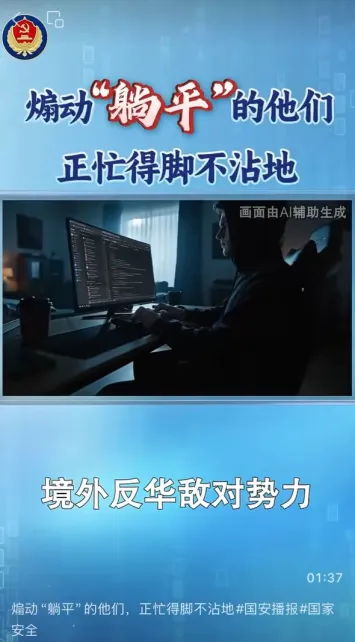
Earlier this year, China’s Ministry of State Security (MSS) conducted a campaign that blamed “foreign forces” for funding the spread in China of “lying flat” (躺平), a term that has become widely used to describe the rejection of societal expectations that push individuals to strive for material and social achievement. The official media attributing the trend of lying flat to foreign interference was promptly pilloried by Chinese netizens who filled online comment sections with criticism and satire. A popular vlogger sarcastically complained that he wanted to “report” foreign forces for failing to pay him despite his tireless efforts to lie flat. These responses have all since been censored.
The CCP’s seeming obsession with curbing the lying flat mindset is worth understanding. The term’s popularity rose in response to China’s grueling “996” work culture, in which many companies expect their employees to work from 9 a.m. to 9 p.m. for 6 days each week. But as the concept of lying flat has expanded, the CCP has become worried that it reflects an underlying resistance to the party’s designs for Chinese people, and that an increasing number of citizens simply don’t care about or support the idea of working harder to contribute to a more powerful state. The Communist Party’s leader Xi Jinping has explicitly spoken out against the lying flat attitude.
Responding to discontent with censorship
The issue of popular indifference to nationalist goals has gained greater urgency for the CCP as a persistently sluggish domestic economy has fueled the popularity of lying flat and other forms of societal opposition, including protests. The CDM project has documented a rise in public protests, many of which have been driven by economic grievances like unpaid wages, unfinished housing, or land confiscation. While the CCP has long been concerned with preventing public mobilization, which it euphemistically calls “maintaining social stability,” new directives to strengthen community surveillance and prevent large numbers of migrant workers from “idling in their hometowns” reveal a growing anxiety that the spread of discontent is fueling more dissent.
The CCP’s concerns over popular discontent have also led to intensified censorship efforts. In February, the Cyberspace Administration of China ordered that social media platforms take down and reduce the visibility of content that “incites negative feelings.” In its most recent report, CDM found that the censorship campaign resulted in a significant decrease in information about protests published on Douyin (the Chinese version of TikTok). A CDM analysis of nearly 3,000 Douyin posts about protest showed that two-thirds had been deleted, with higher rates for those about protests that were likely to involve government malfeasance. An earlier CDM analysis of 4,000 posts from Sina Weibo (a microblogging platform) found that those expressing dissent against powerful actors, even if they were not government actors, were more likely to be taken down.
Repression falls short
One aim of these propaganda and censorship campaigns is to suppress the sense among citizens that defiance is commonplace, whether through lying flat or public demonstration. The strategy may be effective in reducing the virality of dissent and preventing some localized protests from morphing into larger movements by keeping people in the dark. However, it has failed to eliminate a spirit of opposition that China’s citizens continue to exhibit.
As shown by the most recent CDM report, citizens sometimes even mobilize more quickly in response to government efforts to silence them. In June, peaceful protests sparked by an animal abuse case in Chongqing developed into a large demonstration lasting four days, with a number of protesters joining in defiance after police detained some of the participants on the first day. In August 2025, a violent school bullying case in Jiangyou, Sichuan Province, led hundreds to gather in front of a city government building to demand an adequate official response. When that protest was met with a police crackdown, thousands more took to the streets, with some protesters even recorded chanting “give us back democracy.”
This spirit of defiance is also apparent in residential neighborhoods across China, where disputes between homeowners and property management companies over fees and misconduct have led to rising numbers of protest events. Residents have increasingly self-organized to achieve greater autonomy in their communities, sometimes using grassroots elections to form owners’ committees and oust the management companies. Residents persist in these activities despite joint efforts by local governments and property firms to interfere with or suppress their organizing.
Defiance endures
Such opposition to authority is common in China. CDM has recorded more than 16,000 protests since June 2022, occurring in every region of the country. In 2025, CDM documented 5,343 dissent events, the highest annual number of protests recorded by the project, marking a 44 percent rise over the previous year. While typically sparked by economic grievances, many events are also driven by issues like school safety, environmental causes, or official misconduct. At least a third of protests are directed at the government or other state actors.
Through media controls, the CCP attempts to restrict citizens’ ability to grasp the extent of lying flat and public protests in China, but it fails to fundamentally alter the spirit of defiance that so many of the country’s citizens possess. International actors—especially those with large public platforms—can help by amplifying the everyday protest of people in China who are acting in defiance of a party-state that seeks to silence them.
