


Policy Brief July 2, 2026
Cuba at a Breaking Point: Why This Moment Requires Holding the Line On Human Rights
Democratic governments should support Cubans’ fundamental rights—or risk allowing the country’s repressive regime to adapt and survive while the Cuban people remain in dire straits.
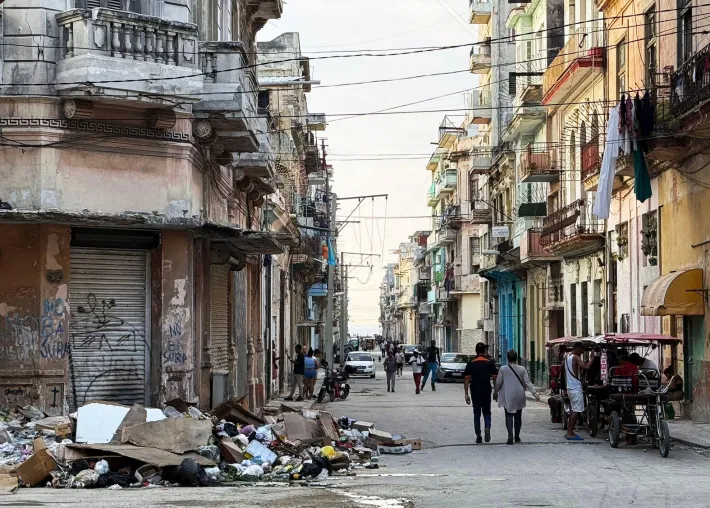
Garbage is seen uncollected on a street in Havana, Cuba during a severe energy crisis throughout the country. (Photo credit: Paul Hennessy/SOPA Images via ZUMA Press Wire)
By Katie Turner, Program Manager, Latin American & the Caribbean
Cuba has faced economic crises before. This time, it is different.
Over the past five years, roughly a quarter of the Cuban population has left, reflecting a profound loss of confidence in the country’s future. Those who remain face severe shortages of food, medicine, fuel, and electricity. Blackouts are routine. Hospitals lack supplies. Meeting basic needs requires constant improvisation.
This is not a temporary downturn. It reflects decades of centralized state control and repressive governance, including suffocating restrictions on political, civic, and economic life under Cuba’s unaccountable authoritarian regime. During past crises, the government was able to mitigate pressure through external support, including from governments in Russia, Venezuela, and China. That model has now broken down.
US measures imposed against the Cuban regime in 2026 tightened constraints on fuel imports and access to hard currency, accelerating nationwide shortages of basic supplies and disruptions across key sectors including electricity generation and tourism. At the same time, long-standing inefficiencies in production and distribution, combined with deep-rooted economic mismanagement, have been exposed. The state can no longer shield the population from the consequences of its corrupt governance. The regime’s traditional external backers have scaled back their support or shifted priorities, leaving Havana with fewer lifelines and diminishing prospects of much-needed relief.
Conditions are not only the result of economic strain. They reflect an entrenched system designed to tightly control how Cuban citizens respond to crisis. For decades, the regime has restricted independent civic action, limiting the ability of individuals and communities to organize relief, report shortages, or mobilize support in times of need. Amid today’s crisis these constraints have become even more severe: security forces, pervasive surveillance, and penalties for dissent deter people from sharing information or coordinating aid, even as shortages deepen. As needs grow, opportunities to address them remain constrained, and human suffering increases.
This is a moment for the Cuban people’s democratic allies to remain firm, and to act decisively and without delay. While international governments have begun to recalibrate their policies toward Cuba, without sustained pressure to improve human rights and accountability the regime will adapt once again without delivering meaningful improvements.
Maintaining control
Power in Cuba is distributed across the Communist Party leadership, security services, military-linked economic structures, and Raúl Castro and his inner circle. Military-linked business conglomerates, particularly the Grupo de Administración Empresarial SA (GAESA), dominate key economic sectors with minimal transparency, concentrating revenue and diverting billions in foreign-currency earnings into channels that do not translate into public services or critical infrastructure. This concentration of economic power also enables the regime to capture the benefits of external investment, remittances, tourism revenue, and humanitarian assistance, reinforcing its tight economic and political control.
Repression remains central. As of June 2026, more than 1,280 political prisoners remain detained in Cuba, despite release announcements including several in 2026 that coincided with US negotiations. These are not signs of reform, but part of a pattern in which political prisoners are leveraged as bargaining chips while the system itself and the humanitarian conditions facing ordinary Cubans remain unchanged.
Meanwhile, public discontent is rising. Those expressing grievances face detention, surveillance, intimidation, imprisonment, and forced exile. Independent organizations like Cubalex, the Observatorio Cubano de Derechos Humanos, and Justicia 11J continue to document these patterns. Repression also extends abroad, with activists and journalists facing harassment beyond Cuba’s borders, reportedly including inside the United States.
At the same time, opaque governance enables continued engagement with US adversaries like the governments of Russia and China, carrying broader implications for hemispheric geopolitical stability and security.
These dynamics show that external policy by democratic governments, whether based on pressure or engagement aiming to promote economic conditions and human rights, can no longer rely on assumptions of gradual reform. Without up-front demands for accountability, transparency, and respect for fundamental rights, policies risk reinforcing Cuba’s repressive system.
A divided international response
Cuba’s economic and political crisis has prompted shifts in its international relations, but the responses remain divided.
In May 2026, citing limited progress on human rights and governance, the European Union placed its cooperation agreement with Cuba under review, threatening to scale back political dialogue and development cooperation. In June, the European Parliament adopted a resolution calling for sanctions, the release of political prisoners, and a reevaluation of engagement absent concrete human rights progress. The United States has maintained its long-standing embargo but significantly increased pressure in ways not seen before: tightening sanctions, targeting fuel supplies, and further restricting financial flows into the country.
Across Latin America, divisions are growing. Governments in Brazil and Mexico emphasize dialog and humanitarian engagement, maintaining that Cuba’s crisis should be addressed through cooperation and respect for Cuba’s sovereignty. Others are recalibrating more sharply. In March 2026, Costa Rican authorities suspended diplomatic recognition of the Cuban government and closed the country’s embassy in Havana, citing repression and human rights abuses.
This fragmentation creates an opening the Cuban government knows how to exploit. It has repeatedly shown that it can adapt and make selective concessions to maintain control. Without clear, shared goals among democracies for transparency, accountability, and measurable human rights improvements, external involvement risks feeding Cuban authorities’ cycle of repression and misrule rather than improving daily realities and alleviating the humanitarian suffering of the Cuban people.
What must happen next
The conditions that sustained Cuba’s system are broken, but reform will not happen on its own.
While independent Cuban civil society has already begun to articulate proposals for achieving democratic change, there are concrete steps that the United States and other democracies can take to help support these actors, restore the rule of law, and stand with the Cuban people in their pursuit of justice, accountability, and the opportunity to determine their own future. At a minimum, when crafting policy, they should prioritize the following results, with the ultimate measure of success being whether policies expand fundamental freedoms, address the immediate humanitarian crisis, and improve the daily lives of the Cuban people.
Securing the release of political prisoners and restoration of fundamental rights. The unconditional release of all Cuban political prisoners and the restoration of free expression and civic space must come first. Support should be extended to political prisoners and their families following release, including assistance that addresses immediate needs and reintegration support. Moving forward, international actors should prioritize the restoration and protection of fundamental rights and ending repression by conditioning engagement on repealing laws that criminalize dissent, establishing legal safeguards for free expression, association, and peaceful assembly, and enabling independent monitoring, which includes granting organizations like the International Committee of the Red Cross (ICRC) access to detention facilities.
Increasing transparency and accountability. The Cuban regime’s centralized control enables authorities to divert resources away from the Cuban people and into their own pockets. In the near term, any humanitarian assistance should be sent through channels that reach people directly, including trusted civil society networks, rather than through state-controlled systems. Looking ahead, international donors should require independent audits and public reporting by state-controlled entities to ensure transparency. Over time, policy should prioritize the separation of military institutions from commercial activity, increased civilian oversight, and redirection of investment toward essential services, including electricity, water, food production, health care, transportation, and housing.
Supporting Cuban civil society and independent media. Independent Cuban civil society must be included in consultations, implementation, and oversight of international initiatives. In time, durable progress will depend on structural change and social repair. Independent media and civil society are critical to documentation and other efforts that strengthen accountability and future reform, and democratic governments should support them.
Conditioning regime engagement. Any engagement with the regime should be tied to measurable human rights benchmarks, with targeted sanctions reinforcing accountability for repression and corruption.
This is not the moment to pull back
Something irreversible is underway in Cuba. The conditions that once allowed the system to endure are no longer intact.
The path forward remains uncertain, but the implications are clear. This is a moment to stay firm on human rights and governance issues. Pulling back now would reduce pressure on the regime at a consequential moment. Sustained focus on the humanitarian crisis and on human rights and accountability offers the clearest path to real improvement in daily life for Cubans, and the chance for them to pursue their own democratic aspirations.