


Perspectives October 29, 2026
The Cuban Regime Didn't Just Interrupt a UN Event. It Validated Its Own Central Premise.
An altercation at the United Nations last week showed in public what people in Cuba live with every day: a government that answers dissent by trying to crush it.
Written By
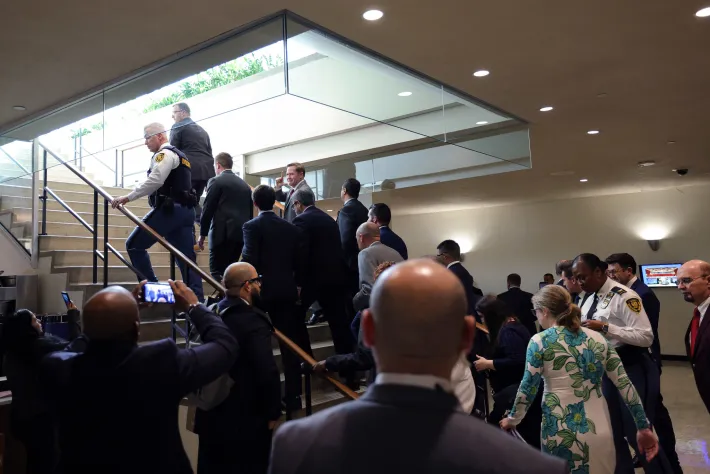
US Ambassador to the UN Mike Waltz reacts to Cuban diplomats following the Cuba Libre event. (Photo Credit: US Mission to the United Nations)
At a United Nations event last week, the Cuban regime proved its critics right.
On October 19, diplomats, UN officials, and journalists gathered in New York to hear directly from brave Cubans whose lives have been shaped by political imprisonment, censorship, forced exile, and repression. They came to discuss what happens in Cuba when citizens peacefully exercise their fundamental rights.
By the end of the event, they had their answer.
What unfolded at the United Nations was instantly recognizable to many Cubans. Cuba's permanent representative to the UN, Ernesto Soberón Guzmán, and other government representatives crowded the entrances and hallways outside the meeting room, filming attendees, including the organizer, US Ambassador to the UN Mike Waltz, shouting accusations and branding regime critics “terrorists” and “liars.” The scene mirrored the harassment and smear campaigns that the regime has long deployed against its opponents.
Similar scenes have surfaced beyond Cuba’s borders before, including at the 2015 Summit of the Americas in Panama, where independent Cuban civil society members faced harassment, physical confrontations, and mob-style intimidation by pro-regime delegates.
What made last week’s events different is that representatives of UN member states saw the regime’s methods firsthand. As I watched the scene unfold, the irony was impossible to miss: while former political prisoners and dissidents described the regime’s tactics inside the room, representatives of the Cuban state were demonstrating them outside.
The event featured some of Cuba's most prominent independent voices. Award-winning artist Luis Manuel Otero Alcántara spoke about the cost of dissent. Opposition leader and former prisoner of conscience José Daniel Ferrer reflected on years of repression. Other experts exposed the corruption and economic structures that help sustain the regime, which has tried to blame the US embargo instead of its own malfeasance for the plight of the Cuban people.
The intimidation at the United Nations has since been followed by a sustained campaign to discredit event participants, underscoring how far the regime will go to attack those who challenge its narrative.
Yet the confrontation outside the meeting room and in the media since is only a glimpse of what the panelists described in New York last week. Luis Manuel, José Daniel, and countless other Cubans have paid a far higher price than insults and intimidation. More than 1,300 political prisoners remain in Cuba, according to Prisoners Defenders.
Independent journalists, artists, activists, and religious leaders continue to face harassment for peacefully exercising fundamental rights, while many others have been forced into exile. What has unfolded last week reflects a much broader system of repression that continues to shape daily life in Cuba and the lives of those who are now forced to live abroad.
There were reminders about the importance of speaking out on behalf of those still suffering in Cuba’s prisons. Luis Manuel movingly recounted to Amb. Waltz how news of his advocacy at a previous event at the United Nations had reached him in prison.
For decades, the Cuban regime has imprisoned dissidents, silenced independent journalists, driven critics into exile, and denied its citizens basic civil and political rights. Freedom House’s Freedom in the World report has rated Cuba Not Free every year for more than half a century, and today it receives just 9 out of 100 points, the lowest score in the Western Hemisphere.
Standing with independent Cuban civil society requires more than expressions of concern. It requires sustained support, visibility, and solidarity with those risking everything to defend fundamental freedoms.
Some of Cuba’s bravest voices came to the United Nations to tell their stories. The world should listen. And after what unfolded both inside and outside that meeting room, it should have no doubt about what is at stake. The time to stand with the Cuban people is now.