

Cuba
Not Free
9
100
| PR Political Rights | 0 40 |
| CL Civil Liberties | 9 60 |
Last Year's Score & Status
10
100
Not Free
A country or territory’s Freedom in the World status depends on its aggregate Political Rights score, on a scale of 0–40, and its aggregate Civil Liberties score, on a scale of 0–60.
See the methodology.
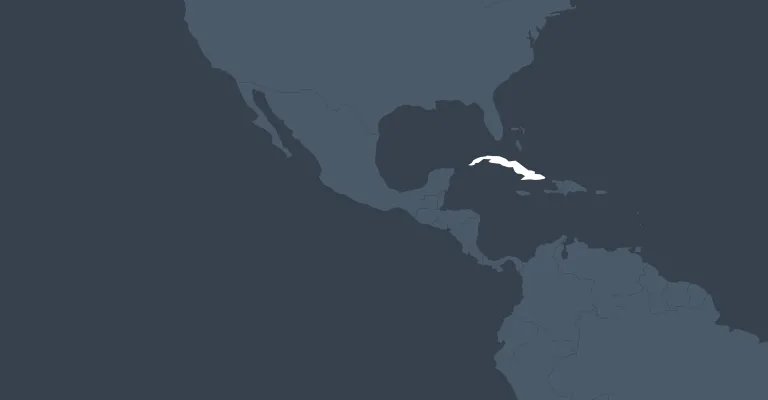


Cuba’s one-party communist state outlaws political pluralism, bans independent media, suppresses dissent, and severely restricts basic civil liberties. The government continues to dominate the economy despite recent reforms that permit private-sector activity and foreign investment. The regime’s undemocratic character has not changed since a generational transition in political leadership that started in 2018 and included the introduction of a new constitution and the gradual passage of complementary new legislation.
- In July it was reported that, for the first time in decades, the private sector had surpassed the state sector in retail sales of goods and services by value, accounting for 55 percent of such sales in 2024.
- In August, an investigative report by Miami Herald journalist Nora Gámez Torres drew on leaked Grupo de Administración Empresarial SA (GAESA) documents to allege that the military-owned conglomerate held at least $18 billion in liquid assets as of March 2024. According to the Herald, GAESA dominated large swaths of the economy, including tourism, money transfers and currency exchanges, and a special development zone, which gave it significant control over foreign currency. GAESA’s operations generally remained opaque, as it did not face oversight by the National Assembly or the Comptroller General’s Office, and the leaked financial statements themselves lacked transparency. Cuban authorities issued no direct response to the reporting, but government-run media targeted Gámez Torres with a smear campaign.
- In October, prominent dissident José Daniel Ferrer was released from prison and left Cuba for the United States, saying he had agreed to go into exile after enduring torture in detention. Ferrer and a number of other political prisoners had been conditionally released in January as part of a deal between Havana and Washington, but he and fellow dissident Félix Navarro were imprisoned again in April after the agreement fell through.
- In December, the People’s Supreme Court (TSP) sentenced Alejandro Gil Fernández, who had been dismissed as deputy prime minister and economy minister in 2024, to life in prison for espionage. He was also sentenced in a separate trial to a concurrent term of 20 years in prison for corruption offenses, including bribery, falsification of public documents, and tax evasion. Both trials were closed to the public, and in general there was little transparency around the case.
- Separately in December, Homero Acosta Álvarez resigned from his posts as a member and secretary of the National Assembly, and as a member of the Council of State, the body that exercises legislative power between the full assembly’s two brief annual sessions. Two other Council of State members also resigned. At the same assembly session, the president of the TSP, Rubén Remigio Ferro, was “released” from office. Some commentators interpreted this set of leadership changes as part of a strategic realignment within the ruling Communist Party in response to internal disagreements and growing social discontent.
This report has been abridged for Freedom in the World 2026 due to ongoing budget constraints. Freedom in the World is entirely funded by nongovernmental sources such as private foundations, corporations, and individuals like you. Please consider making a donation to support future editions of this vital resource.
For additional background information, see the reports from the 2024 and 2025 editions of Freedom in the World.
A1
1.00-4.00 pts0-4 pts
| Was the current head of government or other chief national authority elected through free and fair elections? | 0.000 4.004 |
A2
1.00-4.00 pts0-4 pts
| Were the current national legislative representatives elected through free and fair elections? | 0.000 4.004 |
A3
1.00-4.00 pts0-4 pts
| Are the electoral laws and framework fair, and are they implemented impartially by the relevant election management bodies? | 0.000 4.004 |
B1
1.00-4.00 pts0-4 pts
| Do the people have the right to organize in different political parties or other competitive political groupings of their choice, and is the system free of undue obstacles to the rise and fall of these competing parties or groupings? | 0.000 4.004 |
B2
1.00-4.00 pts0-4 pts
| Is there a realistic opportunity for the opposition to increase its support or gain power through elections? | 0.000 4.004 |
B3
1.00-4.00 pts0-4 pts
| Are the people’s political choices free from domination by forces that are external to the political sphere, or by political forces that employ extrapolitical means? | 0.000 4.004 |
B4
1.00-4.00 pts0-4 pts
| Do various segments of the population (including ethnic, racial, religious, gender, LGBT+, and other relevant groups) have full political rights and electoral opportunities? | 0.000 4.004 |
C1
1.00-4.00 pts0-4 pts
| Do the freely elected head of government and national legislative representatives determine the policies of the government? | 0.000 4.004 |
C2
1.00-4.00 pts0-4 pts
| Are safeguards against official corruption strong and effective? | 0.000 4.004 |
Score Change: The score declined from 1 to 0 due to evidence of kleptocratic practices by a powerful military-owned conglomerate and the lack of impartial investigations or fair trials to address corruption allegations.
C3
1.00-4.00 pts0-4 pts
| Does the government operate with openness and transparency? | 0.000 4.004 |
D1
1.00-4.00 pts0-4 pts
| Are there free and independent media? | 0.000 4.004 |
D2
1.00-4.00 pts0-4 pts
| Are individuals free to practice and express their religious faith or nonbelief in public and private? | 3.003 4.004 |
D3
1.00-4.00 pts0-4 pts
| Is there academic freedom, and is the educational system free from extensive political indoctrination? | 0.000 4.004 |
D4
1.00-4.00 pts0-4 pts
| Are individuals free to express their personal views on political or other sensitive topics without fear of surveillance or retribution? | 0.000 4.004 |
E1
1.00-4.00 pts0-4 pts
| Is there freedom of assembly? | 0.000 4.004 |
E2
1.00-4.00 pts0-4 pts
| Is there freedom for nongovernmental organizations, particularly those that are engaged in human rights– and governance-related work? | 0.000 4.004 |
E3
1.00-4.00 pts0-4 pts
| Is there freedom for trade unions and similar professional or labor organizations? | 0.000 4.004 |
F1
1.00-4.00 pts0-4 pts
| Is there an independent judiciary? | 0.000 4.004 |
F2
1.00-4.00 pts0-4 pts
| Does due process prevail in civil and criminal matters? | 0.000 4.004 |
F3
1.00-4.00 pts0-4 pts
| Is there protection from the illegitimate use of physical force and freedom from war and insurgencies? | 0.000 4.004 |
F4
1.00-4.00 pts0-4 pts
| Do laws, policies, and practices guarantee equal treatment of various segments of the population? | 1.001 4.004 |
G1
1.00-4.00 pts0-4 pts
| Do individuals enjoy freedom of movement, including the ability to change their place of residence, employment, or education? | 1.001 4.004 |
G2
1.00-4.00 pts0-4 pts
| Are individuals able to exercise the right to own property and establish private businesses without undue interference from state or nonstate actors? | 1.001 4.004 |
G3
1.00-4.00 pts0-4 pts
| Do individuals enjoy personal social freedoms, including choice of marriage partner and size of family, protection from domestic violence, and control over appearance? | 2.002 4.004 |
G4
1.00-4.00 pts0-4 pts
| Do individuals enjoy equality of opportunity and freedom from economic exploitation? | 1.001 4.004 |


Country Facts
-
Population
11,210,000 -
Global Freedom Score
9 100 not free -
Internet Freedom Score
21 100 not free
