


Seismic Shifts on the Global Internet
The shape of the internet is changing, as governments across the ideological spectrum erect new barriers to how people access information and express themselves online.

Press release June 2, 2022
There were at least 735 direct, physical incidents of transnational repression between 2014 and 2021, with four additional governments targeting dissidents abroad for the first time last year.
More governments than ever are targeting dissidents beyond their own borders in order to stifle dissent, employing a range of repressive tactics that countries hosting exiles and diasporas are ill-equipped to prevent, according to a new report released today by Freedom House.
The report, Defending Democracy in Exile: Policy Responses to Transnational Repression, documents the growing phenomenon of transnational repression, finding that there have been at least 735 direct, physical incidents of transnational repression since 2014—including assassinations, abductions, assaults, detentions, and unlawful deportations. It also assesses existing responses by host governments, international organizations, and technology companies, and offers guidance on what they can do to better protect vulnerable groups and individuals from this global threat to democracy and human rights.
“Autocrats have joined forces to brazenly target exiled dissidents and erode basic liberties around the world,” said Michael J. Abramowitz, president of Freedom House. “This phenomenon shows that repression anywhere threatens freedom everywhere, and it puts human rights and democracy activists in serious peril. Defenders of democracy in government, civil society, and the private sector must use all tools available to turn back this rising tide of authoritarianism and create the conditions necessary for a safer, freer world.”
Governments have targeted individuals and communities in at least 84 countries, the report finds. Perpetrators of transnational repression in the United States include the governments of China, Egypt, Iran, Russia, and Rwanda, among others. Since September 2020, the U.S. Department of Justice has indicted 19 people for engaging in transnational repression in the country, with some accused of plotting abductions and assaults.
“Governments, companies, international organizations, and civil society all have a critical role to play in developing and strengthening strategies to address transnational repression,” said Yana Gorokhovskaia, who leads Freedom House’s work on transnational repression and coauthored the report with research analyst Isabel Linzer. “There are many pragmatic steps that can be taken—from training law enforcement about the tactics authoritarians use to investing in strong digital security measures.”
Additional report findings:
The report notes that high-profile attacks on dissidents—including Belarusian authorities’ forced landing of a commercial flight to arrest exiled journalist Raman Pratasevich and Beijing’s relentless campaign against Uyghurs living abroad—have begun to spur democratic policymakers into action. However, governments that host targeted groups and individuals need to improve their security, migration, and foreign policies to ensure that they offer appropriate protection and are capable of delivering accountability for perpetrators.
Key recommendations for host countries:
Freedom House released the first comprehensive global survey of transnational repression, Out of Sight, Not Out of Reach, in 2021. That report is available here.
Freedom House is a nonprofit, nonpartisan organization that works to create a world where all are free. We inform the world about threats to freedom, mobilize global action, and support democracy’s defenders.
The shape of the internet is changing, as governments across the ideological spectrum erect new barriers to how people access information and express themselves online.
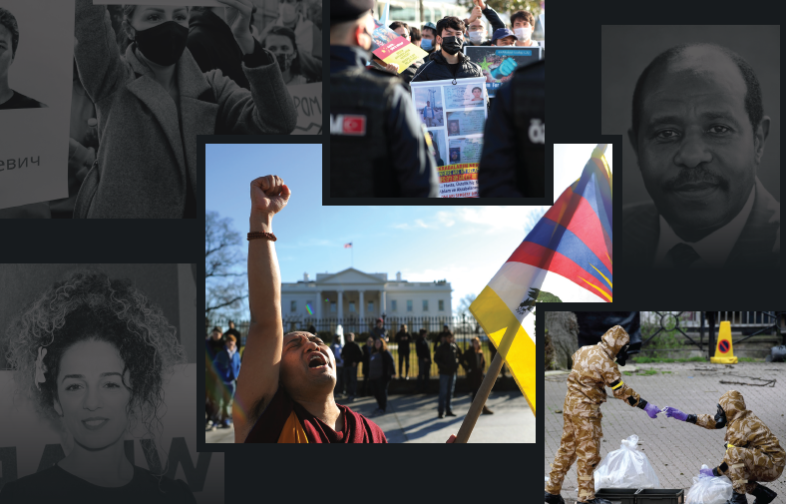
More governments than ever are targeting dissidents beyond their own borders in order to stifle dissent, employing a range of repressive tactics that countries hosting exiles and diasporas are ill-equipped to prevent, according to a new report released today by Freedom House.


