



Perspectives January 15, 2026
Q&A: Amid the Chinese Communist Party’s Authoritarian Rule, How Does Freedom House Uncover Dissent in China?
Written By
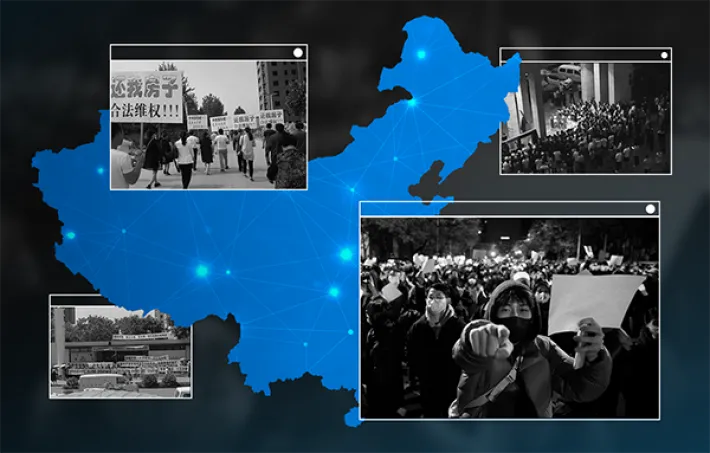
Protest activity in China is more common than many people may realize. Kevin Slaten, research lead for the China Dissent Monitor (CDM), spoke with our editors about how the CDM team uncovers dissent activity in China, what this information tells us about economic, social, and political trends there, and why understanding dissent and protest in China is important for people living in the United States.
What is the China Dissent Monitor, and what insight does it provide about dissent in China?
CDM is currently the only public database of protest events in China. We have collected and analyzed nearly 14,000 such events since June 2022.
The Chinese Communist Party (CCP) has for many years systematically censored information about protests in China’s media and internet, and it has arrested citizens who attempted to centralize this information into a database. The regime’s efforts to suppress documentation of these events (and to repress protest itself) is an indication of how important information about dissent in China is. Understanding patterns related to the frequency, topics, and locations of dissent provides insight into how China’s economic slowdown affects ordinary people, the efficacy of government policies, and public dissatisfaction with the conduct of government and other officials—as well as systemic injustices and potentially even regime stability.
CDM tracks and organizes information that is critical for anyone with an interest in understanding China’s economy, society, or governance. Activists, political and economic analysts, and journalists all use CDM data. Chinese citizens can also better understand what is going on in their own country from data collected by CDM.
What are some of the challenges you face in tracking dissent in China?
The CDM team races every day to document protest activity on China’s social media sites before it is deleted. Depending on the topic and size of the event—and whether it goes viral—some posts may disappear in minutes. Online censorship makes this sort of documentation difficult. Searches for dissent-related terms don’t turn up many results, and protest posts are often restricted, for example. The consequence is that protest information is often inconspicuous or scattered.
Additionally, dissent by some social groups, such as ethnic and religious minorities or activists, is not well represented on Chinese social media because these groups face especially stringent restrictions like closer surveillance by state security. The CDM team must look to other sources to ensure that the database embodies the diversity of dissent that occurs in China, such as information from NGOs that focus on particular groups. All of these challenges require a dedicated team to consistently monitor and centralize the information in a database where it can be coded to enable deeper analysis, and ultimately shared with the public.
How much do Chinese citizens know about dissent across China? Can CDM help raise awareness within the country?
Chinese citizens often have some understanding that protests happen, having seen them in internet posts or heard anecdotes through their social networks. But, they may not know the real prevalence or distribution of protests, including in their own cities, much less other regions. This can contribute to the perception that protest is an abnormal or illegitimate way to seek justice, a narrative that the CCP promotes and benefits from. CDM helps fill in these information gaps and enables Chinese citizens to better understand events in their own communities.
CDM recently was featured in The Guardian and The Economist. What were the discoveries you highlighted?
CDM documented 70 percent more rural protests in 2025 than in 2024. This trend was unreported before The Guardian published it as an exclusive. Most of these protest events are driven by disputes over people being forcibly relocated or subject to unfair treatment in land-acquisition processes. This is usually driven by local government’s aim to generate revenue from land development, a process that frequently involves corruption or misconduct by local officials. As a result, rural dissent frequently targets government actors. While CDM has previously published analysis about this type of dissent, the sharp increase in protests could be the effect of underlying trends, such as heavily indebted local government’s motivation to confiscate more land for development or rising unemployment among migrant workers from rural areas.
More generally, protest events across China have been increasing in the last year, according to CDM’s database. This upward trend is primarily associated with economic grievances, particularly protests by workers, home buyers, and other consumers or investors. The Economist used this finding as a jumping off point to explore why protest is frequent in an authoritarian country, the ways economic or other protests can evolve into political dissent, and the implications for the CCP.
What is the relationship between dissent and protest in China and the security and prosperity of ordinary Americans?
A lot of the things that prompt dissent in China—from widespread labor rights violations to repression of ethnic minority groups—reflect consequences of the CCP systematically restricting rights like free expression and free association. We can already see the influence of this system expanding beyond China’s borders. For example, the CCP manipulates media in other countries and is the world’s worst perpetrator of transnational repression, when governments reach across borders to intimidate or attack exiles they perceive as a threat. Chinese companies import poor labor practices into the foreign countries where they work. This puts pressure on American companies to compete by lowering their labor standards. Thus CCP abuses can undermine people’s rights everywhere, including in the United States.
That China’s citizens protest regularly despite the risk of arrest and persecution also demonstrates that—like people everywhere—they too demand fairness and justice. Hopefully this knowledge will encourage Americans to stand in solidarity with the struggles of the Chinese people. Certainly a world where the most populous country is free would be a safer and more secure world for the United States.
The CDM database went dark for part of 2025 due to the sweeping cuts in US foreign funding. Why is the CDM so important for policymakers, investors, and researchers, and how can we support it?
Accurate information about developments in China is increasingly difficult to find as the CCP has restricted access to economic and social data, in addition to suppressing public criticism through its sprawling censorship apparatus. CDM is an alternative source of information which, by documenting protest actions, sheds light on the state of China’s economic, social, and political developments at the grassroots level.
CDM is also valuable for policymakers and others concerned with challenging the CCP narrative that its authoritarian model of governance delivers more benefits to citizens than democracy can. One of the reasons it suppresses information about dissent is because it spotlights problems within its political system: the party paints a picture of steady economic prosperity, yet there are widespread protests linked to land grabs, a real estate sector in prolonged crisis, and failing companies, among other issues. People frequently resort to public protest because they don’t trust or find effective the official channels the CCP has set up to resolve disputes.
The CDM is now back online thanks to a tranche of short-term funding. However, without further support, policymakers, businesses, investors, researchers, and others could once again lose access to this uniquely valuable public resource that exposes the social and political developments the CCP tries to hide. To help CDM continue its groundbreaking research, please donate to Freedom House today.