

Bangladesh
Partly Free
44
100
| PR Political Rights | 15 40 |
| CL Civil Liberties | 29 60 |
Last Year's Score & Status
45
100
Partly Free
A country or territory’s Freedom in the World status depends on its aggregate Political Rights score, on a scale of 0–40, and its aggregate Civil Liberties score, on a scale of 0–60.
See the methodology.
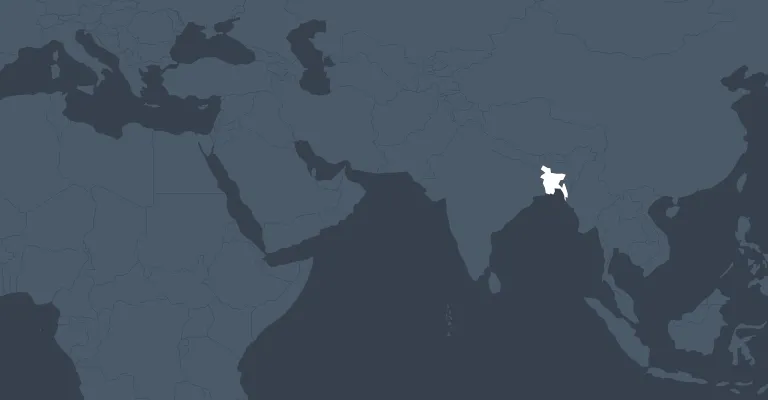


In August 2024, the ruling Awami League (AL), which consolidated its control by harassing political opponents and co-opting state institutions during its 15 years in power, was overthrown in a student-led uprising. With the backing of the military and student protesters, an interim government led by Nobel Peace Prize winner Muhammad Yunus took office. Over the next year and a half, the interim government reopened political and civic space and began to implement reforms ahead of planned elections, but extralegal violence and political retribution remained problems.
- The AL, which had faced a de facto ban in 2024, was formally banned under an antiterrorism law in May, pending the final outcome of legal cases against its leadership. Sheikh Hasina, the former prime minister and AL leader who had fled to India the previous year, was later convicted in absentia in separate trials on charges of contempt, corruption, and crimes against humanity linked to the use of lethal force against the 2024 student-led protest movement. Observers raised concerns about the judiciary’s adherence to international due process standards when handling cases against Hasina and other AL figures.
- A pattern of extralegal political violence continued during the year, including attacks involving AL supporters and their opponents. Sharif Osman Hadi, a prominent student leader, vocal critic of the Hasina government, and potential parliamentary candidate, was shot to death in December by an unidentified gunman. His killing sparked widespread and violent unrest across Bangladesh, with mobs attacking media offices, cultural sites, and properties associated with the AL and India.
- The interim government operated without a legislature throughout the year, but general elections were scheduled for February 2026. The Islamist party Jamaat-e-Islami had its registration restored by the Supreme Court in June, formally ending a ban that had been in place since 2013 and clearing the way for the party’s participation in the elections. Former Prime Minister Khaleda Zia—longtime head of the Bangladesh Nationalist Party, the AL’s main rival—died in December after a prolonged illness, and leadership of the party passed to her son, Tarique Rahman, who returned from exile in London that month. Rahman was expected to be a key contender for prime minister.
- In May, the interim government’s Cyber Security Ordinance took effect, replacing the repressive 2023 Cyber Security Act. While the new ordinance repealed the harshest elements of the older law, human rights groups argued that it retained restrictive provisions, and both journalists and ordinary citizens continued to face arrest and extralegal violence in connection with their speech. In a separate reform in September, a High Court ruling struck down two past amendments to the constitution, leaving the Supreme Court, not the president in consultation with the Supreme Court, responsible for oversight and discipline of lower court judges.
- Reports of extralegal violence against Hindus and members of other religious minority groups persisted during the year, as did cases of intimidation by Islamist groups that curtailed women’s participation in public life.
This report has been abridged for Freedom in the World 2026 due to ongoing budget constraints. Freedom in the World is entirely funded by nongovernmental sources such as private foundations, corporations, and individuals like you. Please consider making a donation to support future editions of this vital resource.
For additional background information, see the reports from the 2024 and 2025 editions of Freedom in the World.
A1
1.00-4.00 pts0-4 pts
| Was the current head of government or other chief national authority elected through free and fair elections? | 1.001 4.004 |
A2
1.00-4.00 pts0-4 pts
| Were the current national legislative representatives elected through free and fair elections? | 0.000 4.004 |
Score Change: The score declined from 1 to 0 because, although elections were scheduled for early 2026, the interim government operated without a legislature throughout the year following the dissolution of Parliament in August 2024.
A3
1.00-4.00 pts0-4 pts
| Are the electoral laws and framework fair, and are they implemented impartially by the relevant election management bodies? | 2.002 4.004 |
B1
1.00-4.00 pts0-4 pts
| Do the people have the right to organize in different political parties or other competitive political groupings of their choice, and is the system free of undue obstacles to the rise and fall of these competing parties or groupings? | 3.003 4.004 |
B2
1.00-4.00 pts0-4 pts
| Is there a realistic opportunity for the opposition to increase its support or gain power through elections? | 1.001 4.004 |
B3
1.00-4.00 pts0-4 pts
| Are the people’s political choices free from domination by forces that are external to the political sphere, or by political forces that employ extrapolitical means? | 2.002 4.004 |
B4
1.00-4.00 pts0-4 pts
| Do various segments of the population (including ethnic, racial, religious, gender, LGBT+, and other relevant groups) have full political rights and electoral opportunities? | 2.002 4.004 |
C1
1.00-4.00 pts0-4 pts
| Do the freely elected head of government and national legislative representatives determine the policies of the government? | 1.001 4.004 |
C2
1.00-4.00 pts0-4 pts
| Are safeguards against official corruption strong and effective? | 1.001 4.004 |
C3
1.00-4.00 pts0-4 pts
| Does the government operate with openness and transparency? | 2.002 4.004 |
D1
1.00-4.00 pts0-4 pts
| Are there free and independent media? | 2.002 4.004 |
D2
1.00-4.00 pts0-4 pts
| Are individuals free to practice and express their religious faith or nonbelief in public and private? | 2.002 4.004 |
D3
1.00-4.00 pts0-4 pts
| Is there academic freedom, and is the educational system free from extensive political indoctrination? | 2.002 4.004 |
D4
1.00-4.00 pts0-4 pts
| Are individuals free to express their personal views on political or other sensitive topics without fear of surveillance or retribution? | 2.002 4.004 |
E1
1.00-4.00 pts0-4 pts
| Is there freedom of assembly? | 2.002 4.004 |
E2
1.00-4.00 pts0-4 pts
| Is there freedom for nongovernmental organizations, particularly those that are engaged in human rights– and governance-related work? | 2.002 4.004 |
E3
1.00-4.00 pts0-4 pts
| Is there freedom for trade unions and similar professional or labor organizations? | 2.002 4.004 |
F1
1.00-4.00 pts0-4 pts
| Is there an independent judiciary? | 2.002 4.004 |
F2
1.00-4.00 pts0-4 pts
| Does due process prevail in civil and criminal matters? | 1.001 4.004 |
F3
1.00-4.00 pts0-4 pts
| Is there protection from the illegitimate use of physical force and freedom from war and insurgencies? | 2.002 4.004 |
F4
1.00-4.00 pts0-4 pts
| Do laws, policies, and practices guarantee equal treatment of various segments of the population? | 1.001 4.004 |
G1
1.00-4.00 pts0-4 pts
| Do individuals enjoy freedom of movement, including the ability to change their place of residence, employment, or education? | 3.003 4.004 |
G2
1.00-4.00 pts0-4 pts
| Are individuals able to exercise the right to own property and establish private businesses without undue interference from state or nonstate actors? | 2.002 4.004 |
G3
1.00-4.00 pts0-4 pts
| Do individuals enjoy personal social freedoms, including choice of marriage partner and size of family, protection from domestic violence, and control over appearance? | 2.002 4.004 |
G4
1.00-4.00 pts0-4 pts
| Do individuals enjoy equality of opportunity and freedom from economic exploitation? | 2.002 4.004 |


Country Facts
-
Population
171,200,000 -
Global Freedom Score
44 100 partly free -
Internet Freedom Score
45 100 partly free
