

Côte d'Ivoire
Partly Free
46
100
| PR Political Rights | 17 40 |
| CL Civil Liberties | 29 60 |
Last Year's Score & Status
49
100
Partly Free
A country or territory’s Freedom in the World status depends on its aggregate Political Rights score, on a scale of 0–40, and its aggregate Civil Liberties score, on a scale of 0–60.
See the methodology.
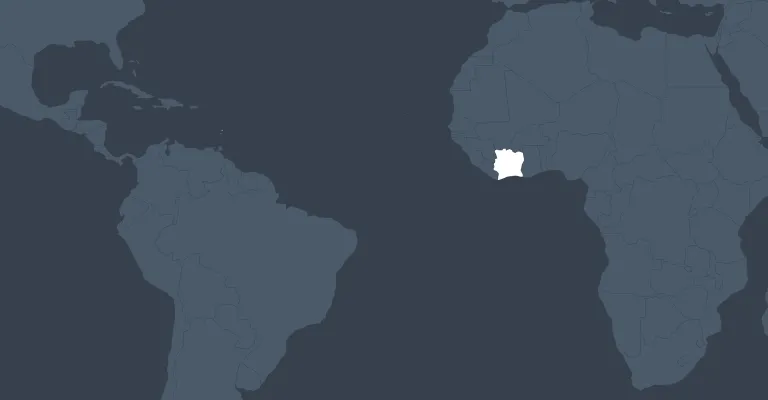


Côte d’Ivoire continues to recover from an armed conflict that ended in 2011. Several root causes of that conflict remain, including ethnic and regional tensions, land disputes, corruption, and impunity. Nongovernmental organizations and independent journalists continue to contribute to Ivorian politics and society. However, conditions for political rights and civil liberties eroded in 2025, when incumbent President Alassane Ouattara won a fourth presidential term after authorities excluded the main opposition candidates from participating in the year’s election and cracked down on political expression.
This report has been abridged for Freedom in the World 2026 due to ongoing budget constraints. Freedom in the World is entirely funded by nongovernmental sources such as private foundations, corporations, and individuals like you. Please consider making a donation to support future editions of this vital resource.
For additional background information, see the reports from the 2024 and 2025 editions of Freedom in the World.
A1
1.00-4.00 pts0-4 pts
| Was the current head of government or other chief national authority elected through free and fair elections? | 1.001 4.004 |
Score Change: The score declined from 2 to 1 because incumbent president Alassane Ouattara won a fourth term after authorities excluded the main opposition candidates from the election, leaving voters essentially without a choice at the ballot box. Previously term limited, Outtara was able to participate in the election as a result of a constitutional revision in 2016.
A2
1.00-4.00 pts0-4 pts
| Were the current national legislative representatives elected through free and fair elections? | 2.002 4.004 |
A3
1.00-4.00 pts0-4 pts
| Are the electoral laws and framework fair, and are they implemented impartially by the relevant election management bodies? | 2.002 4.004 |
B1
1.00-4.00 pts0-4 pts
| Do the people have the right to organize in different political parties or other competitive political groupings of their choice, and is the system free of undue obstacles to the rise and fall of these competing parties or groupings? | 2.002 4.004 |
Score Change: The score declined from 3 to 2 because authorities banned rallies organized by political parties that had been excluded from the presidential election, and police forcefully dispersed attempts to organize an opposition demonstration and arrested participants.
B2
1.00-4.00 pts0-4 pts
| Is there a realistic opportunity for the opposition to increase its support or gain power through elections? | 2.002 4.004 |
B3
1.00-4.00 pts0-4 pts
| Are the people’s political choices free from domination by forces that are external to the political sphere, or by political forces that employ extrapolitical means? | 2.002 4.004 |
B4
1.00-4.00 pts0-4 pts
| Do various segments of the population (including ethnic, racial, religious, gender, LGBT+, and other relevant groups) have full political rights and electoral opportunities? | 2.002 4.004 |
C1
1.00-4.00 pts0-4 pts
| Do the freely elected head of government and national legislative representatives determine the policies of the government? | 2.002 4.004 |
C2
1.00-4.00 pts0-4 pts
| Are safeguards against official corruption strong and effective? | 1.001 4.004 |
C3
1.00-4.00 pts0-4 pts
| Does the government operate with openness and transparency? | 1.001 4.004 |
D1
1.00-4.00 pts0-4 pts
| Are there free and independent media? | 2.002 4.004 |
D2
1.00-4.00 pts0-4 pts
| Are individuals free to practice and express their religious faith or nonbelief in public and private? | 3.003 4.004 |
D3
1.00-4.00 pts0-4 pts
| Is there academic freedom, and is the educational system free from extensive political indoctrination? | 2.002 4.004 |
D4
1.00-4.00 pts0-4 pts
| Are individuals free to express their personal views on political or other sensitive topics without fear of surveillance or retribution? | 2.002 4.004 |
Score Change: The score declined from 3 to 2 because authorities increasingly used criminal penalties to punish social media users who posted remarks or videos critical of the government in the run-up to the presidential election, discouraging open discussion of politics.
E1
1.00-4.00 pts0-4 pts
| Is there freedom of assembly? | 2.002 4.004 |
E2
1.00-4.00 pts0-4 pts
| Is there freedom for nongovernmental organizations, particularly those that are engaged in human rights– and governance-related work? | 2.002 4.004 |
E3
1.00-4.00 pts0-4 pts
| Is there freedom for trade unions and similar professional or labor organizations? | 3.003 4.004 |
F1
1.00-4.00 pts0-4 pts
| Is there an independent judiciary? | 1.001 4.004 |
F2
1.00-4.00 pts0-4 pts
| Does due process prevail in civil and criminal matters? | 1.001 4.004 |
F3
1.00-4.00 pts0-4 pts
| Is there protection from the illegitimate use of physical force and freedom from war and insurgencies? | 2.002 4.004 |
F4
1.00-4.00 pts0-4 pts
| Do laws, policies, and practices guarantee equal treatment of various segments of the population? | 2.002 4.004 |
G1
1.00-4.00 pts0-4 pts
| Do individuals enjoy freedom of movement, including the ability to change their place of residence, employment, or education? | 2.002 4.004 |
G2
1.00-4.00 pts0-4 pts
| Are individuals able to exercise the right to own property and establish private businesses without undue interference from state or nonstate actors? | 2.002 4.004 |
G3
1.00-4.00 pts0-4 pts
| Do individuals enjoy personal social freedoms, including choice of marriage partner and size of family, protection from domestic violence, and control over appearance? | 1.001 4.004 |
G4
1.00-4.00 pts0-4 pts
| Do individuals enjoy equality of opportunity and freedom from economic exploitation? | 2.002 4.004 |


Country Facts
-
Population
28,160,000 -
Global Freedom Score
46 100 partly free
