

Ecuador
Partly Free
64
100
| PR Political Rights | 27 40 |
| CL Civil Liberties | 37 60 |
Last Year's Score & Status
65
100
Partly Free
A country or territory’s Freedom in the World status depends on its aggregate Political Rights score, on a scale of 0–40, and its aggregate Civil Liberties score, on a scale of 0–60.
See the methodology.
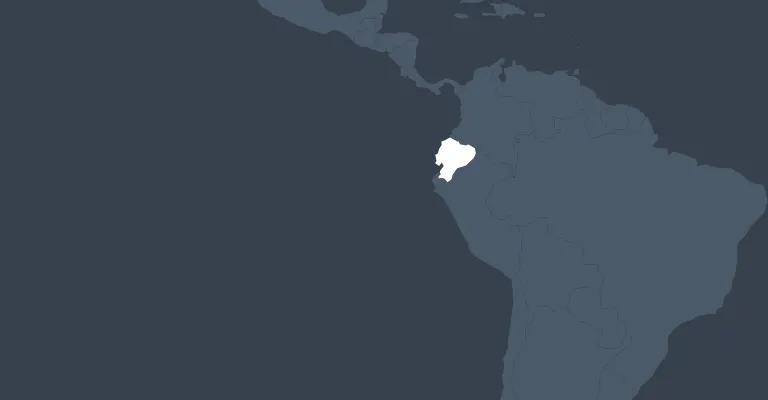


Ecuador holds regular, competitive elections, but the influence of organized crime and related violence have increased significantly in recent years, affecting the functioning of state institutions and the security of ordinary citizens. Due process violations, attacks on journalists, human rights abuses, and official corruption are ongoing challenges, and the new government of President Daniel Noboa Azín has engaged in practices that further threaten civil liberties.
- In April, incumbent president Daniel Noboa Azín won the year’s presidential election, taking 56 percent of the second-round vote against Luisa González, the candidate of the Citizen Revolution Movement (RC), who received 44 percent. An Organization of American States (OAS) election observation mission praised the election as credible and peaceful but expressed concern about attempts by Noboa to influence the National Electoral Council (CNE), as well as about the improper use of public resources for campaigning. A European Union (EU) monitoring mission expressed similar concerns.
- Ecuador held elections for the 151 members of the National Assembly in February, concurrently with the first round of the presidential election. Former President Rafael Correa’s Citizen Revolution Movement–Renewal Movement (RC–RETO) won 67 seats, and Noboa’s National Democratic Action (ADN) won 66. The remaining 18 seats were distributed among a number of local parties and movements.
- In September and October, protests erupted in several cities following Noboa’s move to cancel diesel fuel subsidies. The demonstrations were mostly peaceful, though some violent acts by demonstrators took place. National and international civil society organizations reported that abuses were committed by police and military forces deployed to contain the protests. Ecuador’s Alliance of Human Rights Organizations said 473 people were injured and 206 were detained; 3 were reportedly killed.
- In August, the Law for the Control of Irregular Capital Flows (the “Foundations Law”) came into effect. Authorities said its purpose was to prevent nonprofit organizations from being used for illicit activities such as money laundering or tax evasion. However, civil society and rights groups expressed concern that it could be used to interfere with the operations of nongovernmental organizations (NGOs) that criticized the government.
- By late November, authorities had recorded 8,393 killings—an average of 25 murders per day. The deteriorating security situation prompted states of emergency and de facto restrictions across the country, particularly in parts Ecuador’s coastal and Amazon regions where the presence of the state and law enforcement agencies was limited or has been violently challenged. The state of emergency and associated police crackdowns prompted concerns about damage to due process protections and the rule of law.
This report has been abridged for Freedom in the World 2026 due to ongoing budget constraints. Freedom in the World is entirely funded by nongovernmental sources such as private foundations, corporations, and individuals like you. Please consider making a donation to support future editions of this vital resource.
For additional background information, see last year’s full report.
A1
1.00-4.00 pts0-4 pts
| Was the current head of government or other chief national authority elected through free and fair elections? | 3.003 4.004 |
Score Change: The score declined from 4 to 3 because the incumbent exploited public resources and state institutions to tilt the playing field in his favor during the presidential election, disadvantaging opponents and eroding public trust in the fairness of the contest.
A2
1.00-4.00 pts0-4 pts
| Were the current national legislative representatives elected through free and fair elections? | 4.004 4.004 |
A3
1.00-4.00 pts0-4 pts
| Are the electoral laws and framework fair, and are they implemented impartially by the relevant election management bodies? | 3.003 4.004 |
B1
1.00-4.00 pts0-4 pts
| Do the people have the right to organize in different political parties or other competitive political groupings of their choice, and is the system free of undue obstacles to the rise and fall of these competing parties or groupings? | 3.003 4.004 |
B2
1.00-4.00 pts0-4 pts
| Is there a realistic opportunity for the opposition to increase its support or gain power through elections? | 3.003 4.004 |
B3
1.00-4.00 pts0-4 pts
| Are the people’s political choices free from domination by forces that are external to the political sphere, or by political forces that employ extrapolitical means? | 2.002 4.004 |
B4
1.00-4.00 pts0-4 pts
| Do various segments of the population (including ethnic, racial, religious, gender, LGBT+, and other relevant groups) have full political rights and electoral opportunities? | 3.003 4.004 |
C1
1.00-4.00 pts0-4 pts
| Do the freely elected head of government and national legislative representatives determine the policies of the government? | 2.002 4.004 |
C2
1.00-4.00 pts0-4 pts
| Are safeguards against official corruption strong and effective? | 2.002 4.004 |
C3
1.00-4.00 pts0-4 pts
| Does the government operate with openness and transparency? | 2.002 4.004 |
D1
1.00-4.00 pts0-4 pts
| Are there free and independent media? | 2.002 4.004 |
D2
1.00-4.00 pts0-4 pts
| Are individuals free to practice and express their religious faith or nonbelief in public and private? | 4.004 4.004 |
D3
1.00-4.00 pts0-4 pts
| Is there academic freedom, and is the educational system free from extensive political indoctrination? | 3.003 4.004 |
D4
1.00-4.00 pts0-4 pts
| Are individuals free to express their personal views on political or other sensitive topics without fear of surveillance or retribution? | 3.003 4.004 |
E1
1.00-4.00 pts0-4 pts
| Is there freedom of assembly? | 3.003 4.004 |
E2
1.00-4.00 pts0-4 pts
| Is there freedom for nongovernmental organizations, particularly those that are engaged in human rights– and governance-related work? | 3.003 4.004 |
E3
1.00-4.00 pts0-4 pts
| Is there freedom for trade unions and similar professional or labor organizations? | 3.003 4.004 |
F1
1.00-4.00 pts0-4 pts
| Is there an independent judiciary? | 2.002 4.004 |
F2
1.00-4.00 pts0-4 pts
| Does due process prevail in civil and criminal matters? | 2.002 4.004 |
F3
1.00-4.00 pts0-4 pts
| Is there protection from the illegitimate use of physical force and freedom from war and insurgencies? | 1.001 4.004 |
F4
1.00-4.00 pts0-4 pts
| Do laws, policies, and practices guarantee equal treatment of various segments of the population? | 2.002 4.004 |
G1
1.00-4.00 pts0-4 pts
| Do individuals enjoy freedom of movement, including the ability to change their place of residence, employment, or education? | 2.002 4.004 |
G2
1.00-4.00 pts0-4 pts
| Are individuals able to exercise the right to own property and establish private businesses without undue interference from state or nonstate actors? | 2.002 4.004 |
G3
1.00-4.00 pts0-4 pts
| Do individuals enjoy personal social freedoms, including choice of marriage partner and size of family, protection from domestic violence, and control over appearance? | 3.003 4.004 |
G4
1.00-4.00 pts0-4 pts
| Do individuals enjoy equality of opportunity and freedom from economic exploitation? | 2.002 4.004 |


Country Facts
-
Population
18,000,000 -
Global Freedom Score
64 100 partly free -
Internet Freedom Score
63 100 partly free
