

Guinea-Bissau
Partly Free
33
100
| PR Political Rights | 7 40 |
| CL Civil Liberties | 26 60 |
Last Year's Score & Status
41
100
Partly Free
A country or territory’s Freedom in the World status depends on its aggregate Political Rights score, on a scale of 0–40, and its aggregate Civil Liberties score, on a scale of 0–60.
See the methodology.
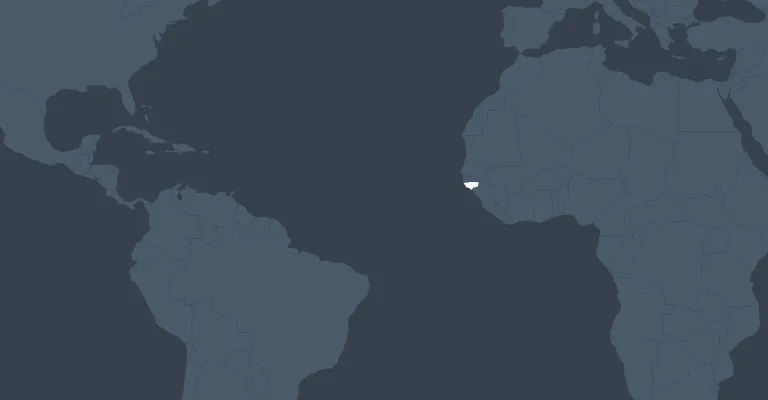


Guinea-Bissau’s political system has been hampered in recent years by power struggles between the presidency and the parliamentary majority, and a military coup in late 2025 thwarted efforts to restore regular political order by holding overdue elections. Conditions for civil liberties had gradually improved as the country recovered from the aftermath of an earlier coup in 2012, though police continued to disrupt some demonstrations, and journalists faced interference with their work. Corruption remains a major problem that has been exacerbated by organized criminal activity, including drug trafficking.
- The Supreme Court of Justice ruled in February that President Umaro Sissoco Embaló’s five-year presidential term would expire in September, despite arguments from the political opposition and civil society groups that it should have expired that month. The government then announced that overdue presidential and legislative elections would be held in November. A mission to the country from the Economic Community of West African States, tasked with helping to negotiate a consensus-based election plan, departed in March after the president threatened to expel it.
- In August, a few months before the elections, the president appointed Braima Camará, a former ally of the opposition, to the position of prime minister, replacing Rui Duarte de Barros following the resignation of the government. Although the prime minister is supposed to be chosen in consultation with the parliamentary parties, the president had dissolved the parliament in late 2023 and prevented it from reconvening. Also in August, authorities suspended three major Portuguese public media outlets and ordered their journalists to leave the country without explanation; a reporter for one of the outlets had been physically attacked in July in connection with his work.
- In September, the Supreme Court of Justice rejected the electoral candidates of the African Party for the Independence of Guinea-Bissau and Cabo Verde (PAIGC), which had been the largest parliamentary party. The court claimed that the applications had been filed too late, though they were submitted before the deadline. The PAIGC, having been excluded from the ballot, ultimately endorsed independent candidate Fernando Dias da Costa for the presidency.
- Authorities in Portugal were investigating suspected embezzlement and laundering of public funds from Guinea-Bissau during the year, even as public-sector workers in the country organized multiple strikes over unpaid wages. In June, for example, health and education workers mounted a strike to protest the government’s breach of an earlier agreement to repay accumulated salary debts, some of which dated back to 2007.
- The military carried out a coup three days after the November 23 general elections, before the official results were announced, but after Dias, the opposition candidate, claimed victory over Embaló; although soldiers seized records and equipment from the National Election Commission, tally sheets that had already been shared externally supported Dias’s claim. President Embaló was allowed to leave the country, Dias took refuge in the Nigerian embassy, and the head of the PAIGC was arrested. In December, the military junta suspended the constitution and issued a transitional charter to cover a one-year transition period. The army chief of staff, General Horta Inta-A, was sworn in as transitional president, and the incumbent finance minister, Ilídio Vieira Té, was appointed as prime minister; a 65-member transitional legislature was also created. The Supreme Court of Justice remained in place as the “custodian” of the transitional charter.
This report has been abridged for Freedom in the World 2026 due to ongoing budget constraints. Freedom in the World is entirely funded by nongovernmental sources such as private foundations, corporations, and individuals like you. Please consider making a donation to support future editions of this vital resource.
For additional background information, see the reports from the 2024 and 2025 editions of Freedom in the World.
A1
1.00-4.00 pts0-4 pts
| Was the current head of government or other chief national authority elected through free and fair elections? | 0.000 4.004 |
Score Change: The score declined from 2 to 0 because a military coup interrupted the November 2025 general elections, and the army chief of staff was named as the transitional president.
A2
1.00-4.00 pts0-4 pts
| Were the current national legislative representatives elected through free and fair elections? | 0.000 4.004 |
Score Change: The score declined from 1 to 0 because legislative elections that had been postponed from 2024 to 2025 were interrupted by the November coup, and the previous parliament remained dissolved throughout the year.
A3
1.00-4.00 pts0-4 pts
| Are the electoral laws and framework fair, and are they implemented impartially by the relevant election management bodies? | 1.001 4.004 |
Score Change: The score declined from 2 to 1 because armed soldiers entered the headquarters of the electoral commission during the military coup and destroyed or seized paperwork, tallies, and computers, making it impossible to publish the official results of the elections.
B1
1.00-4.00 pts0-4 pts
| Do the people have the right to organize in different political parties or other competitive political groupings of their choice, and is the system free of undue obstacles to the rise and fall of these competing parties or groupings? | 2.002 4.004 |
Score Change: The score declined from 3 to 2 because even before the coup, which led to the exile or detention of the incumbent president and key opposition figures, the Supreme Court excluded the main opposition party from participating in the presidential and legislative elections.
B2
1.00-4.00 pts0-4 pts
| Is there a realistic opportunity for the opposition to increase its support or gain power through elections? | 1.001 4.004 |
Score Change: The score declined from 2 to 1 because the military coup made it impossible for opposition parties to win power through elections.
B3
1.00-4.00 pts0-4 pts
| Are the people’s political choices free from domination by forces that are external to the political sphere, or by political forces that employ extrapolitical means? | 0.000 4.004 |
Score Change: The score declined from 1 to 0 because the military junta effectively overrode the people’s political choices, seizing or destroying election materials and installing its own leader by force.
B4
1.00-4.00 pts0-4 pts
| Do various segments of the population (including ethnic, racial, religious, gender, LGBT+, and other relevant groups) have full political rights and electoral opportunities? | 2.002 4.004 |
C1
1.00-4.00 pts0-4 pts
| Do the freely elected head of government and national legislative representatives determine the policies of the government? | 0.000 4.004 |
Score Change: The score declined from 1 to 0 because the country’s remaining elected officials were overthrown during the year, and government policy was subsequently determined by the military leadership.
C2
1.00-4.00 pts0-4 pts
| Are safeguards against official corruption strong and effective? | 1.001 4.004 |
C3
1.00-4.00 pts0-4 pts
| Does the government operate with openness and transparency? | 0.000 4.004 |
D1
1.00-4.00 pts0-4 pts
| Are there free and independent media? | 1.001 4.004 |
D2
1.00-4.00 pts0-4 pts
| Are individuals free to practice and express their religious faith or nonbelief in public and private? | 3.003 4.004 |
D3
1.00-4.00 pts0-4 pts
| Is there academic freedom, and is the educational system free from extensive political indoctrination? | 3.003 4.004 |
D4
1.00-4.00 pts0-4 pts
| Are individuals free to express their personal views on political or other sensitive topics without fear of surveillance or retribution? | 3.003 4.004 |
E1
1.00-4.00 pts0-4 pts
| Is there freedom of assembly? | 1.001 4.004 |
E2
1.00-4.00 pts0-4 pts
| Is there freedom for nongovernmental organizations, particularly those that are engaged in human rights– and governance-related work? | 2.002 4.004 |
E3
1.00-4.00 pts0-4 pts
| Is there freedom for trade unions and similar professional or labor organizations? | 3.003 4.004 |
F1
1.00-4.00 pts0-4 pts
| Is there an independent judiciary? | 1.001 4.004 |
F2
1.00-4.00 pts0-4 pts
| Does due process prevail in civil and criminal matters? | 0.000 4.004 |
F3
1.00-4.00 pts0-4 pts
| Is there protection from the illegitimate use of physical force and freedom from war and insurgencies? | 2.002 4.004 |
F4
1.00-4.00 pts0-4 pts
| Do laws, policies, and practices guarantee equal treatment of various segments of the population? | 2.002 4.004 |
G1
1.00-4.00 pts0-4 pts
| Do individuals enjoy freedom of movement, including the ability to change their place of residence, employment, or education? | 2.002 4.004 |
G2
1.00-4.00 pts0-4 pts
| Are individuals able to exercise the right to own property and establish private businesses without undue interference from state or nonstate actors? | 1.001 4.004 |
G3
1.00-4.00 pts0-4 pts
| Do individuals enjoy personal social freedoms, including choice of marriage partner and size of family, protection from domestic violence, and control over appearance? | 1.001 4.004 |
G4
1.00-4.00 pts0-4 pts
| Do individuals enjoy equality of opportunity and freedom from economic exploitation? | 1.001 4.004 |


Country Facts
-
Population
2,106,000 -
Global Freedom Score
33 100 partly free
