

Kuwait
Not Free
30
100
| PR Political Rights | 7 40 |
| CL Civil Liberties | 23 60 |
Last Year's Score & Status
31
100
Not Free
A country or territory’s Freedom in the World status depends on its aggregate Political Rights score, on a scale of 0–40, and its aggregate Civil Liberties score, on a scale of 0–60.
See the methodology.
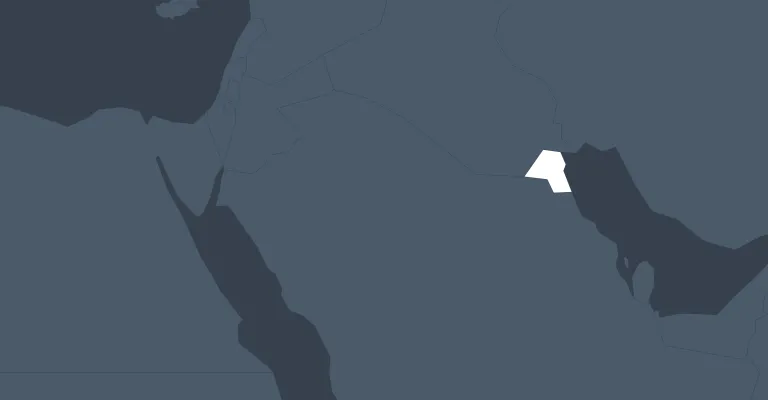


Kuwait is an emirate ruled by the Sabah family. The monarchy holds executive power and dominates most state institutions. Prior to its dissolution in 2024, the elected parliament played an influential role and often challenged the government. State authorities impose some constraints on civil liberties, including speech and assembly, and the country’s large population of noncitizen workers faces particular disadvantages.
- The authorities continued to punish political dissent during the year. In April, for example, the Court of Appeal issued rulings in the cases of five former members of parliament and two former candidates who had been convicted on charges that included “insulting the emir” in connection with their opposition to the dissolution of the elected legislature in 2024. Five of the seven men received prison terms ranging from two to four years, and the sentences of the remaining two were suspended.
- Mohammed al-Barghash—a prominent activist on behalf of Kuwait’s population of stateless people, known as bidoon—was detained in June after using the social media platform X to publicize his request for a meeting with the interior minister about the bidoon issue; he was charged with state security offenses. Al-Barghash had faced a series of prosecutions in the past, most recently securing an acquittal on slander and false news charges in May.
- Over the course of the year, the country’s attorney general and Supreme Judicial Council promoted women to senior prosecutorial positions for the first time. Such moves were reportedly backed by the emir but had previously been opposed by some Islamist members of parliament.
- The government continued a campaign of citizenship revocations that had begun in 2024, and by late 2025 more than 50,000 people had been stripped of citizenship on the grounds that their status had been obtained fraudulently or otherwise illegally. Those affected were required to surrender their passports by October 1, and many were reportedly rendered stateless as a result of the government actions; Kuwait does not recognize dual citizenship, meaning people obtaining Kuwaiti citizenship must give up their previous nationality. A law that took effect in late 2024 stipulated that the foreign wives of Kuwaiti men could no longer secure citizenship through marriage, and expanded the government’s authority to revoke citizenship on security grounds or for various criminal offenses. Among other prominent individuals who lost their citizenship during the year was preacher, media figure, and businessman Tareq al-Suwaidan, who had been associated with the Muslim Brotherhood.
- Authorities also persisted with a crackdown on migrant workers, arresting and deporting hundreds of people for alleged violations of a new immigration law, Decree No. 114, that was issued in November 2024 and took effect in January. Among other vague provisions, the law allowed deportations when “necessary for the public interest, security, or morals.” At the same time, beginning in July, migrant workers seeking to travel outside of Kuwait were required to obtain permission from their employers via an online portal or phone application operated by the Interior Ministry.
This report has been abridged for Freedom in the World 2026 due to ongoing budget constraints. Freedom in the World is entirely funded by nongovernmental sources such as private foundations, corporations, and individuals like you. Please consider making a donation to support future editions of this vital resource.
For additional background information, see the reports from the 2024 and 2025 editions of Freedom in the World.
A1
1.00-4.00 pts0-4 pts
| Was the current head of government or other chief national authority elected through free and fair elections? | 0.000 4.004 |
A2
1.00-4.00 pts0-4 pts
| Were the current national legislative representatives elected through free and fair elections? | 0.000 4.004 |
A3
1.00-4.00 pts0-4 pts
| Are the electoral laws and framework fair, and are they implemented impartially by the relevant election management bodies? | 0.000 4.004 |
B1
1.00-4.00 pts0-4 pts
| Do the people have the right to organize in different political parties or other competitive political groupings of their choice, and is the system free of undue obstacles to the rise and fall of these competing parties or groupings? | 1.001 4.004 |
B2
1.00-4.00 pts0-4 pts
| Is there a realistic opportunity for the opposition to increase its support or gain power through elections? | 0.000 4.004 |
B3
1.00-4.00 pts0-4 pts
| Are the people’s political choices free from domination by forces that are external to the political sphere, or by political forces that employ extrapolitical means? | 2.002 4.004 |
B4
1.00-4.00 pts0-4 pts
| Do various segments of the population (including ethnic, racial, religious, gender, LGBT+, and other relevant groups) have full political rights and electoral opportunities? | 1.001 4.004 |
C1
1.00-4.00 pts0-4 pts
| Do the freely elected head of government and national legislative representatives determine the policies of the government? | 0.000 4.004 |
C2
1.00-4.00 pts0-4 pts
| Are safeguards against official corruption strong and effective? | 1.001 4.004 |
C3
1.00-4.00 pts0-4 pts
| Does the government operate with openness and transparency? | 2.002 4.004 |
D1
1.00-4.00 pts0-4 pts
| Are there free and independent media? | 1.001 4.004 |
D2
1.00-4.00 pts0-4 pts
| Are individuals free to practice and express their religious faith or nonbelief in public and private? | 2.002 4.004 |
D3
1.00-4.00 pts0-4 pts
| Is there academic freedom, and is the educational system free from extensive political indoctrination? | 2.002 4.004 |
D4
1.00-4.00 pts0-4 pts
| Are individuals free to express their personal views on political or other sensitive topics without fear of surveillance or retribution? | 1.001 4.004 |
E1
1.00-4.00 pts0-4 pts
| Is there freedom of assembly? | 2.002 4.004 |
E2
1.00-4.00 pts0-4 pts
| Is there freedom for nongovernmental organizations, particularly those that are engaged in human rights– and governance-related work? | 2.002 4.004 |
E3
1.00-4.00 pts0-4 pts
| Is there freedom for trade unions and similar professional or labor organizations? | 1.001 4.004 |
F1
1.00-4.00 pts0-4 pts
| Is there an independent judiciary? | 1.001 4.004 |
F2
1.00-4.00 pts0-4 pts
| Does due process prevail in civil and criminal matters? | 2.002 4.004 |
F3
1.00-4.00 pts0-4 pts
| Is there protection from the illegitimate use of physical force and freedom from war and insurgencies? | 2.002 4.004 |
F4
1.00-4.00 pts0-4 pts
| Do laws, policies, and practices guarantee equal treatment of various segments of the population? | 2.002 4.004 |
G1
1.00-4.00 pts0-4 pts
| Do individuals enjoy freedom of movement, including the ability to change their place of residence, employment, or education? | 1.001 4.004 |
Score Change: The score declined from 2 to 1 because the government had revoked the citizenship of tens of thousands of people since 2024, rendering many of them stateless and preventing them from traveling freely.
G2
1.00-4.00 pts0-4 pts
| Are individuals able to exercise the right to own property and establish private businesses without undue interference from state or nonstate actors? | 1.001 4.004 |
G3
1.00-4.00 pts0-4 pts
| Do individuals enjoy personal social freedoms, including choice of marriage partner and size of family, protection from domestic violence, and control over appearance? | 2.002 4.004 |
G4
1.00-4.00 pts0-4 pts
| Do individuals enjoy equality of opportunity and freedom from economic exploitation? | 1.001 4.004 |


Country Facts
-
Population
4,269,000 -
Global Freedom Score
30 100 not free
