

Thailand
Not Free
33
100
| PR Political Rights | 11 40 |
| CL Civil Liberties | 22 60 |
Last Year's Score & Status
34
100
Not Free
A country or territory’s Freedom in the World status depends on its aggregate Political Rights score, on a scale of 0–40, and its aggregate Civil Liberties score, on a scale of 0–60.
See the methodology.
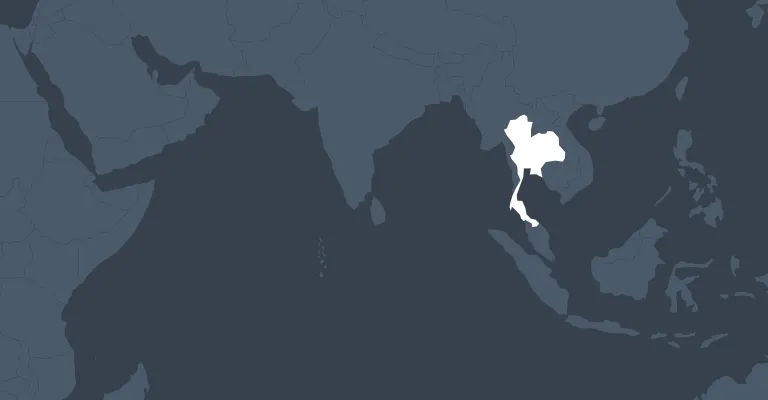


Following five years of direct military rule, Thailand transitioned to a military-dominated, semielected government in 2019. While 2023 elections were comparatively open and competitive, the leading opposition party, Move Forward, was blocked from forming a government by the military-appointed Senate and subsequently dissolved by the Constitutional Court. The second-largest opposition group, the Pheu Thai Party (PTP), entered government in coalition with several military-aligned parties, but two successive PTP prime ministers were removed by the same court over alleged ethics violations in 2024 and 2025, signaling the continued dominance of the country’s unelected institutions. Press freedom remains constrained, due process is not guaranteed, and there is impunity for crimes committed against civic activists.
- A law allowing same-sex marriage, which had been adopted in 2024, came into effect in January. The legislation made Thailand the first country in Southeast Asia to grant same-sex couples the same rights as heterosexual couples, on matters including financial benefits, medical care, adoption, and inheritance.
- Armed conflict between Thailand and Cambodia broke out in July over a long-disputed border territory. In Thailand, more than 180,000 civilians were displaced by the fighting, which ended with a ceasefire after about four days. Combat resumed in December before another ceasefire took hold late that month. Dozens of Thais—most of them soldiers—were reportedly killed as a direct result of the clashes, and hundreds of thousands of civilians remained displaced as of late December.
- In August, the Constitutional Court—which had a history of removing elected leaders and suppressing reformist parties—dismissed Prime Minister Paetongtarn Shinawatra of the PTP for an alleged ethics violation stemming from a leaked phone call with former Cambodian Prime Minister Hun Sen. The parliament voted in September to install Anutin Charnvirakul, leader of the royalist, conservative Bhumjaithai Party, as the prime minister of a minority government; although Bhumjaithai was only the third-largest party in the lower house, it won the conditional backing of the top-ranked progressive People’s Party in exchange for concessions including a pledge to hold elections by early 2026. Anutin dissolved the chamber in December, and balloting was set for February.
- The authorities continued to prosecute individuals accused of criticizing the monarchy. Among other cases during the year, five activists who allegedly obstructed a royal motorcade amid a protest in 2020 were sentenced to between 16 and 21 years in prison after an appellate court reversed their acquittals. Also that month, the Bangkok Criminal Court sentenced People’s Party lawmaker and prodemocracy activist Chonthicha Jangrew to two years and eight months in prison for criticizing the monarchy on Facebook, and an appellate court upheld another two-year sentence against her in a separate lèse-majesté case. Chonthicha was released on bail pending appeal.
This report has been abridged for Freedom in the World 2026 due to ongoing budget constraints. Freedom in the World is entirely funded by nongovernmental sources such as private foundations, corporations, and individuals like you. Please consider making a donation to support future editions of this vital resource.
For additional background information, see the reports from the 2024 and 2025 editions of Freedom in the World.
A1
1.00-4.00 pts0-4 pts
| Was the current head of government or other chief national authority elected through free and fair elections? | 1.001 4.004 |
A2
1.00-4.00 pts0-4 pts
| Were the current national legislative representatives elected through free and fair elections? | 2.002 4.004 |
A3
1.00-4.00 pts0-4 pts
| Are the electoral laws and framework fair, and are they implemented impartially by the relevant election management bodies? | 0.000 4.004 |
B1
1.00-4.00 pts0-4 pts
| Do the people have the right to organize in different political parties or other competitive political groupings of their choice, and is the system free of undue obstacles to the rise and fall of these competing parties or groupings? | 1.001 4.004 |
B2
1.00-4.00 pts0-4 pts
| Is there a realistic opportunity for the opposition to increase its support or gain power through elections? | 1.001 4.004 |
B3
1.00-4.00 pts0-4 pts
| Are the people’s political choices free from domination by forces that are external to the political sphere, or by political forces that employ extrapolitical means? | 1.001 4.004 |
B4
1.00-4.00 pts0-4 pts
| Do various segments of the population (including ethnic, racial, religious, gender, LGBT+, and other relevant groups) have full political rights and electoral opportunities? | 2.002 4.004 |
C1
1.00-4.00 pts0-4 pts
| Do the freely elected head of government and national legislative representatives determine the policies of the government? | 1.001 4.004 |
C2
1.00-4.00 pts0-4 pts
| Are safeguards against official corruption strong and effective? | 1.001 4.004 |
C3
1.00-4.00 pts0-4 pts
| Does the government operate with openness and transparency? | 1.001 4.004 |
D1
1.00-4.00 pts0-4 pts
| Are there free and independent media? | 1.001 4.004 |
D2
1.00-4.00 pts0-4 pts
| Are individuals free to practice and express their religious faith or nonbelief in public and private? | 3.003 4.004 |
D3
1.00-4.00 pts0-4 pts
| Is there academic freedom, and is the educational system free from extensive political indoctrination? | 1.001 4.004 |
D4
1.00-4.00 pts0-4 pts
| Are individuals free to express their personal views on political or other sensitive topics without fear of surveillance or retribution? | 1.001 4.004 |
E1
1.00-4.00 pts0-4 pts
| Is there freedom of assembly? | 1.001 4.004 |
E2
1.00-4.00 pts0-4 pts
| Is there freedom for nongovernmental organizations, particularly those that are engaged in human rights– and governance-related work? | 1.001 4.004 |
E3
1.00-4.00 pts0-4 pts
| Is there freedom for trade unions and similar professional or labor organizations? | 1.001 4.004 |
F1
1.00-4.00 pts0-4 pts
| Is there an independent judiciary? | 1.001 4.004 |
F2
1.00-4.00 pts0-4 pts
| Does due process prevail in civil and criminal matters? | 1.001 4.004 |
F3
1.00-4.00 pts0-4 pts
| Is there protection from the illegitimate use of physical force and freedom from war and insurgencies? | 1.001 4.004 |
F4
1.00-4.00 pts0-4 pts
| Do laws, policies, and practices guarantee equal treatment of various segments of the population? | 1.001 4.004 |
G1
1.00-4.00 pts0-4 pts
| Do individuals enjoy freedom of movement, including the ability to change their place of residence, employment, or education? | 2.002 4.004 |
Score Change: The score declined from 3 to 2 because a border conflict between Cambodia and Thailand had resulted in the displacement of hundreds of thousands of people by year’s end.
G2
1.00-4.00 pts0-4 pts
| Are individuals able to exercise the right to own property and establish private businesses without undue interference from state or nonstate actors? | 2.002 4.004 |
G3
1.00-4.00 pts0-4 pts
| Do individuals enjoy personal social freedoms, including choice of marriage partner and size of family, protection from domestic violence, and control over appearance? | 3.003 4.004 |
G4
1.00-4.00 pts0-4 pts
| Do individuals enjoy equality of opportunity and freedom from economic exploitation? | 2.002 4.004 |


Country Facts
-
Population
71,700,000 -
Global Freedom Score
33 100 not free -
Internet Freedom Score
39 100 not free
