

Gaza Strip*
Not Free
2
100
| PR Political Rights | -2 40 |
| CL Civil Liberties | 4 60 |
Last Year's Score & Status
2
100
Not Free
A country or territory’s Freedom in the World status depends on its aggregate Political Rights score, on a scale of 0–40, and its aggregate Civil Liberties score, on a scale of 0–60.
See the methodology.
* Indicates a territory as opposed to an independent country.
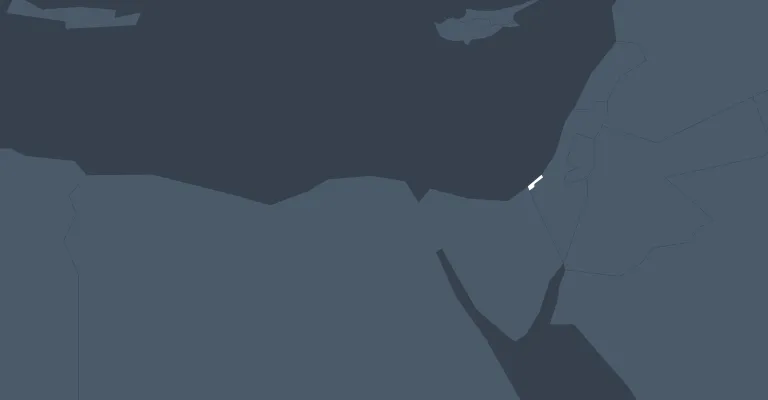
A Note About Related Territories
Territories are sometimes assessed separately from related countries if they meet certain criteria, including significantly different conditions for political rights and civil liberties, and boundaries that are sufficiently stable to allow annual comparisons.
Related Territories: 2026 Global Freedom Score Overview


Click on a scorecard to visit each country's Freedom in the World Report.


The numerical scores and status listed for the Gaza Strip do not reflect the actions of Gaza-based militant groups in Israel or the West Bank, as conditions there are examined in separate reports. Any actions that affect conditions for people within Gaza, such as Israeli military strikes, are captured in this report. Freedom in the World reports assess the level of political rights and civil liberties in a given geographical area, regardless of whether they are affected by the state, nonstate actors, or foreign powers. Related, disputed, or occupied territories are sometimes assessed separately from the relevant countries if they meet certain criteria, including distinct conditions for political rights and civil liberties and boundaries that are sufficiently stable to allow year-on-year comparisons. For more information, see the report methodology and FAQ.
The political rights and civil liberties of Gaza Strip residents are severely constrained or denied. The Palestinian political and militant group known as Hamas, or the Islamic Resistance Movement, gained control of the Gaza Strip in 2007, following its victory in the preceding year’s Palestinian legislative elections and a subsequent conflict with Fatah, the ruling party in the West Bank. The entrenched division between Hamas and the Fatah-led Palestinian Authority (PA) since then has contributed to the repeated postponement of elections, which have not been held in the Gaza Strip since 2006. Hamas—which has been designated as a terrorist organization by the United States, the European Union, and other democracies—governs the territory under its control in an authoritarian manner, actively suppressing criticism of its rule. Since 2007, Israel’s de facto blockade of the territory, periodic military incursions, and rule-of-law violations have imposed serious hardship on the civilian population, as has Egypt’s tight control over the southern border. After Hamas forces killed some 1,200 Israelis and took more than 250 hostages in the most devastating terrorist attack on Israeli territory in October 2023, Israel responded with a military campaign in Gaza that killed tens of thousands of Palestinians and deprived the civilian population of access to adequate water, food, medical care, and shelter. An October 2025 ceasefire left Hamas in de facto control of less than half of the Gaza Strip, with Israeli forces occupying the remainder.
- In October, Israel and Hamas agreed to a ceasefire and the release of Israeli hostages and Palestinian prisoners, which represented the first phase of a 20-point peace plan set forth by the United States. The stipulated release of both living and deceased hostages and prisoners was nearly complete by year’s end. The UN Security Council voted in November to endorse the remaining aspects of the US plan, including the creation of a Board of Peace headed by US President Donald Trump, which would oversee an appointed transitional administration in Gaza as well as an International Stabilization Force to provide security. None of these new entities had been established as of December, and the territory remained divided between Hamas and Israeli forces along a designated ceasefire line.
- According to the UN Office for the Coordination of Humanitarian Affairs (UN OCHA) as of December, more than 71,000 Palestinians had been killed in Gaza since October 2023, up from about 45,000 at the end of 2024; more than 170,000 injuries were also reported. Even after the ceasefire, factors including the extensive physical damage to the territory continued to impede freedom of movement, business activity, education, and other aspects of civilian life. For example, some 89 percent of Gaza’s water and sanitation infrastructure had been damaged or destroyed, more than 92 percent of all housing units and 88 percent of commercial facilities had been damaged or destroyed, and 93 percent of schools required full reconstruction or major rehabilitation, according to UN OCHA.
- Prior to the ceasefire, the conflict continued to drive up casualties among journalists, health workers, and humanitarian aid personnel. As of late 2025, the Committee to Protect Journalists had documented the killing of more than 200 Palestinian journalists and media workers in Gaza since October 2023, up from about 150 at the end of 2024. According to UN OCHA, more than 1,700 health workers were killed over the course of the conflict, and the roughly 580 aid workers killed were employees of UN agencies or nongovernmental organizations.
- In August, the UN-backed Integrated Food Security Phase Classification (IPC) system confirmed that a famine was underway in Gaza, and hundreds of people were reportedly killed by Israeli soldiers or security contractors while attempting to access food from distribution centers or convoys during the year. While more humanitarian assistance began to enter Gaza following the October ceasefire, overall conditions remained dire.
This report has been abridged for Freedom in the World 2026. Freedom in the World is entirely funded by nongovernmental sources such as private foundations, corporations, and individuals like you. Please consider making a donation to support future editions of this vital resource.
For additional background information, see the reports from the 2024 and 2025 editions of Freedom in the World.
A1
1.00-4.00 pts0-4 pts
| Was the current head of government or other chief national authority elected through free and fair elections? | 0.000 4.004 |
A2
1.00-4.00 pts0-4 pts
| Were the current national legislative representatives elected through free and fair elections? | 0.000 4.004 |
A3
1.00-4.00 pts0-4 pts
| Are the electoral laws and framework fair, and are they implemented impartially by the relevant election management bodies? | 0.000 4.004 |
B1
1.00-4.00 pts0-4 pts
| Do the people have the right to organize in different political parties or other competitive political groupings of their choice, and is the system free of undue obstacles to the rise and fall of these competing parties or groupings? | 1.001 4.004 |
B2
1.00-4.00 pts0-4 pts
| Is there a realistic opportunity for the opposition to increase its support or gain power through elections? | 0.000 4.004 |
B3
1.00-4.00 pts0-4 pts
| Are the people’s political choices free from domination by forces that are external to the political sphere, or by political forces that employ extrapolitical means? | 0.000 4.004 |
B4
1.00-4.00 pts0-4 pts
| Do various segments of the population (including ethnic, racial, religious, gender, LGBT+, and other relevant groups) have full political rights and electoral opportunities? | 0.000 4.004 |
C1
1.00-4.00 pts0-4 pts
| Do the freely elected head of government and national legislative representatives determine the policies of the government? | 0.000 4.004 |
C2
1.00-4.00 pts0-4 pts
| Are safeguards against official corruption strong and effective? | 0.000 4.004 |
C3
1.00-4.00 pts0-4 pts
| Does the government operate with openness and transparency? | 0.000 4.004 |
.
Add Q
| Is the government or occupying power deliberately changing the ethnic composition of a country or territory so as to destroy a culture or tip the political balance in favor of another group? | -3.00-3 |
D1
1.00-4.00 pts0-4 pts
| Are there free and independent media? | 0.000 4.004 |
D2
1.00-4.00 pts0-4 pts
| Are individuals free to practice and express their religious faith or nonbelief in public and private? | 1.001 4.004 |
D3
1.00-4.00 pts0-4 pts
| Is there academic freedom, and is the educational system free from extensive political indoctrination? | 0.000 4.004 |
D4
1.00-4.00 pts0-4 pts
| Are individuals free to express their personal views on political or other sensitive topics without fear of surveillance or retribution? | 2.002 4.004 |
E1
1.00-4.00 pts0-4 pts
| Is there freedom of assembly? | 0.000 4.004 |
E2
1.00-4.00 pts0-4 pts
| Is there freedom for nongovernmental organizations, particularly those that are engaged in human rights– and governance-related work? | 0.000 4.004 |
E3
1.00-4.00 pts0-4 pts
| Is there freedom for trade unions and similar professional or labor organizations? | 0.000 4.004 |
F1
1.00-4.00 pts0-4 pts
| Is there an independent judiciary? | 0.000 4.004 |
F2
1.00-4.00 pts0-4 pts
| Does due process prevail in civil and criminal matters? | 0.000 4.004 |
F3
1.00-4.00 pts0-4 pts
| Is there protection from the illegitimate use of physical force and freedom from war and insurgencies? | 0.000 4.004 |
F4
1.00-4.00 pts0-4 pts
| Do laws, policies, and practices guarantee equal treatment of various segments of the population? | 0.000 4.004 |
G1
1.00-4.00 pts0-4 pts
| Do individuals enjoy freedom of movement, including the ability to change their place of residence, employment, or education? | 0.000 4.004 |
G2
1.00-4.00 pts0-4 pts
| Are individuals able to exercise the right to own property and establish private businesses without undue interference from state or nonstate actors? | 0.000 4.004 |
G3
1.00-4.00 pts0-4 pts
| Do individuals enjoy personal social freedoms, including choice of marriage partner and size of family, protection from domestic violence, and control over appearance? | 1.001 4.004 |
G4
1.00-4.00 pts0-4 pts
| Do individuals enjoy equality of opportunity and freedom from economic exploitation? | 0.000 4.004 |

Country Facts
-
Global Freedom Score
2 100 not free
