


Perspectives April 22, 2026
Freedom House Experts on What Trump Should Discuss with Xi in Beijing
Freedom House experts urge the United States to raise the release of political prisoners, Taiwan, transnational repression, sanctions evasion, and more.
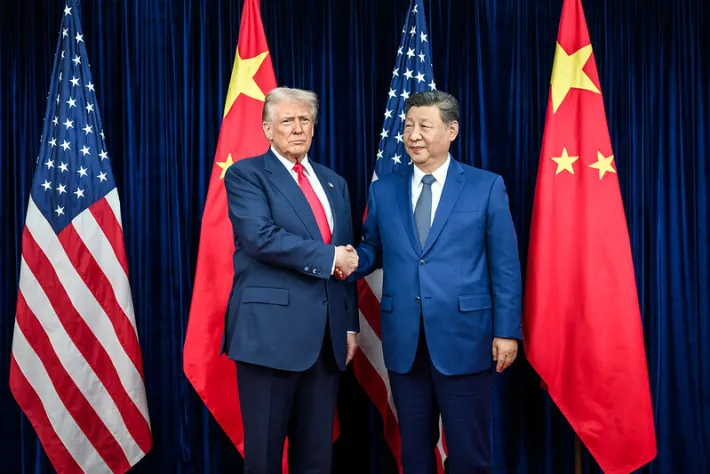
President Donald Trump greets Chinese President Xi Jinping before a bilateral meeting at the Gimhae International Airport terminal, Thursday, October 30, 2025, in Busan, South Korea. (Photo Credit: Daniel Torok/The White House)
A planned summit between President Donald Trump and Chinese Communist Party (CCP) General Secretary Xi Jinping is now set to take place May 14–15 in Beijing. While US officials have indicated that trade relations are at the top of the agenda, the high-level meeting comes as the CCP is deepening political and economic relationships around the world, continuing to clamp down on freedoms at home, using its growing military to threaten China’s neighbors, and enabling authoritarian states, including Iran.
“The US-China relationship will define the fate of global security in the 21st century,” said Jamie Fly, CEO of Freedom House. “A China where the Chinese people can exercise their universal rights will be a better partner for the United States and the rest of the free world. Any engagement of the CCP should recognize this fact and ensure that American leverage is applied to seek the release of political prisoners, protection of Taiwan’s autonomy, and Beijing’s respect for ethnic minorities.”
As Xi tightens his grip over domestic affairs while asserting the CCP’s presence abroad, we asked Freedom House experts to identify key issues that merit attention at the upcoming Trump-Xi summit—and which Freedom House will continue to track closely, given the serious consequences if they go unaddressed.
Katie LaRoque, Director for Policy and Advocacy
Press for the release of political prisoners and an end to persecution of minority groups.
China has long been recognized as the global leader in political imprisonment. In recent years, the CCP regime has solidified its claim to this title through the mass imprisonment of activists, lawyers, religious believers, minorities, and anyone else it views as a threat. With an estimated half-million Uyghurs detained in Xinjiang alone—which the first Trump administration determined constitutes a crime against humanity—the scale of political imprisonment in China is truly unrivaled.
President Trump has a unique opportunity to score a major diplomatic win for the United States by securing the release of some of the world’s highest-profile political prisoners held by the CCP, including Hong Kong publisher Jimmy Lai and Pastor Ezra Jin, founder and pastor of Zion Church, a large underground network in China that has refused state registration. This tangible outcome—returning to the United States with Jimmy Lai and Pastor Jin on Air Force One—would be a powerful and highly visible demonstration of US leadership. Building on the administration’s commendable record of securing the release of political prisoners worldwide, a breakthrough in these cases could help unlock diplomatic pathways to securing the release of others unjustly detained in China and Hong Kong.
President Trump should also raise the CCP’s repression of Uyghurs, Tibetans, and other ethnic minorities, making clear that these concerns are rooted in core American values and cannot be set aside. Under Xi, authorities have intensified restrictions on freedom of religion and expression, targeting communities for practicing their faith, speaking their language, or expressing their identity—forms of repression the United States cannot accept. A new “ethnic unity” law further entrenches this campaign by mandating Mandarin-language instruction in schools, replacing education previously offered in native languages like Uyghur and Tibetan.
As Freedom House’s Fred Hiatt Program to Free Political Prisoners program has found, political imprisonment is a key tool for limiting dissent and free expression by facilitating the removal from society of those who challenge the regime. If relations between the United States and China are to improve, the United States should make clear that it expects to see meaningful progress in both the release of political prisoners—including Jimmy Lai and Pastor Ezra Jin—as well as an end to policies of repression against ethnic minorities.
Kevin Slaten, Research Lead, China Dissent Monitor; Manager, Taiwan Office
Signal that the United States will deter adventurism in Taiwan.
I’ll be watching whether the United States chooses to check or accommodate Xi Jinping’s authoritarian ambitions. Xi’s rule has become characterized by a deepened autocracy with power centralized in his own hands. He has led the dismantlement of independent civil society, mass arbitrary internment of Uyghurs, and intensified surveillance and censorship throughout the country. Recent years have proven that it is an expansionist authoritarianism couched in nationalism. As economic and demographic headwinds mount in China, contributing to a nearly 50 percent rise in protest, according to Freedom House’s China Dissent Monitor, focusing domestic attention on external adventures has become even more critical to Xi maintaining power. This is what drove him to disregard international obligations and crush freedom in Hong Kong. And it is what underlies his continual march toward using coercion to threaten Taiwan’s democracy.
If the United States understands that Xi’s machinations against Taiwan are domestically and ideologically motivated, then there is no amount of dealing that will make him desire otherwise. To ensure the continued survival of one the strongest democracies in Asia, the United States must signal through rhetoric and action that it will deter Xi’s efforts to change the status quo with Taiwan.
Yana Gorokhovskaia, Research Director, Strategy and Design
Confront Xi about the CCP’s aggressive campaign of transnational repression.
It is in the United States’ interest for President Donald Trump to raise directly with President Xi that China’s campaign of transnational repression is an unacceptable threat to fundamental freedom and national security. According to Freedom House’s data, China is responsible for almost a quarter of all recorded cases of physical transnational repression in the world since 2014. The Chinese government targets a broad range of individuals and groups, including human rights defenders, journalists, international students, former political insiders, as well as members of religious and ethnic minorities. It relies on tactics like digital surveillance, forced returns, assault, assassinations, and threats against families. As a new report from ChatGPT, the generative artificial intelligence chatbot developed by OpenAI, reveals, intimidating overseas activists is an everyday task for some Chinese security officials.
People living in the United States are not safe from this campaign. The Federal Bureau of Investigation (FBI) has said that China’s transnational repression is becoming more brazen and includes setting up secret overseas police stations in American cities, recruiting criminal groups and private investigators to surveil and harass dissidents, and destroying artwork that is critical of the Chinese Communist Party.
The United States pioneered much of the security and communications strategies currently used by democratic countries to combat transnational repression. Leader-to-leader public diplomacy remains one of the most important tools for pushing back on this tactic of global authoritarianism.
Samy G., Senior Program Manager
Emphasize that the United States believes religious freedom is a universal right.
In recent years, Chinese authorities have increased control over how people practice their religion, including through advanced surveillance technologies such as facial recognition, and they have implemented policies that try to make religion fit within the CCP’s ideology and ensure loyalty to the regime. Groups that do not follow the state’s rules, like house churches, have been targeted. Many of these groups have been stopped from meeting and their leaders have been harassed, detained, or put on house arrest, and their places of worship have been subject to destruction.
In this context, Freedom House is calling for the immediate release of Pastor Ezra Jin, along with approximately 18 other pastors associated with Zion Church, who have remained in detention since an October 2025 crackdown and face charges that carry up to three years in prison.
Authorities have also sent members of religious minorities, especially Uyghur Muslims, to “reeducation” centers, where they are subjected to political and religious indoctrination and pressured to abandon their faith. Tibetan Buddhists or Chinese who practice Falun Gong are also being targeted all over China. Freedom House has been active in assisting those targeted by helping them access lawyers, supporting their families while they are in detention, enabling families to afford visiting prisoners, offering them basic supplies, and sometimes even helping them relocate to a safe place. Freedom House also works closely with diaspora communities, maintaining support and direct connections with survivors and rights defenders facing religious persecution in China. This engagement supports the ongoing documentation of cases and enables quicker responses when new incidents occur.
US authorities should communicate that religious freedom is a universal human right. They should also make clear that the US government will impose targeted sanctions against those who violate that right and will seek to support affected communities, both inside China and abroad.
Masha Donnelly, Chief of Staff
Confront Xi about China’s role facilitating sanctions evasion.
Recent investigations show that Chinese and Hong Kong-based firms supplied roughly 76 percent of battlefield goods reaching Russia and that more than 4,000 Chinese companies have engaged with sanctioned Russian defense entities. Chinese actors also serve as the primary economic lifeline for the Iranian regime, purchasing the vast majority of its sanctioned oil and enabling financial networks that convert those revenues into funding for its nuclear program, missile development, and affiliated armed groups. The decision to temporarily lift sanctions on Russian and Iranian oil, taken to manage energy-market fallout from strikes on Iran, further cedes leverage. The illicit financial channels that corrupt and repressive governments rely on also enable authoritarian regimes in Latin America, and accelerate the development of parallel financial infrastructure outside of US visibility.
Instead of providing adversarial regimes access to additional revenue and giving away bargaining chips, the United States should reassert its ability to punish authoritarian actors by making clear to Beijing that sanctions will be enforced.
The key to effective enforcement of US sanctions lies in regulatory tolerance and financial channels that sit within Beijing’s control. Chinese authorities could restrict these flows, but Chinese state-linked institutions facilitate cross-border payments tied to sanctioned trade. This is a direct challenge to US interests and one that should be addressed at the highest level between President Trump and Xi Jinping.
Kian Vesteinsson, Senior Research Analyst for Technology and Democracy
Revive export controls on advanced semiconductors and fabrication equipment to thwart digital authoritarianism.
The president should use the summit to ensure that US companies and artificial intelligence (AI) expertise do not fuel the CCP’s apparatus of censorship and surveillance. The imposition of export controls on state-of-the-art semiconductors, often referred to as chips, and the equipment needed for their fabrication offers one point of leverage. Chinese firms have lagged in the race to develop state-of-the-art semiconductors. Export controls on advanced semiconductors and fabrication equipment could be revived to include licenses that limit end-uses involving military or law enforcement activities.
China has ranked as the world’s worst environment for internet freedom for over a decade in Freedom House’s Freedom on the Net index, as the CCP has built a repressive regime of censorship and surveillance designed to silence dissent and maintain control. These tools are increasingly powered by artificial intelligence, as with movement-tracing technology for retribution against protesters and speech-recognition software tailored to surveil minority ethnic groups. These technologies process an enormous volume of data, requiring significant computational power to carry out the CCP’s agenda for repression. Regardless of the policy mechanism, the president should seek to prevent US AI expertise from being abused for the CCP’s agenda of digital authoritarianism.