

Jordan
Partly Free
44
100
| A Obstacles to Access | 14 25 |
| B Limits on Content | 15 35 |
| C Violations of User Rights | 15 40 |
Last Year's Score & Status
47
100
Partly Free
Scores are based on a scale of 0 (least free) to 100 (most free).
See the methodology and report acknowledgements.
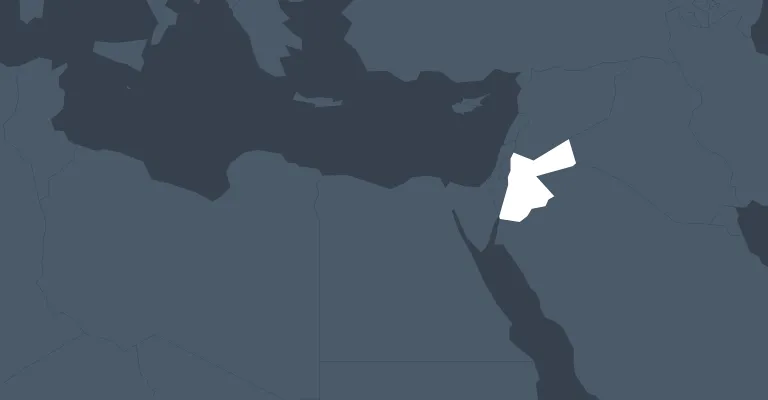


Internet freedom declined in Jordan due to a spike in false and misleading information around the conflict in Iran and because the government issued reporting bans during politically sensitive moments. Localized blocking of communication platforms took place during school exams,1 and the Cybercrime Law was used to stifle freedom of expression online. Journalists, activists, and social media users continued to face prosecution, harassment, and surveillance in response to their online criticism of the government or commentary on sensitive topics such as Israel’s conduct in the Gaza Strip.
This report has been abridged for Freedom on the Net 2026. Please consider making a donation to support future editions of this vital resource. For additional information, see the 2024 full report and 2025 abridged report.
- 1@AlMamlaka TV, “Nine communications apps will be temporarily banned at Tawjihi…” Facebook, June 18, 2025, https://www.facebook.com/AlMamlakaTV/videos/9988565311238648/; “Jordan: Messaging apps blocked near high school exam centers – details,” Saraha News, June 18, 2025, https://www.sarahanews.net/1170934-%D8%A7%D9%84%D8%A3%D8%B1%D8%AF%D9%86….
A1
1.00-6.00 pts0-6 pts
| Do infrastructural limitations restrict access to the internet or the speed and quality of internet connections? | 5.005 6.006 |
A2
1.00-3.00 pts0-3 pts
| Is access to the internet prohibitively expensive or beyond the reach of certain segments of the population for geographical, social, or other reasons? | 1.001 3.003 |
A3
1.00-6.00 pts0-6 pts
| Does the government exercise technical or legal control over internet infrastructure for the purposes of restricting connectivity? | 4.004 6.006 |
A4
1.00-6.00 pts0-6 pts
| Are there legal, regulatory, or economic obstacles that restrict the diversity of service providers? | 3.003 6.006 |
A5
1.00-4.00 pts0-4 pts
| Do national regulatory bodies that oversee service providers, digital platforms, and the internet more broadly fail to operate in a free, fair, and independent manner? | 1.001 4.004 |
B1
1.00-6.00 pts0-6 pts
| Does the state block or filter, or compel service providers to block or filter, internet content, particularly material that is protected by international human rights standards? | 3.003 6.006 |
B2
1.00-4.00 pts0-4 pts
| Do state or nonstate actors employ legal, administrative, or other means to force publishers, digital platforms, content hosts, or other intermediaries to delete content, particularly material that is protected by international human rights standards? | 1.001 4.004 |
B3
1.00-4.00 pts0-4 pts
| Do restrictions on the internet and digital content lack transparency, proportionality to the stated aims, or an independent appeals process? | 1.001 4.004 |
B4
1.00-4.00 pts0-4 pts
| Do journalists, commentators, and ordinary people practice self-censorship online? | 2.002 4.004 |
B5
1.00-4.00 pts0-4 pts
| Are online sources of information controlled or manipulated by the government or other powerful actors to advance a favored interest? | 2.002 4.004 |
B6
1.00-3.00 pts0-3 pts
| Are there economic, regulatory, or other constraints that negatively affect individuals’ ability to publish content online? | 1.001 3.003 |
B7
1.00-4.00 pts0-4 pts
| Does the online information landscape lack diversity and reliability? | 2.002 4.004 |
Score Change: The score declined from 3 to 2 because the online environment is increasingly less reliable,1 primarily because of the proliferation of misinformation as well as the Media Commission’s use of reporting bans during politically sensitive moments, which was exacerbated by the ongoing regional conflict.2
- 1“Akeed Logs 96 Rumors in January, Says 90% Originated on Social Media,” Jordan News Agency, January 2, 2026, https://petra.gov.jo/ar/index.php/en/news/akeed-logs-96-rumors-in-janua…; Rana Sabbagh, “Jordan's Impossible Balancing Act,” Al Hurra, July 2026, https://alhurra.com/en/28499?utm_source.
- 2“The Media Authority prohibits the publication or filming of any information related to the Kingdom’s defense operations,” Addustour, March 3, 2026, https://www.addustour.com/articles/1552109-%D9%87%D9%8A%D8%A6%D8%A9-%D8…; “Jordan tightens rules on street reporting to curb trend-chasing, media chaos,” The Arab Weekly, July 20, 2025, https://www.thearabweekly.com/jordan-tightens-rules-street-reporting-cu….
B8
1.00-6.00 pts0-6 pts
| Do conditions impede individuals’ ability to form communities, mobilize, and campaign online, particularly on political and social issues? | 3.003 6.006 |
C1
1.00-6.00 pts0-6 pts
| Do the constitution or other laws fail to protect rights such as freedom of expression, access to information, and press freedom, including on the internet, and are they enforced by a judiciary that lacks independence? | 2.002 6.006 |
C2
1.00-4.00 pts0-4 pts
| Are there laws that assign criminal penalties or civil liability for online activities, particularly those that are protected under international human rights standards? | 1.001 4.004 |
C3
1.00-6.00 pts0-6 pts
| Are individuals penalized for online activities, particularly those that are protected under international human rights standards? | 2.002 6.006 |
Score Change: The score declined from 3 to 2 because authorities used the 2023 Cybercrime Law to detain and interrogate people for their online expression during the coverage period and to impose harsh criminal penalties—including several multiyear prison sentences and numerous arrests—for social media posts that were critical of the king or the government’s position on Gaza.1
- 1“The Gulf region and neighbouring countries: Ongoing repression by authorities,” Gulf Center for Human Rights, April 2, 2026, https://www.gc4hr.org/the-gulf-region-and-neighbouring-countries-ongoin…; “Jordan: Activist’s five-year prison sentence for peaceful criticism upheld amid escalating repression,” Amnesty International, September 18, 2025, https://www.amnesty.org/en/latest/news/2025/09/jordan-activists-five-ye…; “Jordan targeting Gaza solidarity in largest arrest campaign in decades,” Middle East Eye, July 15, 2025, https://www.middleeasteye.net/news/jordan-targeting-gaza-solidarity-lar…; “Jordan fuelling 'internal crisis' with Palestine solidarity crackdown, sources say,” Middle East Eye, July 25, 2025, https://www.middleeasteye.net/news/jordan-fuelling-internal-crisis-pale….
C4
1.00-4.00 pts0-4 pts
| Does the government place restrictions on anonymous online communication or encryption? | 2.002 4.004 |
C5
1.00-6.00 pts0-6 pts
| Does state surveillance of internet activities infringe on individuals’ right to privacy? | 2.002 6.006 |
C6
1.00-6.00 pts0-6 pts
| Does monitoring and collection of user data by service providers and other technology companies infringe on individuals’ right to privacy? | 2.002 6.006 |
C7
1.00-5.00 pts0-5 pts
| Are individuals subject to extralegal intimidation or physical violence by state authorities or any other actor in relation to their online activities? | 2.002 5.005 |
Score Change: The score declined from 3 to 2 because security forces reportedly engaged in physical abuse, including torture, against people detained or jailed for their online content, which led to the deaths in custody of at least two online activists,1 including Ahmad Al-Ibrahim, who reportedly died due to police torture just one day after being arrested for sharing social media posts criticizing Israel’s conduct in Gaza.2
- 1“The Gulf region and neighbouring countries: Ongoing repression by authorities,” Gulf Center for Human Rights, April 2, 2026, https://www.gc4hr.org/the-gulf-region-and-neighbouring-countries-ongoin….
- 2“Engineer Ahmad Al-Ibrahim: A New Victim of Torture at the Hands of Jordanian Security Forces,” Arab Organisation for Human Rights in the UK, July 22, 2025, https://aohr.org.uk/%D8%BA%D8%B2%D8%A9-%D8%A7%D9%84%D9%81%D8%AA%D8%A7%D…; @kaler_barta, “In a case that has sparked widespread condemnation across the Middle East, a young Jordanian engineer…” Instagram, March 17, 2026, https://www.instagram.com/p/DWAVM1HGHZN/.
C8
1.00-3.00 pts0-3 pts
| Are websites, governmental and private entities, service providers, or individuals subject to widespread hacking and other forms of cyberattack? | 2.002 3.003 |


Country Facts
-
Population
11,290,000 -
Global Freedom Score
34 100 partly free -
Internet Freedom Score
44 100 partly free -
Freedom in the World Status
Partly Free
