

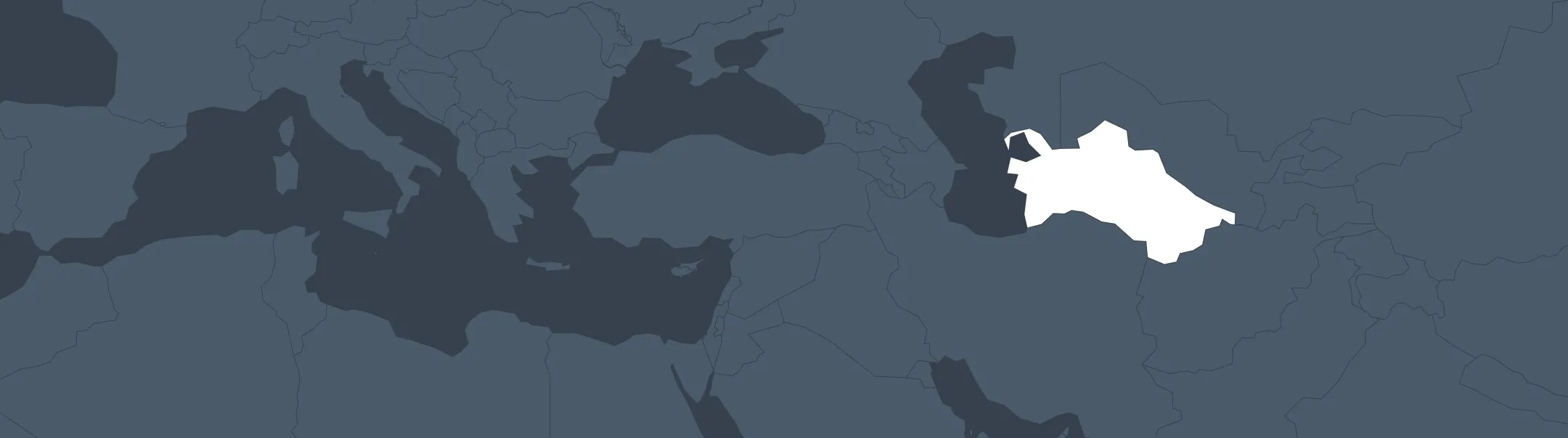

Turkmenistan
Freedom at a Glance
Global Freedom
1 / 100
Not Free


Turkmenistan is a repressive authoritarian state where political rights and civil liberties are almost completely denied in practice. Elections are tightly controlled, the economy is dominated by the state, corruption is systemic, religious groups are persecuted, and political dissent is not tolerated.
Research & Recommendations
Turkmenistan
Not Free
1
100
| PR Political Rights | 0 40 |
| CL Civil Liberties | 1 60 |
Last Year's Score & Status
1
100
Not Free
A country or territory’s Freedom in the World status depends on its aggregate Political Rights score, on a scale of 0–40, and its aggregate Civil Liberties score, on a scale of 0–60.
See the methodology.
Overview
Turkmenistan is a repressive authoritarian state where political rights and civil liberties are almost completely denied in practice. Elections are tightly controlled, ensuring nearly unanimous victories for the president and his supporters. The economy is dominated by the state, corruption is systemic, religious groups are persecuted, and political dissent is not tolerated.
Freedom in the World 2026 Policy Recommendations
Strengthen democratic coordination and collective action in a contested global order
Democratic resilience will increasingly depend on stronger coordination among countries that share a commitment to freedom, the rule of law, and accountable governance.
Reimagine international democracy assistance to help reverse the global decline in freedom
International support for democratic institutions, civil society, and independent media has been associated with modest but meaningful improvements in democratic governance, and it is far less costly than the military outlays necessitated by rising authoritarian aggression.
Prioritize engagement with younger generations in the digital spaces where civic identity is now formed
Young people are increasingly dissatisfied with democracy—not because they reject its principles, but because they see institutions failing to deliver on them. Programmatic work should create clear pathways for meaningful political participation, from voting and policy engagement to community organizing and public leadership, so that young people can translate their expectations into agency.
Turkmenistan
0
100
| DEMOCRACY-PERCENTAGE Democracy Percentage | 0.00 100 |
| DEMOCRACY-SCORE Democracy Score | 1.00 7 |
Last Year's Democracy Percentage & Status
0
100
The ratings are based on a scale of 1 to 7, with 7 representing the highest level of democratic progress and 1 the lowest. The Democracy Score is an average of ratings for the categories tracked in a given year. The Democracy Percentage, introduced in 2020, is a translation of the Democracy Score to the 0-100 scale, where 0 equals least democratic and 100 equals most democratic.
See the methodology.
Executive Summary
In 2023, Turkmenistan remained an autocracy ruled by the strongman Gurbanguly Berdimuhamedow and his son, President Serdar Berdimuhamedow. The year was marked by the elder Berdimuhamedow’s return to power. In January, the parliament adopted constitutional changes that again made the Halk Maslahaty (People’s Council), which Gurbanguly chairs, the highest political body in Turkmenistan. The amendments also bestowed upon Gurbanguly the constitutional status of “National Leader of the Turkmen people,” which gave him far-reaching authority to shape domestic and foreign policy.
Nations in Transit 2024 Policy Recommendations
Ensure that Moscow’s invasion of Ukraine is soundly defeated.
The future of European democracy and security is now inextricably linked to the fate of Ukraine. European Union (EU) and NATO member states must not only invest far more—and more efficiently—in their collective defense, but also provide Ukraine with the assistance it needs to roll back Russian advances and build a durable democracy of its own.
Support democratic renewal and reform.
In addition to defending the international order from emboldened autocrats, democratic governments must attend to democratic renewal within Europe, particularly among nascent democracies.
Provide consistent messaging and support to Europe’s aspiring democracies.
Military aggression from autocracies in the region has underscored the dangers of exclusion from democracy-based organizations like the EU and NATO, galvanizing the political will of policymakers in aspiring member states and generating further public pressure to undertake long-sought democratic reforms.
News and Updates
Featured

Freedom House Perspectives


News Releases & Media Coverage

Country Facts
Basic Facts
Freedom in the World Score
1
/ 100
Not Free
Nations in Transit Score
0
/ 100
Population: 6,431,000
Internet Facts
Status
Not Tracked
Election Facts
Status
Not Tracked
Transnational Repression
Status
Not Tracked
