

Venezuela
Not Free
26
100
| A Obstacles to Access | 9 25 |
| B Limits on Content | 9 35 |
| C Violations of User Rights | 8 40 |
Last Year's Score & Status
26
100
Not Free
Scores are based on a scale of 0 (least free) to 100 (most free).
See the methodology and report acknowledgements.
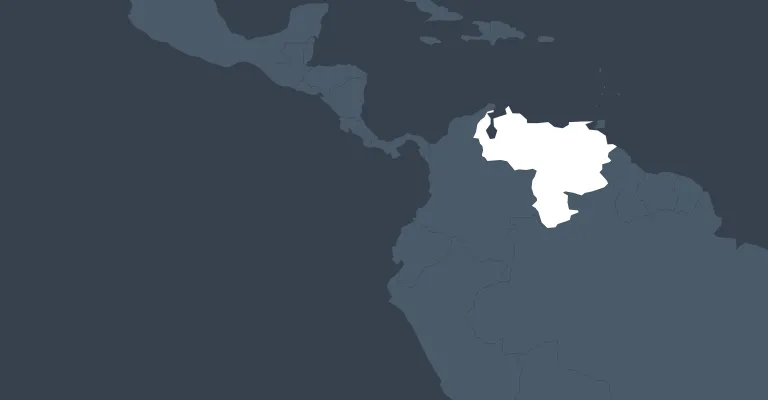


Internet freedom remained restricted in Venezuela during the coverage period. While President Nicolás Maduro, who had overseen a campaign of severe repression since 2013, was captured by US special forces in January 2026, the interim government that succeeded him retained tight control over online expression and access to online information. Widespread and prolonged blocking of news sites, social media and communications platforms, and anticensorship tools continued,1 although several long-blocked news websites were made accessible in September 2026 after the coverage period.2 The manipulation of online content,3 arrests and imprisonment for social media posts,4 and mass digital surveillance5 also continued to be pervasive.
This report has been abridged for Freedom on the Net 2026. Please consider making a donation to support future editions of this vital resource. For additional information, see the 2024 full report and 2025 abridged report.
- 1VEsinFiltro, “Censored Network: Restrictions on #InternetVE,” January 17, 2026, https://vesinfiltro.org/noticias/2025-censorship-report/.
- 2Emilio Reynoso, “Venezuela unblocks some news websites censored for years,” Deutsche Welle, September 18, 2026, https://www.dw.com/en/venezuela-unblocks-some-news-websites-censored-fo….
- 3Andrés Azpúrua and Iria Puyosa, “Watch the Watchers: Surveillance technologies for political control in Venezuela,” VEsinFiltro and DFRLab, March 2026, https://vesinfiltro.org/res/files/VSF-DFRLab-Watch_the_Watchers.pdf; Instituto Prensa y Sociedad de Venezuela, “Filtración expone cómo el oficialismo intenta ‘ordenar el relato’ tras la captura de Maduro para contener la fractura interna [A leak exposes how the ruling party is trying to ‘control the narrative’ after Maduro's capture in order to contain the internal rift],” January 12, 2026, https://ipysvenezuela.org/2026/01/12/filtracion-expone-como-el-oficiali….
- 4Espacio Público, “Líder comunitario Manuel Sánchez condenado a 10 años de prisión por hacer denuncias en Tik Tok [Community leader Manuel Sánchez sentenced to 10 years in prison for making accusations on TikTok],” January 29, 2026, https://espaciopublico.ong/manuel-sanchez-condenado-10-anos-hacer-denun….
- 5Andrés Azpúrua and Iria Puyosa, “Watch the Watchers: Surveillance technologies for political control in Venezuela,” VEsinFiltro and DFRLab, March 2026, https://vesinfiltro.org/res/files/VSF-DFRLab-Watch_the_Watchers.pdf.
A1
1.00-6.00 pts0-6 pts
| Do infrastructural limitations restrict access to the internet or the speed and quality of internet connections? | 3.003 6.006 |
A2
1.00-3.00 pts0-3 pts
| Is access to the internet prohibitively expensive or beyond the reach of certain segments of the population for geographical, social, or other reasons? | 0.000 3.003 |
A3
1.00-6.00 pts0-6 pts
| Does the government exercise technical or legal control over internet infrastructure for the purposes of restricting connectivity? | 4.004 6.006 |
Score Change: The score improved from 3 to 4 because localized disruptions to internet connectivity were not reported during the coverage period, unlike in past years.
A4
1.00-6.00 pts0-6 pts
| Are there legal, regulatory, or economic obstacles that restrict the diversity of service providers? | 2.002 6.006 |
A5
1.00-4.00 pts0-4 pts
| Do national regulatory bodies that oversee service providers, digital platforms, and the internet more broadly fail to operate in a free, fair, and independent manner? | 0.000 4.004 |
B1
1.00-6.00 pts0-6 pts
| Does the state block or filter, or compel service providers to block or filter, internet content, particularly material that is protected by international human rights standards? | 1.001 6.006 |
B2
1.00-4.00 pts0-4 pts
| Do state or nonstate actors employ legal, administrative, or other means to force publishers, digital platforms, content hosts, or other intermediaries to delete content, particularly material that is protected by international human rights standards? | 1.001 4.004 |
B3
1.00-4.00 pts0-4 pts
| Do restrictions on the internet and digital content lack transparency, proportionality to the stated aims, or an independent appeals process? | 0.000 4.004 |
B4
1.00-4.00 pts0-4 pts
| Do journalists, commentators, and ordinary people practice self-censorship online? | 1.001 4.004 |
B5
1.00-4.00 pts0-4 pts
| Are online sources of information controlled or manipulated by the government or other powerful actors to advance a favored interest? | 1.001 4.004 |
B6
1.00-3.00 pts0-3 pts
| Are there economic, regulatory, or other constraints that negatively affect individuals’ ability to publish content online? | 1.001 3.003 |
B7
1.00-4.00 pts0-4 pts
| Does the online information landscape lack diversity and reliability? | 1.001 4.004 |
B8
1.00-6.00 pts0-6 pts
| Do conditions impede individuals’ ability to form communities, mobilize, and campaign online, particularly on political and social issues? | 3.003 6.006 |
C1
1.00-6.00 pts0-6 pts
| Do the constitution or other laws fail to protect rights such as freedom of expression, access to information, and press freedom, including on the internet, and are they enforced by a judiciary that lacks independence? | 1.001 6.006 |
C2
1.00-4.00 pts0-4 pts
| Are there laws that assign criminal penalties or civil liability for online activities, particularly those that are protected under international human rights standards? | 0.000 4.004 |
C3
1.00-6.00 pts0-6 pts
| Are individuals penalized for online activities, particularly those that are protected under international human rights standards? | 1.001 6.006 |
C4
1.00-4.00 pts0-4 pts
| Does the government place restrictions on anonymous online communication or encryption? | 2.002 4.004 |
C5
1.00-6.00 pts0-6 pts
| Does state surveillance of internet activities infringe on individuals’ right to privacy? | 1.001 6.006 |
Score Change: The score declined from 2 to 1 because state surveillance has become more pervasive in recent years, including through increasingly expansive state-sponsored applications that collect large swaths of personal data, systemic monitoring of social media platforms and messaging applications, and routine mobile-device searches.1
- 1Ibid.
C6
1.00-6.00 pts0-6 pts
| Does monitoring and collection of user data by service providers and other technology companies infringe on individuals’ right to privacy? | 2.002 6.006 |
C7
1.00-5.00 pts0-5 pts
| Are individuals subject to extralegal intimidation or physical violence by state authorities or any other actor in relation to their online activities? | 1.001 5.005 |
C8
1.00-3.00 pts0-3 pts
| Are websites, governmental and private entities, service providers, or individuals subject to widespread hacking and other forms of cyberattack? | 0.000 3.003 |


Country Facts
-
Population
28,300,000 -
Global Freedom Score
13 100 not free -
Internet Freedom Score
26 100 not free -
Freedom in the World Status
Not Free
