

West Bank*
Not Free
22
100
| PR Political Rights | 4 40 |
| CL Civil Liberties | 18 60 |
Last Year's Score & Status
22
100
Not Free
A country or territory’s Freedom in the World status depends on its aggregate Political Rights score, on a scale of 0–40, and its aggregate Civil Liberties score, on a scale of 0–60.
See the methodology.
* Indicates a territory as opposed to an independent country.
A Note About Related Territories
Territories are sometimes assessed separately from related countries if they meet certain criteria, including significantly different conditions for political rights and civil liberties, and boundaries that are sufficiently stable to allow annual comparisons.
Related Territories: 2026 Global Freedom Score Overview


Click on a scorecard to visit each country's Freedom in the World Report.


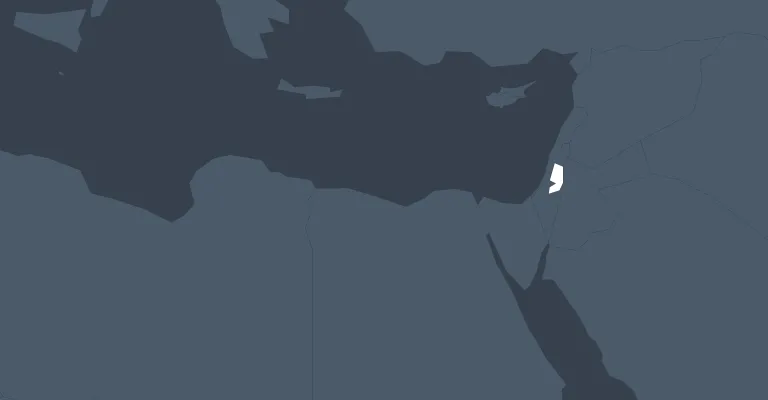
The numerical scores and status listed for the West Bank do not reflect developments in the Gaza Strip or Israel, as conditions there are examined in separate reports. Any actions that affect conditions for people within the West Bank, including both Palestinian residents and Jewish Israeli settlers, are captured in this report. Freedom in the World reports assess the level of political rights and civil liberties in a given geographical area, regardless of whether they are affected by the state, nonstate actors, or foreign powers. Related, disputed, or occupied territories are sometimes assessed separately from the relevant countries if they meet certain criteria, including distinct conditions for political rights and civil liberties and boundaries that are sufficiently stable to allow year-on-year comparisons. For more information, see the report methodology and FAQ.
Israel’s military occupation of the West Bank entails onerous physical barriers and constraints on movement for Palestinians, demolition of Palestinian homes and other physical infrastructure, restrictions on Palestinians’ political rights and civil liberties, and expanding Jewish settlements that are widely considered to constitute a violation of international law. Jewish settlers in the West Bank are Israeli citizens and have access to the same rights and liberties as other Jewish Israelis. Settlers have enjoyed relative impunity for violence against Palestinians, which is widespread. Terrorist attacks by Palestinians have targeted Israeli civilians in East Jerusalem. Most of the West Bank’s Palestinian residents fall under the administrative jurisdiction of the Palestinian Authority (PA), which operates with an expired presidential mandate and has no functioning legislature. The PA governs in an authoritarian manner, engaging in repression against journalists and activists who present critical views on its rule. East Jerusalem Palestinians are governed directly by Israeli civilian authorities; while a small minority of them have Israeli citizenship, most have a special residency status that denotes a restricted set of rights compared with those of Israeli citizens.
- In January and February, the Israeli military carried out major operations in the Jenin, Tulkarm, and Nur Shams refugee camps in the northern West Bank. Some 32,000 Palestinian residents were forced to leave and prevented from swiftly returning, and about 850 buildings were demolished over the subsequent months. Israeli military and government officials said the raids were part of counterterrorism operations to protect Israeli settlements and settlers. Separately, in June, during Israel’s 12-day war with Iran, Israeli authorities in the West Bank closed roads and checkpoints and imposed other barriers that temporarily sealed off Palestinian towns. The population also reportedly faced an increase in military raids and violence by Jewish Israeli settlers during the conflict.
- Although the overall number of occupation-related killings and demolitions in the West Bank decreased slightly compared with previous years, these practices continued in 2025. According to the UN Office for the Coordination for Humanitarian Affairs, there were some 240 cases of lethal violence by Israelis against Palestinians, including nine perpetrated by Jewish Israeli settlers, as well as 17 killings of Israelis by Palestinians. About 1,700 structures were destroyed during the year, causing the displacement of more than 2,100 people. Meanwhile, the Israeli military reported that the total number of attacks by settlers—including assaults, arson, and other violent crimes against Palestinians or security forces—increased by 27 percent compared with 2024.
- In April, the Palestine Liberation Organization and the PA created the position of vice president and named Hussein al-Sheikh as the first officeholder. PA President Mahmoud Abbas issued a decree in October to confirm that the vice president would serve as interim leader if the president died or was incapacitated. The change, whose legality was questioned by opponents, came amid rising international concerns about the PA’s stability given Abbas’s advanced age, the lack of presidential and legislative elections since 2005 and 2006, and widespread corruption. Although several countries formally recognized the State of Palestine during the year, bringing the total to 156 out of 193 UN member states, the international community continued to insist on substantive Palestinian political reforms and elections.
- In October, the Israeli parliament advanced—in the first of four required readings—a bill that would formally annex all West Bank settlements to Israel, which would be a violation of international law. According to the Israeli nongovernmental organization Peace Now, the government approved a record 54 additional settlements during 2025, compared with a previous high of nine in 2023, and Israel’s Higher Planning Council approved construction of a record 28,000 settlement housing units, nearly double the previous high of about 14,600 from 2023.
This report has been abridged for Freedom in the World 2026. Freedom in the World is entirely funded by nongovernmental sources such as private foundations, corporations, and individuals like you. Please consider making a donation to support future editions of this vital resource.
For additional background information, see the reports from the 2024 and 2025 editions of Freedom in the World.
A1
1.00-4.00 pts0-4 pts
| Was the current head of government or other chief national authority elected through free and fair elections? | 0.000 4.004 |
A2
1.00-4.00 pts0-4 pts
| Were the current national legislative representatives elected through free and fair elections? | 0.000 4.004 |
A3
1.00-4.00 pts0-4 pts
| Are the electoral laws and framework fair, and are they implemented impartially by the relevant election management bodies? | 1.001 4.004 |
B1
1.00-4.00 pts0-4 pts
| Do the people have the right to organize in different political parties or other competitive political groupings of their choice, and is the system free of undue obstacles to the rise and fall of these competing parties or groupings? | 1.001 4.004 |
B2
1.00-4.00 pts0-4 pts
| Is there a realistic opportunity for the opposition to increase its support or gain power through elections? | 0.000 4.004 |
B3
1.00-4.00 pts0-4 pts
| Are the people’s political choices free from domination by forces that are external to the political sphere, or by political forces that employ extrapolitical means? | 1.001 4.004 |
B4
1.00-4.00 pts0-4 pts
| Do various segments of the population (including ethnic, racial, religious, gender, LGBT+, and other relevant groups) have full political rights and electoral opportunities? | 2.002 4.004 |
C1
1.00-4.00 pts0-4 pts
| Do the freely elected head of government and national legislative representatives determine the policies of the government? | 0.000 4.004 |
C2
1.00-4.00 pts0-4 pts
| Are safeguards against official corruption strong and effective? | 1.001 4.004 |
C3
1.00-4.00 pts0-4 pts
| Does the government operate with openness and transparency? | 1.001 4.004 |
.
Add Q
| Is the government or occupying power deliberately changing the ethnic composition of a country or territory so as to destroy a culture or tip the political balance in favor of another group? | -3.00-3 |
D1
1.00-4.00 pts0-4 pts
| Are there free and independent media? | 1.001 4.004 |
D2
1.00-4.00 pts0-4 pts
| Are individuals free to practice and express their religious faith or nonbelief in public and private? | 2.002 4.004 |
D3
1.00-4.00 pts0-4 pts
| Is there academic freedom, and is the educational system free from extensive political indoctrination? | 2.002 4.004 |
D4
1.00-4.00 pts0-4 pts
| Are individuals free to express their personal views on political or other sensitive topics without fear of surveillance or retribution? | 1.001 4.004 |
E1
1.00-4.00 pts0-4 pts
| Is there freedom of assembly? | 1.001 4.004 |
E2
1.00-4.00 pts0-4 pts
| Is there freedom for nongovernmental organizations, particularly those that are engaged in human rights– and governance-related work? | 1.001 4.004 |
E3
1.00-4.00 pts0-4 pts
| Is there freedom for trade unions and similar professional or labor organizations? | 2.002 4.004 |
F1
1.00-4.00 pts0-4 pts
| Is there an independent judiciary? | 1.001 4.004 |
F2
1.00-4.00 pts0-4 pts
| Does due process prevail in civil and criminal matters? | 1.001 4.004 |
F3
1.00-4.00 pts0-4 pts
| Is there protection from the illegitimate use of physical force and freedom from war and insurgencies? | 0.000 4.004 |
F4
1.00-4.00 pts0-4 pts
| Do laws, policies, and practices guarantee equal treatment of various segments of the population? | 1.001 4.004 |
G1
1.00-4.00 pts0-4 pts
| Do individuals enjoy freedom of movement, including the ability to change their place of residence, employment, or education? | 1.001 4.004 |
G2
1.00-4.00 pts0-4 pts
| Are individuals able to exercise the right to own property and establish private businesses without undue interference from state or nonstate actors? | 1.001 4.004 |
G3
1.00-4.00 pts0-4 pts
| Do individuals enjoy personal social freedoms, including choice of marriage partner and size of family, protection from domestic violence, and control over appearance? | 2.002 4.004 |
G4
1.00-4.00 pts0-4 pts
| Do individuals enjoy equality of opportunity and freedom from economic exploitation? | 1.001 4.004 |

Country Facts
-
Global Freedom Score
22 100 not free
