




Perspectives March 19, 2026
After 20 Years of Global Decline, These Basic Freedoms Have Been Hit Hardest
According to the 2026 edition of Freedom in the World, media freedom, personal expression, and due process registered the most severe deterioration over the last two decades.
Written By
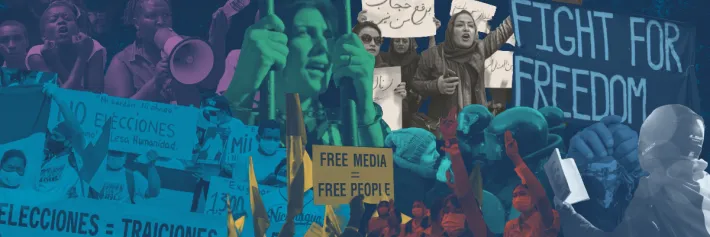
Freedom declined globally for the 20th consecutive year in 2025. Freedom in the World 2026, the latest edition of Freedom House’s annual report on political rights and civil liberties, found that 54 countries experienced a deterioration in conditions, whereas 35 marked an improvement. Over the course of the year, a combination of coups, crackdowns on peaceful protesters, and the consolidation of executive power caused damage to a wide array of fundamental freedoms.
While nearly all of the 25 indicators tracked by Freedom in the World have declined during the last two decades, media freedom, freedom of personal expression, and the right to due process have registered the sharpest downgrades. The global average scores for the three liberties fell by 15 percent, 17 percent, and 15 percent, respectively, over the 20-year period.
If the sustained pressure on these rights continues in the years to come, it will mean reduced accountability for those in power, constrained public debate on major issues and policies, and fewer protections against injustice and arbitrary violations of individual freedom. Creative solutions are needed to ensure that this dangerous erosion can be halted and reversed.
Targeting media freedom
Even freely elected leaders can bristle at being subjected to media scrutiny and have increasingly pushed back with the tools available to them. The process may start with tighter regulatory control, then escalate to the withholding of public funds and redirection of advertising revenue away from critical news outlets. In many cases, government allies in the private sector buy up media houses and impose self-censorship, or journalists face interrogations and other harassment from the authorities.
Virtually all of these tools have been employed in Hungary, where Prime Minister Viktor Orbán’s Fidesz party is seeking to extend its 16 years in power in next month’s elections. Critical journalists and news outlets have increasingly been subjected to legal harassment, for example, and in November a progovernment media company acquired Hungary’s most popular tabloid. Fidesz began its long pattern of measures aimed at undercutting media freedom soon after its 2010 electoral victory: The new government enacted a number of restrictive laws and regulations, and within a few years, it had withdrawn most advertising from independent media and overseen a proliferation of progovernment outlets. The ruling party’s infringements on media freedom and other fundamental rights have contributed to Hungary’s 28-point score decline on Freedom in the World’s 100-point scale over the last 20 years.
Clamping down on personal expression
In recent years, authoritarian regimes have punished critical speech with greater intensity, employing large-scale arrests and prosecutions to create a broader chilling effect among their populations. The repressive campaigns often coincide with mass protests, as security forces work to silence public discussion and online speech about ongoing assemblies and related state abuses.
Iranian authorities, for example, responded to antigovernment protests that began in late 2025 and carried into January 2026 by shutting down the internet, arresting tens of thousands of people, jailing journalists for their coverage of the demonstrations, and killing civilians in the streets—with the reported death toll ranging from nearly 7,000 confirmed killings to estimates of more than 30,000. While Iran has been ranked in the Not Free category for nearly four decades, the regime has grown increasingly intolerant of dissent and has developed sophisticated and draconian methods to monitor and silence its critics, both offline and online. Journalists, activists, and social media users have received lengthy prison sentences—and in some cases death sentences—for online posts that criticized the government. Successive prodemocracy protest movements in the country, from the 2009 Green Revolution to the 2022 Woman Life Freedom uprising, have been met with censorship, mass arrests, and lethal violence.
Undercutting due process rights
The rights of defendants and detainees have suffered as authorities in illiberal and authoritarian settings use politicized criminal charges to restrict peaceful dissent. In Hong Kong, for example, 78-year-old prodemocracy media owner Jimmy Lai was sentenced last month to 20 years in prison on vague charges of collusion with foreign forces and publication of seditious content.
This egregious penalty is just the latest in a series of devastating attacks on civil liberties and the rule of law in Hong Kong as it falls under the Chinese Communist Party’s growing influence. The National Security Law, imposed by Beijing in 2020, contained numerous features that were detrimental to due process rights, including provisions for closed trials and for cases to be transferred to mainland China. The law’s implementation has resulted in arbitrary arrests, prosecutions, and imprisonment, prompting many dissidents to flee abroad, and it is not the only repressive legislation to be adopted in recent years. Just days after Lai’s sentencing, the father of an overseas-based Hong Kong prodemocracy activist received eight months’ imprisonment for offenses under a separate 2024 national security ordinance, marking the first time that such measures had been used against an activist’s family member.
Defending basic rights for the next 20 years
Political rights and civil liberties across the board have come under sustained attack over the last 20 years. Shoring up protections for independent media, safeguarding the right to personal expression, and upholding due process of law must all be made priorities if the world is to turn the tide in favor of freedom. Collective action by democracies and assistance for those facing repression can play a critical role in bolstering these fundamental liberties.
While democratic governments have long worked together to support the advancement of basic rights at home and abroad, in recent years democracies in Europe as well as the United States have pulled away from their traditional activities as defenders of global freedom. The funding cuts of 2025 have had severe and widespread effects on the democracy community around the world. In authoritarian countries, international programs that once helped protect and empower human rights defenders, journalists, activists, and lawyers have been weakened or closed, even as state repression continues unabated.
Policymakers, practitioners, and partners from the democratic community can help champion media freedom by calling out efforts to target journalists and media outlets with arbitrary or punitive investigations, and by denouncing preferential treatment from the government for politically loyal outlets. Scaled-up efforts to support independent media—including public-interest journalism and exile media—should include financial assistance as well as innovative funding models, technical support, skills training, and mentoring.
Democracies must fiercely guard the right to personal expression at home and work vigorously to defend it abroad. Private companies should prioritize the provision of technologies that help individuals in closed environments circumvent government censorship, protect themselves against surveillance, and overcome restrictions on connectivity. To uphold due process, democracy’s defenders can support the improvement of prosecutorial independence and provide assistance for human rights lawyers working in restrictive settings or representing clients who face political persecution.
Targeted democracy assistance can have a tangible impact. Freedom House’s emergency assistance programs, for example, have helped protect more than 17,000 human rights defenders, organizations, and survivors over the past decade. But such assistance cannot rely on shrinking public budgets alone. To reverse the deterioration of media independence, free personal expression, due process, and myriad other rights and liberties that have come under attack during this period of decline, democratic governments must collaborate with philanthropic leaders and the private sector to reimagine their support for the brave activists and ordinary citizens living on the front lines of the global struggle for freedom.