

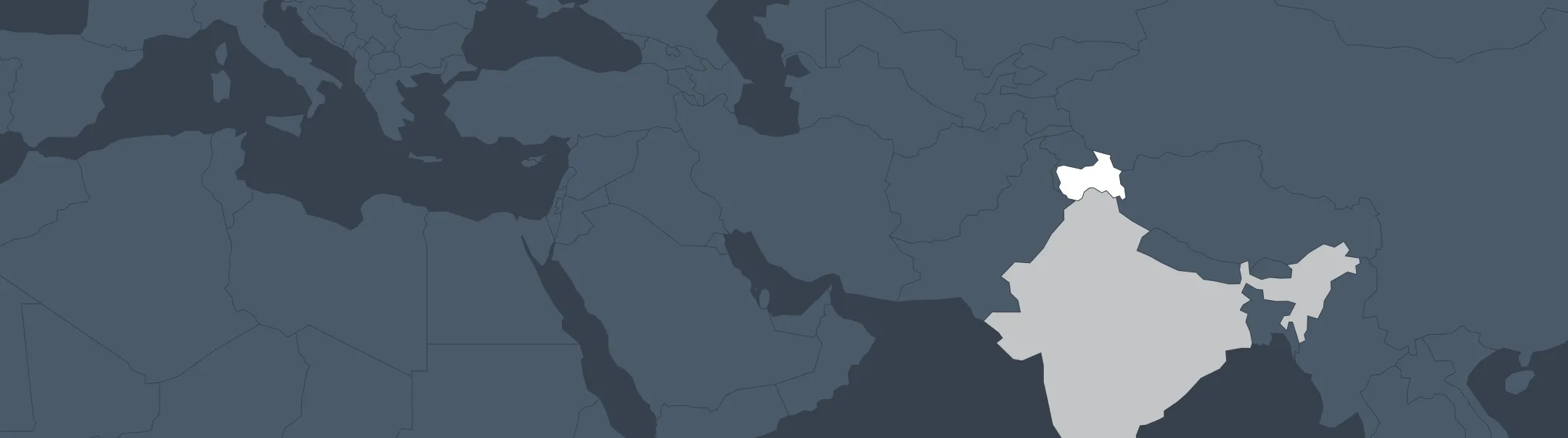
Indian Kashmir
Freedom at a Glance
Global Freedom
38 / 100
Partly Free


Control of Kashmir has been divided between India and Pakistan since 1948, and Indian-administered Kashmir long enjoyed substantial autonomy under India’s constitution. However, the region’s autonomous status was revoked in 2019, and what had been the state of Jammu and Kashmir was reconstituted as two union territories under the direct control of the Indian central government. The move stripped residents of many of their previous political rights.
Research & Recommendations
Indian Kashmir*
Partly Free
38
100
| PR Political Rights | 17 40 |
| CL Civil Liberties | 21 60 |
Last Year's Score & Status
38
100
Partly Free
A country or territory’s Freedom in the World status depends on its aggregate Political Rights score, on a scale of 0–40, and its aggregate Civil Liberties score, on a scale of 0–60.
See the methodology.
* Indicates a territory as opposed to an independent country.
Overview
Control of Kashmir has been divided between India and Pakistan since 1948, and Indian-administered Kashmir long enjoyed substantial autonomy under India’s constitution. However, the region’s autonomous status was revoked in 2019, and the state of Jammu and Kashmir was reconstituted as two union territories under the direct control of the Indian central government. The move stripped residents of many of their previous political rights, and civil liberties were curtailed to quell public opposition. While one of the union territories, Jammu and Kashmir, held legislative elections in 2024, Indian authorities as of 2025 had yet to comply with 2023 Supreme Court instructions to restore its status as a state. The other union territory, Ladakh, has no elected executive or legislature. Indian security forces are frequently accused of human rights violations in the region, but perpetrators are rarely punished. Separatist and jihadist militants continue to wage a protracted insurgency.
Freedom in the World 2026 Policy Recommendations
Strengthen democratic coordination and collective action in a contested global order
Democratic resilience will increasingly depend on stronger coordination among countries that share a commitment to freedom, the rule of law, and accountable governance.
Reimagine international democracy assistance to help reverse the global decline in freedom
International support for democratic institutions, civil society, and independent media has been associated with modest but meaningful improvements in democratic governance, and it is far less costly than the military outlays necessitated by rising authoritarian aggression.
Prioritize engagement with younger generations in the digital spaces where civic identity is now formed
Young people are increasingly dissatisfied with democracy—not because they reject its principles, but because they see institutions failing to deliver on them. Programmatic work should create clear pathways for meaningful political participation, from voting and policy engagement to community organizing and public leadership, so that young people can translate their expectations into agency.
News and Updates

Freedom House Perspectives


News Releases & Media Coverage
Country Facts
Basic Facts
Freedom in the World Score
38
/ 100
Partly Free
Internet Facts
Status
Not Tracked
Election Facts
Status
Not Tracked
Transnational Repression
Status
Not Tracked
Note: Freedom in the World reports assess the level of political rights and civil liberties in a given geographical area, regardless of whether they are affected by the state, nonstate actors, or foreign powers. Disputed territories are sometimes assessed separately if they meet certain criteria, including boundaries that are sufficiently stable to allow year-on-year comparisons. For more information, see the report methodology and FAQ.
