

Special Report
2026
Collaboration and Resistance: Tracking Transnational Repression in 2025


Freedom House recorded 126 new incidents of physical, direct transnational repression during the year, bringing the total number of cases in our database, which spans 2014 to 2025, to 1,375.
Last year, governments all over the world assassinated, assaulted, kidnapped, threatened, and harassed critics beyond their borders. Freedom House recorded 126 new incidents of physical, direct transnational repression during the year, bringing the total number of cases in our database, which spans 2014 to 2025, to 1,375.
Autocrats collaborating in Southeast Asia and in East Africa were responsible for the majority of incidents recorded during the year. Thailand cooperated with both Chinese and Vietnamese authorities to detain and return members of minority groups. The deportation of 40 Uyghur men to China in February cemented China’s status as the world’s leading perpetrator of transnational repression. In East Africa, Kenyan, Ugandan, and Tanzanian authorities helped each other track, detain, and return activists in an effort to impede civic mobilization ahead of and during elections.
The group of perpetrator governments expanded. Six new states—Afghanistan, Benin, Georgia, Kenya, Tanzania, and Zimbabwe—were identified as using tactics of transnational repression. As of 2025, at least 54 governments, or over a quarter of all countries in the world, have tried to silence dissidents abroad.
With 49 incidents, detention was the most ubiquitous tactic of transnational repression documented last year. It was followed closely, with 48 incidents, by unlawful deportation. In at least 11 cases of detention or unlawful deportation, perpetrator governments were able to use Interpol notices against exiled dissidents, suggesting that the organization’s reforms have not yet addressed avenues for abuse available to member governments.
Although incidents of transnational repression continue to happen, awareness of this threat has grown substantially among democratic governments and at multilateral forums. Many governments have increased public outreach to vulnerable communities and directed their security agencies to provide warnings and protective measures.1 Still, not all exiled dissidents have found effective protection after relocating abroad, and governments continue to enable transnational repression through flaws in their migration systems, returning exiled activists and dissidents to their home countries in spite of the danger.
- 1
Grady Vaughan and Yana Gorokhovskaia, More Action Needed to Ensure Safety: Combating Transnational Repression in Australia (Washington, DC: Freedom House, October 2025), https://freedomhouse.org/report/special-report/2025/more-action-needed-ensure-safety-combating-transnational-repression; Yana Gorokhovskaia and Grady Vaughan, Engaging the Community: Combating Transnational Repression in Canada (Washington, DC: Freedom House, May 2025), https://freedomhouse.org/report/transnational-repression/canada/2025; Grady Vaughan and Yana Gorokhovskaia, From Awareness to Action: Combating Transnational Repression in the United Kingdom (Washington, DC: Freedom House, May 2025), https://freedomhouse.org/report/transnational-repression/united-kingdom/2025.

Authoritarian Collaboration
Collaboration among authoritarian governments fueled transnational repression in Southeast Asia and East Africa in 2025. Over half of the incidents recorded last year—69 of 126—occurred in these two regions.2 In Asia, the collaboration was driven by geopolitical pressure and economic incentives from Beijing. In Africa, meanwhile, collaboration stemmed from a mutual desire to suppress mobilization by activists during especially tense political moments, like the lead-up to elections.
The government of Thailand, which has a history of enabling neighboring governments to harass and harm exiled dissidents within its territory, forcibly returned 40 Uyghur men to China in February.3 The men, who had spent over a decade in immigration detention with limited access to lawyers or medical care, were once part of a larger group of Uyghurs seeking to escape China’s crackdown in Xinjiang by making their way through Southeast Asia to Turkey.4 They were deported by the Thai government despite a hunger strike they mounted, offers from third countries to resettle them, and requests made by UN Refugee Agency officials to visit them.5
According to Thailand’s deputy foreign affairs minister, the repatriation helped Thailand avoid “retaliation from China.”6 In addition to fearing backlash from Beijing, Thai authorities may have considered economic interests when facilitating this act of transnational repression; in the months following the deportation, China pledged to inject money into the country’s agricultural, vehicle manufacturing, and data industries.7 Beijing is also expanding investments into and financial support of Thailand’s struggling economy and directing tourism flows to Thailand.
Thailand also aided Vietnamese officials in their efforts to reach members of religious and ethnic minorities from Vietnam who had escaped abroad. After immigration sweeps by Thai authorities caught religious leaders and human rights activists from Hmong and Montagnard communities,8 Vietnamese police officials were allowed to access the detainees in Thai immigration facilities and pressure them to return home.9 The two countries have also been negotiating an extradition treaty for the last two years, and in May signed a comprehensive agreement to combat crime and exchange convicted individuals.10 In November, the Thai government deported Montagnard Indigenous activist Y Quynh Bdap to Vietnam. Bdap cofounded Montagnards Stand for Justice, an organization working to protect religious and cultural rights. He faces politically motivated charges of terrorism in Vietnam.11
The Mekong region has become increasingly unsafe for exiled dissidents. Impunity and a lack of accountability for past disappearances and murders of exiled figures have opened the door to more acts of violence. A Thai national murdered a Cambodian ex-legislator in Thailand in January 2025.12 Although Cambodian authorities extradited the Thai suspect, who had fled to Cambodia, back to Thailand for trial, Thai authorities are still seeking two Cambodian suspects, one of whom has ties to former Cambodian Prime Minister Hun Sen.13
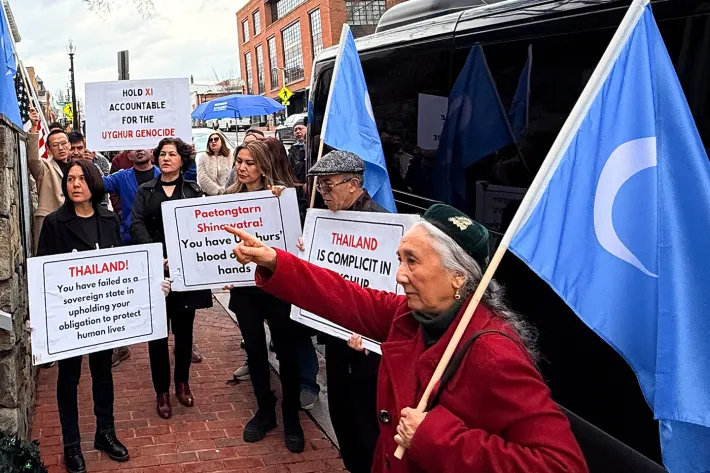
Protesters gathered in front of the Thai embassy in Washington after 40 Uyghurs were deported from Thailand to China, Feb. 27, 2025. (Photo by RFA Uyghur)
Governments in East Africa also increasingly worked together to target activists across borders. In May, Kenyan Foreign Affairs Minister Musalia Mudavadi admitted that domestic law enforcement had assisted Ugandan agents in the November 2024 rendition of Ugandan opposition figure Kizza Besigye, whose party was preparing for the 2026 Ugandan elections. Besigye had been in Kenya to attend a book launch of a local activist when he disappeared. Initially the Kenyan government had denied helping with his abduction, but eventually admitted its role. Officials defended the joint operation by pointing to Nairobi’s “national interest” and the trade relationship between the two countries.14 Besigye is currently on trial facing allegations of treason in Uganda.
The Tanzanian government joined the ranks of perpetrators of transnational repression in 2025. In January, armed men briefly abducted Maria Sarungi Tsehai, a critic of Tanzanian President Samia Suluhu Hassan, in Nairobi. They assaulted her and tried to access her phone.15 Tsehai is a whistleblower and freedom of expression activist who fled Tanzania in 2020 due to threats against her. Her political movement, Change Tanzania, accused Tanzanian security agents in the cross-border attack. In October, President Hassan was re-elected following a deeply flawed contest marked by widespread violence against peaceful protesters.
In July, Mwabili Mwagodi, an outspoken participant in the 2024 Gen Z protests in Kenya, briefly disappeared in Dar es Salaam, Tanzania, shortly after criticizing Kenyan security forces online.16 This came only two months after Tanzanian authorities assaulted and then deported several Kenyan and Ugandan activists and former government officials who had arrived in Tanzania to monitor the trial of opposition leader Tundu Lissu.17
Developments in 2025 made it clear that Kenyan, Tanzanian, and Ugandan law enforcement and intelligence agencies are increasingly coordinating to silence dissent. This kind of cross-border intimidation and authoritarian collaboration is dangerous because it limits opportunities for civic solidarity and can prop up embattled incumbents.
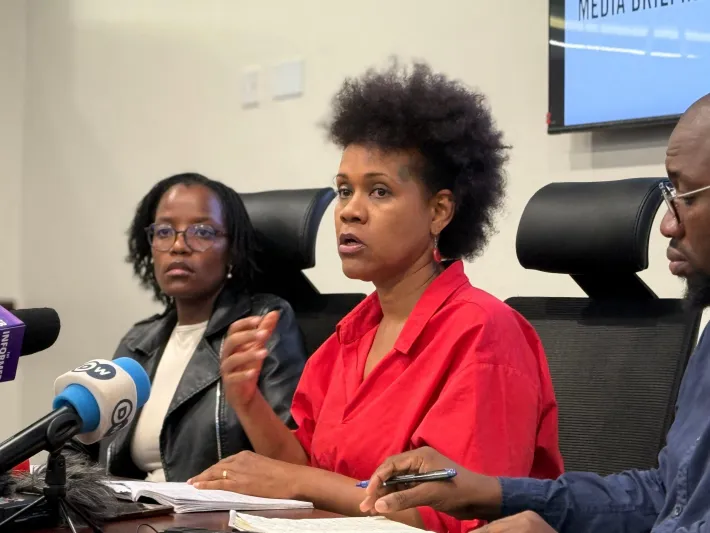
Tanzanian activist Maria Sarungi Tsehai speaks at a press conference in Nairobi following her brief abduction in January 2025. (Photo by Eva-Maria Krafczyk/dpa/Alamy Live News)
- 2
Of the 57 other incidents recorded in 2025, 21 occurred in the Middle East and North Africa, 14 occurred in Europe, 10 occurred in the Americas, 8 in Eurasia, 3 in Southern Africa, and 1 in West Africa.
- 3
Laura Bicker and Kathryn Armstrong, “Thailand Deports Dozens of Uyghurs to China,” British Broadcasting Corporation (BBC), February 27, 2025, https://www.bbc.com/news/articles/c14jjxz8re6o.
- 4
Elise Anderson and Yana Gorokhovskaia, “After a Long Decade in Detention, Uyghur Men in Thailand Face Transnational Repression,” Freedom House,
February 13, 2025, https://freedomhouse.org/article/after-long-decade-detentionuyghur-men-thailand-face-transnational-repression. - 5
Sebastian Strangio, “Thailand Had Offers to Resettle Uyghurs Before Deportation, Report Says,” Diplomat, March 6, 2025, https://thediplomat.com/2025/03/thailand-had-offers-to-resettle-uyghurs-before-deportationreport-says/; United Nations, “UN Agencies Condemn Thailand’s Deportation of Uyghurs to China,” media release, February 27, 2025, https://news.un.org/en/story/2025/02/1160586.
- 6
Jilil Kashgary and Jewlan, “In Reversal, Thai Official Acknowledges Other Countries Offered Uyghurs Resettlement,” Radio Free Asia (RFA), March 6, 2025,
https://www.rfa.org/english/uyghur/2025/03/06/thailand-uyghurs-deported/; United Nations, “UN Agencies Condemn Thailand’s Deportation of Uyghurs to China.” - 7
Prem Singh Gill, “Did China Buy Thailand’s Monarchy? 500,000 Tons of Rice per Uyghur Deportation,” 112 Watch, November 16, 2025, https://112watch.org/didchina-buy-thailands-monarchy/; Jessica C. Liao and Lucas Myers, “Beijing’s Push for a Sino-Centric Asia is Cracking Southeast Asia’s Hedging Game,” War On The Rocks, July 9, 2025, https://warontherocks.com/2025/07/beijings-push-for-a-sinocentric-asia-is-cracking-southeast-asias-hedging-game/.
- 8
United Nations, Communication AL THA 8/2025 (July 24, 2025), https://spcommreports.ohchr.org/TMResultsBase/DownLoadPublicCommunicationFile?gId=30110.
- 9
Human Rights Watch, “Thailand: Vietnamese Refugees at Risk from Hanoi,” November 13, 2025, https://www.hrw.org/news/2025/11/13/thailand-vietnameserefugees-at-risk-from-hanoi.
- 10
Human Rights Watch, “Thailand: Vietnamese Refugees at Risk from Hanoi.”
- 11
Front Line Defenders, “Thai Authorities Forcibly Extradited Human Rights Defender Y Quynh Bdap from Bangkok to Vietnam,” December 3, 2025, https://www.frontlinedefenders.org/en/case/thai-authorities-forcibly-extradited-humanrights-defender-y-quynh-bdap-bangkok-vietnam.
- 12
“Cambodian Ex-MP’s Killer Jailed for Life in Thailand,” France 24, March 10, 2025, https://www.france24.com/en/live-news/20251003-cambodian-ex-mp-s-killer-jailedfor-life-in-thailand.
- 13
Pimuk Rakkanam, “Two Suspects at Large as Thai Court Sentences Hitman for Cambodian Politician Killing,” RFA, March 10, 2025, https://www.rfa.org/english/cambodia/2025/10/03/lim-kimya-killing-thailand-court-verdict/.
- 14
Ian Omondi, “‘The Manner In Which He Came Was Not Clear’: Mudavadi Explains Besigye’s Arrest in Kenya,” Citizen Digital, May 20, 2025, https://www.citizen.digital/article/the-manner-in-which-he-came-was-not-clear-mudavadiexplains-besigyes-arrest-in-kenya-n363119.
- 15
Mohammed Yusuf, “Rights Activist Links Brief Kidnapping in Kenya to Tanzanian Government,” Voice of America (VOA), January 13, 2025, https://www.voanews.com/a/rights-activist-links-brief-kidnapping-in-kenya-totanzanian-government/7935276.html.
- 16
Allan Kisia, “Who Is Human Rights Activist Mwabili Mwagodi,” The Star, July 28, 2025, https://www.the-star.co.ke/news/2025-07-28-who-is-human-rightsactivist-mwabili-mwagodi.
- 17
Farouk Chothia, “Kenya’s Ex-Justice Minister ‘Deported’ from Tanzania,” BBC, May 19, 2025, https://www.bbc.com/news/articles/czdynd8l4pqo; Amnesty International, “Tanzania: Torture and Forcible Deportation of Kenyan and Ugandan Activists Must Be Urgently Investigated,” May 23, 2025, https://www.amnesty.org/en/latest/news/2025/05/tanzania-torture-and-forcible-deportationof-kenyan-and-ugandan-activists-must-be-urgently-investigated/.
Interpol Abuse
Perpetrator governments continued to weaponize Interpol to bolster their transnational repression efforts in 2025. Despite suggestions in some media coverage that it is a global policing force with the power of arrest, Interpol is in fact an organization that facilitates law enforcement cooperation across borders through information sharing.18 But this information-sharing function is routinely abused by some of its 196 member countries for the purpose of transnational repression. In 2025, Freedom House recorded 11 incidents that were linked to Interpol. Governments including Egypt, Kuwait, and Turkmenistan contravened the organization’s own constitution by manipulating the law enforcement network to pursue regime opponents abroad on political grounds.
Although Interpol has enacted piecemeal reforms over the last decade with the aim of addressing abuse, its oversight bodies remain underfunded and understaffed. The organization’s Notices and Diffusion Task Force, which reviews incoming Red Notices and Diffusions for wanted individuals, has a staff of only 45 people tasked with analyzing an average of over 10,000 Red Notices annually.19 This lack of capacity means that spurious notices continue to slip through. In March, Kenyan law enforcement detained Sudanese opposition politician Yassir Arman at the Nairobi airport based on a Red Notice requested by Sudan. A day later, authorities recognized the political nature of this Red Notice and released Arman, who was visiting Nairobi to discuss the Sudanese civil war with international diplomats.20
A core vulnerability of Interpol continues to be its default acceptance of the validity of accusations made by member states. According to the organization’s Rules on the Processing of Data, submissions by members are generally assumed to be reasonable by the organization’s oversight bodies. This benefit of the doubt is afforded even to governments with questionable human rights records.21 Despite the suspension of due process guarantees and the persecution of human rights defenders in El Salvador, Interpol confirmed that it had issued Red Notices in May 2025 against two Spain-based Salvadoran lawyers, Ivania Cruz and Rudy Joya.22 UN experts recognized this as an act of transnational repression and in “direct connection with their [the lawyers’] legitimate human rights work.”23 Although Interpol eventually revoked the Red Notices on the grounds that they were politically motivated, Cruz and Joya faced extradition proceedings in Spain before ultimately receiving asylum in 2026.24
The addition of extra vetting also does not seem to stop Interpol abuse. A recent media investigation made possible by leaked internal documents revealed that even after Interpol introduced new checks on Russia’s ability to submit requests following the full-scale invasion of Ukraine, 90 percent of requests made by the Kremlin were approved. When targeted individuals complained, about half of their requests to remove notices were approved, suggesting that many of the Kremlin’s efforts to pursue people via Interpol were indeed politically motivated and should not have been allowed through the system.25
Interpol’s lack of transparency about its processes creates other problems as well. Because officials have shared summaries of only a very small number of cases reviewed by Interpol’s appellate body, the Commission for the Control of Interpol Files (CCF),26 observers lack information about how the organization interprets its constitution when reviewing cases. Most Red Notices and updates related to existing notices are also not public, creating further risks. Aya Niyazova, a Turkmen activist who was previously detained in 2022 in Croatia due to a Red Notice, was apprehended in September 2025 by Polish border patrol agents due to the same Red Notice, which had apparently never been deleted by the CCF.27 In February 2026, Niyazova reported that Interpol finally invalidated her Red Notice.28
- 18
Ted R. Bromund, How the Abuse of Interpol Contributes to Transnational Repression (Washington, DC: Newlines Institute, July 2025), https://newlinesinstitute.org/wp-content/uploads/20250715-Interpol-Abuse_policyreport-nlisap_.pdf.
- 19
Ted R. Bromund, Sandra Grossman, and Ilan Greenberg, “As Interpol Gets New Secretary General, What Are the Risks of Abuses Over Reforms?,” Just Security, November 1, 2024, https://www.justsecurity.org/104398/new-interpolchief-abuses-reforms/; Otherside Law, “INTERPOL Red Notices 2024 Statistics: More Issued, More Rejected,” July 23, 2025, https://otherside.law/interpol-rednotices-2024-statistics/.
- 20
“Sudanese Pro-democracy Leader Arman Released After Brief Detention in Kenya,” Sudan Tribune, March 6, 2025, https://sudantribune.com/article/298192.
- 21
Ted R. Bromund, How the Abuse of Interpol Contributes to Transnational Repression.
- 22
UN Human Rights Office, “UN Experts Concerned by Weaponisation of Interpol Red Notices Against Human Rights Defenders from El Salvador,” media release, November 10, 2025, https://www.ohchr.org/en/press-releases/2025/11/un-experts-concerned-weaponisation-interpol-red-notices-against-humanrights.
- 23
UN Human Rights Office, “UN Experts Concerned by Weaponisation of Interpol Red Notices.”
- 24
Amnesty International, “URGENT ACTION: Defender in Prolonged Pre-Trial Detention,” February 25, 2026, https://amnesty.ca/wp-content/uploads/2026/02/3rd-UA_20_25_El-Salvador.pdf; “España otorga asilo a dos abogados y voceros de Unidehc que denunciaron persecución en El Salvador [Spain grants asylum to two lawyers and spokespeople for Unidehc who denounced persecution in El Salvador],” El Diario de Hoy, March 3, 2026, https://www.eldiariodehoy.com/noticias/nacionales/espana-otorga-asilo-ados-abogados-y-voceros-de-unidehc-que-denunciaron-persecucion-en-elsalvador/64166/2026/.
- 25
Cate Brown, Max Hudson, and Julia Luft, “Russia Using Interpol’s Wanted List to Target Critics Abroad, Leak Reveals,” BBC, January 25, 2026, https://www.bbc.com/news/articles/c20gg729y1yo.
- 26
Ted R. Bromund, How the Abuse of Interpol Contributes to Transnational Repression.
- 27
“Pussy Riot Member Detained at Polish Border on Turkmenistan’s Request,” The Moscow Times, September 6, 2025, https://www.themoscowtimes.com/2025/09/06/pussy-riot-member-niyazova-detained-at-polish-lithuanianborder-on-turkmenistans-request-a90448.
- 28
Georgia Archer, “Pussy Riot’s Aysoltan Niyazova Removed from Interpol Wanted List After 24 Years,” Novaya Gazeta Europe, February 12, 2026, https://novayagazeta.eu/articles/2026/02/12/pussy-riots-aysoltan-niyazova-removedfrom-interpol-wanted-list-after-24-years-en-news.

Democracies Take Action to Counter Transnational Repression, but Gaps Remain
Host countries where exiled dissidents and activists have taken refuge are working together to create responses to the threat posed by transnational repression and warning targeted individuals about security concerns. But protection remains unevenly available in Europe and elsewhere, while changes to migration enforcement policies in the United States are exposing exiled individuals to the threat of transnational repression.
In 2025, the Group of Seven (G7), the European Parliament (EP), and the Office of the United Nations High Commissioner for Human Rights (OHCHR) published statements, resolutions, and briefs that furthered efforts to define, track, and address transnational repression. In June, the G7 issued a Leaders’ Statement on transnational repression that recognized this authoritarian practice as a threat to human rights and national security, and laid out commitments to improve monitoring and detection as well as devote resources to enhance the resilience of those who may be targeted online and offline.29 In November, the EP’s Subcommittee on Human Rights adopted a resolution on transnational repression against human rights defenders that urged the European Union (EU) to coordinate among its member nations on data collection, mainstream the issue in EU agreements, and apply sanctions for acts of transnational repression that violate European conventions.30 A month after the adoption of this resolution, the EP held a joint event with the OHCHR that brought together a large group of civil society actors now working on transnational repression across Europe.31 The meeting resulted in a plan to include transnational repression in the work of an existing Community of Practice on the state of human rights defenders in Europe. Earlier in the year, the OHCHR published a Civic Space Brief on Transnational Repression, which was the first of its kind devoted exclusively to this issue.32 These commitments focus on gathering information, integrating transnational repression into existing policies and institutional frameworks, and urging governments to pursue accountability. Though nonbinding, they demonstrate a growing understanding of transnational repression as a threat to the exercise of fundamental rights as well as sovereignty.
In addition to the multilateral efforts, several host governments, including Australia, France, and the United Kingdom, launched websites to provide individuals and communities that may be targeted with information about their rights and how to report threats.33 These public initiatives signal government concern about the issue but need to be accompanied by other measures, including in-person outreach to diaspora communities, training for police, and funding for diaspora groups to create mitigation strategies, if they are to form part of a comprehensive effort to enhance resiliency against transnational repression.
Police and security services in Europe and elsewhere are also warning exiled dissidents and activists of imminent threats to their safety. French police and the French General Directorate for Internal Security helped the founder of a Russian nongovernmental organization that publicizes human rights violations in Russian prisons to evade a possible assassination plot in October by moving him around to different safehouses until they could arrest suspects.34 According to Darya Safai, an Iranian-Belgian lawmaker, the Belgian police warned her of a possible kidnapping threat against her after she advocated for placing the Islamic Revolutionary Guard Corps on the European Terror List.35 A Nicaraguan journalist in Costa Rica was also advised by intelligence officials that his life was in danger and that he needed to take safety precautions such as moving houses and avoiding public spaces.36 These warnings, especially when they are part of a larger criminal investigation that results in arrests and trials, are an important way for host governments to protect people. However, police protection tends to be afforded to only a very small number of targeted individuals. For everyone else who may suspect that their safety is at risk, maintaining high levels of security is both time-consuming and expensive.
Gaps in protections remain. In the United Kingdom, which has devoted significant attention to transnational repression in the form of police training, a parliamentary inquiry, and even a task force, attacks on prominent dissidents still took place in 2025. Pakistani dissidents allege that at the end of the year there was a concerted effort to assault and intimidate exiled supporters of the imprisoned former Prime Minister Imran Khan. In December, one former advisor to Khan was assaulted in front of his house and men tried to force their way into the house of another.37 Separately, Roshaan Khattak, a Pakistani human rights defender who is a postgraduate student at Cambridge University, has struggled to get university officials and the police to help him deal with threats he has received in reaction to his research on enforced disappearances in Balochistan and his advocacy on behalf of his cousin, Idris Khattak, a political prisoner in Pakistan.38 The plight of these activists suggests that even when authorities commit to addressing transnational repression at the highest levels of government, security vulnerabilities persist.
Migration systems continue to be a venue through which host governments enable transnational repression even as other government agencies act to counter it. US authorities pioneered many of the responses to transnational repression—training for law enforcement, identification of reported threats, and interagency coordination—that have been adopted in subsequent years by Canadian and European governments.39
In 2025, US authorities continued to seek accountability for transnational repression by condemning the bounties placed on Hong Kong activists, issuing visa restrictions on Thai officials responsible for the forced return of Uyghur men to China, and obtaining a conviction in the case of a murder-for-hire plot against an Iranian activist.40 However, changes to immigration enforcement policies that began in 2024, including the partial suspension of the processing of asylum claims at the southern border and increased detention and deportation efforts, exposed people fleeing persecution for political activism to the threat of transnational repression.41
Last year, US authorities detained a number of exiled activists, placing them at risk of transnational repression. Among the detained were Marlon Castellon Ubilla, a former political prisoner from Nicaragua, Guan Heng, who had filmed the detention centers of Xinjiang, and Gregory Sanabria, a participant in student antiregime protests in Venezuela.42 While those individuals remain in the US, authorities did end up deporting two Russian men, one an exiled dissident and the other an army deserter, to Russia.43 Both men were promptly arrested on their return. Dozens of asylum-seekers, including Christian converts, participants in the Women, Life, Freedom protests, and LGBT+ individuals, were sent back to Iran on chartered flights. What happened to these individuals is unknown. According to the Iranian American Legal Defense Fund, before the deportations, Immigration and Customs Enforcement (ICE) allowed Iranian consular staff to visit the detained individuals to try to convince them to return.44 One of the flights took place in 2026, even after the Iranian regime began to violently crack down on peaceful protesters.45
Democratic host governments, unlike their authoritarian counterparts, rarely if ever directly aid the security services of foreign governments in the pursuit of exiled critics or dissidents. Most countries also make an effort to protect people from extraterritorial violence. However, the United States and other democracies continue to facilitate transnational repression via their immigration systems by detaining and deporting dissidents. This problem can become more acute when immigration enforcement is ramped up and due process protections are weakened.
- 29
Group of Seven, “G7 Leaders’ Statement on Transnational Repression,” June 17, 2025, https://www.pm.gc.ca/en/news/statements/2025/06/17/g7-leadersstatement-transnational-repression.
- 30
European Parliament Resolution of 13 November 2025 on Addressing Transnational Repression of Human Rights Defenders, P10_TA(2025)0258, November 13, 2025, https://www.europarl.europa.eu/doceo/document/TA-10-2025-0258_EN.html.
- 31
United Nations Human Rights Regional Representative for Europe Christina Meinecke, “Transnational Repression: Mapping Trends and Improving Responses,” introductory remarks to the European Parliament, December 4, 2025, https://europe.ohchr.org/resources/speeches/transnational-repressionmapping-trends-and-improving.
- 32
United Nations Human Rights Office, “Civic Space Brief: Transnational Repression,” accessed February 23, 2026, https://www.ohchr.org/sites/default/files/documents/publications/transnational-repression-1-en.pdf.
- 33
French General Directorate for Internal Security, “Fight Against Transnational Repression,” December 26, 2024, https://www.dgsi.interieur.gouv.fr/english/fight-against-transnational-repression; Australian Department of Home Affairs, “Foreign Interference Community Support Hub: Countering Foreign Interference,” accessed February 23, 2026, https://www.cfi.gov.au/; United Kingdom Home Office, “What to Do If You Think You Are the Victim of Transnational Repression,” May 14, 2025, https://www.gov.uk/government/publications/transnational-repression/what-to-do-if-you-think-you-are-thevictim-of-transnational-repression.
- 34
Christophe Ayad, “Four Men Charged in Alleged Plot to Attack a Russian Dissident in Southern France,” Le Monde, October 20, 2025, https://www.lemonde.fr/en/france/article/2025/10/20/four-men-charged-in-alleged-plot-toattack-russian-dissident-in-southern-france_6746584_7.html.
- 35
Reza Jamali and Ray Furlong, “Iran Accused of Kidnap Plot As US, Allies Warn of Growing Threats in West,” Radio Free Europe Radio Liberty (RFE/RL), August 2, 2025, https://www.rferl.org/a/iran-kidnap-plot-lawmakers-threatswest/33492746.html.
- 36
Committee to Protect Journalists Americas Program, “‘They are Hunting Journalists’: Nicaragua’s Covert Repression Tactics Strike Fear Beyond Borders,” (New York, NY: Committee to Protect Journalists, January 8, 2026), https://cpj.org/2026/01/they-are-hunting-journalists-nicaraguas-covertrepression-tactics-strike-fear-beyond-borders/.
- 37
“Three Men in UK Court Accused of Targeting Opponents of Pakistan’s Government,” Reuters, January 24, 2026, https://www.reuters.com/world/uk/three-men-uk-court-accused-targeting-opponents-pakistansgovernment-2026-01-24/.
- 38
Freedom House, “Freedom House Joins Call for Robust Protections Against Transnational Repression in the Higher Education Sector,” October 6, 2025, https://freedomhouse.org/article/freedom-house-joins-call-robust-protectionsagainst-transnational-repression-higher.
- 39
Freedom House, Unsafe in America: Transnational Repression in the United States, (Washington, DC: Freedom House, June 2022), https://freedomhouse.org/report/transnational-repression/united-states.
- 40
US Secretary of State Marco Rubio, “Condemning the Hong Kong Government’s Latest Round of Bounties on Individuals Exercising Freedom of Expression,” press statement, July 26, 2025, https://www.state.gov/releases/office-of-the-spokesperson/2025/07/condemning-the-hong-kong-governmentslatest-round-of-bounties-on-individuals-exercising-freedom-of-expression; Sui-Lee Wee, “U.S. Punishes Thai Officials Over Deportation of Uyghurs to China,” New York Times, March 15, 2025, https://www.nytimes.com/2025/03/15/world/asia/us-sanctions-thai-uyghurs-china.html; US Department of Justice, Office of Public Affairs, “Two Russian Mob Leaders Sentenced to 25 Years in Prison for Murder-For-Hire Targeting a Journalist on Behalf of the Iranian Government,” press release, October 30, 2025, https://www.justice.gov/opa/pr/two-russian-mob-leaders-sentenced-25-years-prison-murder-hire-targetingjournalist-behalf.
- 41
As part of this database update, Freedom House added six new incidents in which the US was the host country. Individuals who remain in immigration detention at the time of writing or whose fates could not be established after their deportation from the US were not included in the dataset. Immigration detention that does not end in a deportation is not typically coded as transnational repression by Freedom House unless there is evidence that the detention itself was at the behest of a foreign government as is sometimes the case with Interpol abuse.
- 42
“Nicaraguan Ex-Political Prisoner at Risk of Deportation,” Confidencial, March 24, 2025, https://confidencial.digital/english/nicaraguan-ex-political-prisonerat-risk-of-deportation/; Emily Feng, “A Chinese Man Who Filmed Secret Footage in Xinjiang Risks Deportation from the U.S.,” National Public Radio (NPR), December 17, 2025, https://www.npr.org/2025/12/17/g-s1-102229/chinaxinjiang-uyghurs-us-deportation; Samantha Schmidt, “Tortured in Venezuela, He’s Asking for Asylum. ICE Just Detained Him,” Washington Post, June 13, 2025, https://www.washingtonpost.com/world/2025/06/13/ice-arrests-torturedvenezuela-asylum-seeker/.
- 43
Paul Sonne and Milana Mazaeva, “He Fled Putin’s War. The U.S. Deported Him to a Russian Jail,” New York Times, September 16, 2025, https://www.nytimes.com/2025/09/16/world/europe/trump-russia-war-deportationsvovchenko.html; Joshua Yaffa, “How an Asylum Seeker in U.S. Custody Ended Up in a Russian Prison,” New Yorker, August 15, 2025, https://www.newyorker.com/news/the-lede/how-an-asylum-seeker-in-us-custody-ended-up-in-arussian-prison.
- 44
Iranian American Legal Defense Fund, “IALDF Investigates ICE Facilities and Files Complaint with the United Nations Regarding Mass Deportations to the Islamic Regime in Iran,” press release, December 17, 2025, https://www.ialdf.org/post/ialdf-investigates-ice-and-files-complaint-with-the-un.
- 45
Jennifer Hansler, “Trump Admin Deports Iranians for First Time Since Brutal Crackdown on Protests,” Cable News Network (CNN), January 26, 2026, https://www.cnn.com/2026/01/26/politics/trump-administration-deports-iranians.
Recommendations
In 2025, authoritarians collaborated to target activists and members of religious and ethnic minorities across borders at the same time that some host governments increased their investment in policies and practices meant to address the threat posed by transnational repression. To ensure that in the coming years more is done to counter transnational repression, Freedom House recommends the following to governments:
- Adopt and codify a government-wide definition of transnational repression that can be used across departments and agencies and in official communications. The definition does not need to enumerate all of the tactics of transnational repression, because tactics can evolve, nor all of the possible groups and individuals who may be targeted, because this risks inadvertently excluding vulnerable people. Instead, a useful definition will recognize that transnational repression is committed by states and their proxies, against individuals living abroad who share a national connection to the origin state, and hinders fundamental rights such as the freedoms of expression, belief, and association.
- Apply sanctions and visa bans against foreign government officials who facilitate transnational repression via forced returns. Following the example set recently by US authorities of applying visa bans on current and former Thai government officials who are responsible for, or complicit in, the forced return of Uyghurs to China,46 democratic governments should consider seeking accountability not only from perpetrators of transnational repression but also from government officials in host countries who facilitate and enable it.
- Interpol Member States should consider increasing their funding to the organization’s oversight bodies: the Notices and Diffusion Task Force and the Commission for the Control of Interpol’s Files. More resources would help to enhance the capacity of these bodies to detect and expunge politically motivated requests from Interpol systems. Member states should also continue to advocate for enhanced reviews of Notices and Diffusions submitted by known perpetrators of transnational repression.
- Continue to engage directly with diaspora communities by creating online resources, providing information on ways to report transnational repression, and connecting communities with local law enforcement. Governments should also establish feedback mechanisms to gauge the efficacy of their outreach strategies. Likewise, local law enforcement should receive more training on transnational repression tactics to bolster targeted communities’ confidence in frontline responses.
- Ensure that immigration enforcement does not facilitate transnational repression. Host governments should follow due process standards when adjudicating claims for asylum and considering deportation in order to protect fundamental rights and safeguard their migration systems from the influence of perpetrator governments seeking the return of exiled activists and dissidents.
To learn more about the issue of transnational repression and what Freedom House recommends, please visit https://freedomhouse.org/report/transnational-repression.
- 46
US Secretary of State Marco Rubio, “Announcement of a Visa Restriction Policy to Address the Forced Return of Uyghurs and Members of Other Ethnic
or Religious Groups with Protection Concerns to China,” press statement, March 14, 2025, https://www.state.gov/announcement-of-a-visa-restrictionpolicy-to-address-the-forced-return-of-uyghurs-and-members-of-other-ethnicor-religious-groups-with-protection-concerns-to-china/.
