


China
Freedom at a Glance
Global Freedom
9 / 100
Not Free
Internet Freedom
9 / 100
Not Free


China’s authoritarian regime has become increasingly repressive in recent years. The ruling Chinese Communist Party (CCP) continues to tighten control over all aspects of life and governance, including the state bureaucracy, the media, online speech, religious practice, universities, businesses, and civil society associations.
Research & Recommendations
China
Not Free
9
100
| PR Political Rights | -2 40 |
| CL Civil Liberties | 11 60 |
Last Year's Score & Status
9
100
Not Free
A country or territory’s Freedom in the World status depends on its aggregate Political Rights score, on a scale of 0–40, and its aggregate Civil Liberties score, on a scale of 0–60.
See the methodology.
Overview
The ruling Chinese Communist Party (CCP) oversees a repressive authoritarian regime and maintains tight control over all aspects of life and governance, including the state bureaucracy, the media, online speech, religious practice, universities, and businesses. CCP General Secretary Xi Jinping has consolidated personal power to a degree not seen in China for decades, and the country’s civil society has been devastated by a multiyear crackdown on political dissent, independent nongovernmental organizations (NGOs), and human rights defenders.
Freedom in the World 2026 Policy Recommendations
Strengthen democratic coordination and collective action in a contested global order
Democratic resilience will increasingly depend on stronger coordination among countries that share a commitment to freedom, the rule of law, and accountable governance.
Reimagine international democracy assistance to help reverse the global decline in freedom
International support for democratic institutions, civil society, and independent media has been associated with modest but meaningful improvements in democratic governance, and it is far less costly than the military outlays necessitated by rising authoritarian aggression.
Prioritize engagement with younger generations in the digital spaces where civic identity is now formed
Young people are increasingly dissatisfied with democracy—not because they reject its principles, but because they see institutions failing to deliver on them. Programmatic work should create clear pathways for meaningful political participation, from voting and policy engagement to community organizing and public leadership, so that young people can translate their expectations into agency.
China
Not Free
9
100
| A Obstacles to Access | 7 25 |
| B Limits on Content | 2 35 |
| C Violations of User Rights | 0 40 |
Last Year's Score & Status
9
100
Not Free
Scores are based on a scale of 0 (least free) to 100 (most free).
See the methodology and report acknowledgements.
Overview
Internet users in China have faced the world’s worst conditions for internet freedom for over a decade. People face severe legal and extralegal repercussions for online activities like sharing news stories, talking about their religious beliefs, and communicating with family members and others overseas. Human rights lawyers and journalists are routinely imprisoned for multiple years over their online activities. Authorities wield immense power to censor and manipulate online content, and seek to scrub any discussion of dissent from the Chinese internet. People across the country faced an hour-long connectivity disruption in August 2025, likely due to a misconfiguration of the internet censorship system known as the Great Firewall.
Freedom on the Net 2026 Policy Recommendations
Undermine Authoritarian Internet Restrictions
Access to the internet is under threat as authoritarian powers continue to create barriers for people to freely express themselves online. Internet shutdowns, throttling, and platform blocking remain among the most common tools of digital repression. At the same time, digital technologies serve as a lifeline for people seeking to expose human rights violations to the outside world and hold dictators accountable.
Safeguard Privacy Online
Protecting privacy online is essential to safeguarding free expression in repressive contexts. Without strong privacy protections, journalists and human rights defenders may self-censor out of a fear of reprisal. Rapid advances in AI—and the growing threat of automated vulnerability exploitation—heighten these risks, leaving civil society organizations increasingly vulnerable to sophisticated cyberattacks.
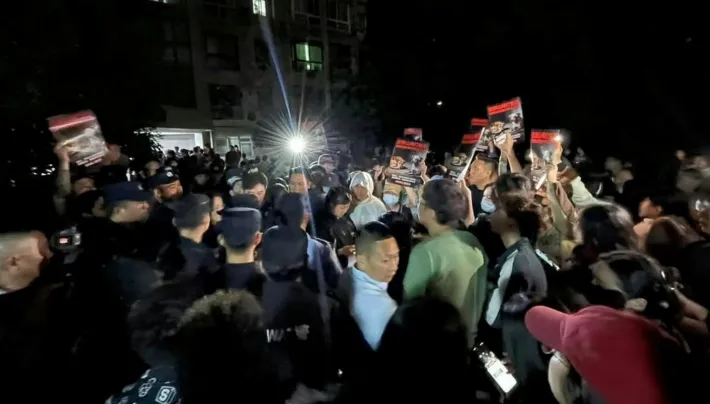
The China Dissent Monitor features interactive research on collective action in public spaces and cases of online dissent, filling a critical information gap in a country with severe media restrictions and risks associated with exposing dissent.
Sign up to receive the China Dissent Monitor
The China Dissent Monitor features quarterly updated interactive data on collective action in public spaces and cases of online dissent.

The China Media Bulletin is a monthly email newsletter that provides unique insight on censorship, disinformation, media freedom, and internet freedom issues related to the People's Republic of China.
Sign up to receive the China Media Bulletin
The China Media Bulletin is a monthly email newsletter that provides unique insight on censorship, disinformation, media freedom, and internet freedom issues related to the People's Republic of China, drawing on both English and Chinese-language sources.

China conducts the most sophisticated, global, and comprehensive campaign of transnational repression in the world. Efforts by the Chinese Communist Party (CCP) to pressure and control the overseas population of Chinese and members of minority communities are marked by three distinctive characteristics. Due to China’s growing power internationally, its technical capacity, and its aggressive claims regarding Chinese citizens and noncitizens overseas, its campaign has a significant effect on the rights and freedoms of overseas Chinese and minority communities in exile in dozens of countries.
Policy Recommendations: Transnational Repression
Raising awareness about the threat of transnational repression.
Like-minded governments and international organizations should work together to highlight the threat of transnational repression and establish international norms for addressing it.
Limiting the ability of perpetrators to commit transnational repression.
This includes agreeing on a common definition of transnational repression, and prohibiting the use of Interpol notices on their own to deny immigration or asylum benefits or conduct arrests.
Bringing accountability for acts of transnational repression.
Among other tactics, governments should deploy a robust strategy for targeted sanctions against perpetrators of transnational repression.

News and Updates
Freedom House Perspectives


News Releases & Media Coverage

Country Facts
Basic Facts
Freedom in the World Score
9
/ 100
Not Free
Freedom on the Net Score
9
/ 100
Not Free
Population: 1,412,175,000
Election Facts
Status
Not Tracked
Transnational Repression
Status
Origin Country
Tactics
Assassination, Rendition, Unlawful Deportation, Assault, Spyware, Family Intimidation, Digital Threat, Interpol Abuse, Mobility Controls
Targets
Minority ethnic and religious groups, human rights defenders, former insiders.

Religious Freedom in China
Falun Gong practitioners across China are subject to widespread surveillance, arbitrary detention, imprisonment, and torture, and they are at a high risk of extrajudicial execution. Freedom House independently verified 933 cases of Falun Gong adherents sentenced to prison terms of up to 12 years between January 1, 2013, and June 1, 2016, often for exercising their right to freedom of expression in addition to freedom of religion. This is only a portion of those sentenced, and thousands more are believed to be held at various prisons and extralegal detention centers.

Beijing's Global Media Influence
The Chinese government, under the leadership of President Xi Jinping, is accelerating a massive campaign to influence media outlets and news consumers around the world. While some aspects of this effort use the tools of traditional public diplomacy, many others are covert, coercive, and potentially corrupt. A growing number of countries have demonstrated considerable resistance in recent years, but Beijing’s tactics are simultaneously becoming more sophisticated, more aggressive, and harder to detect.
